
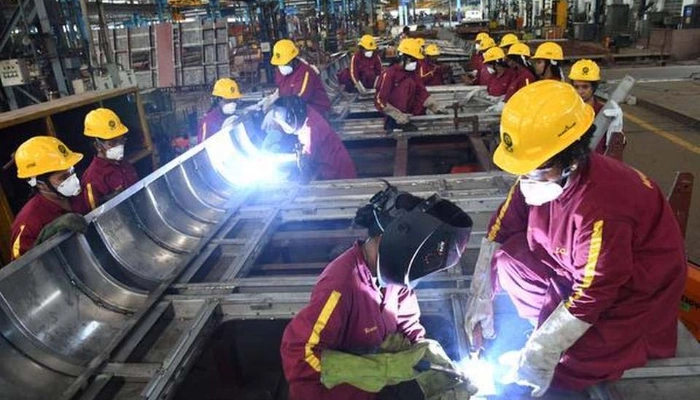
9 July, 2025-In a significant move aimed at boosting industrial productivity and aligning with global manufacturing standards, the Gujarat government has approved a new labor ordinance permitting 12-hour work shifts in factories. The amendment to the Factories Act, 1948, officially extends permissible daily working hours from the previous limit of 9 hours to 12 hours, with specific provisions to protect worker welfare.
The ordinance, passed recently by the state cabinet, has sparked widespread discussions across industry and labor groups. Officials stated that the move is designed to attract more foreign and domestic investment, particularly in sectors such as textiles, pharmaceuticals, and electronics manufacturing, where continuous production cycles are crucial.
Under the new rules, the total weekly work limit remains capped at 72 hours, including overtime. The ordinance mandates that workers must be given a break of at least 30 minutes after every 6 hours of continuous work, and a minimum rest period of 24 hours after a full working day. Companies are also required to obtain consent from workers before implementing the extended shift system.
The Gujarat government emphasized that the extended shifts are optional, not mandatory, and are intended to offer flexibility for both employers and employees. Officials highlighted that several global manufacturing hubs, such as South Korea, Japan, and parts of Europe, operate with similar shift durations, enabling better resource utilization and increased competitiveness.
However, the decision has met with resistance from various labor unions and worker advocacy groups. Critics argue that the ordinance could lead to worker exploitation and pose risks to health and safety. They have raised concerns about the physical toll of longer working hours, particularly in labor-intensive industries, and demanded stronger monitoring mechanisms to prevent misuse.
Representatives of the Gujarat Mazdoor Sabha, a prominent labor union, warned that the policy may pave the way for reduced job opportunities, as companies may prefer fewer workers for longer hours instead of hiring more individuals. They have called for the ordinance to be reviewed in consultation with labor rights organizations and suggested that any shift extension be paired with increased wages and healthcare provisions.
On the other hand, industry leaders and trade associations have welcomed the reform. According to the Gujarat Chamber of Commerce and Industry, the ordinance offers industries greater operational efficiency, especially those working on export deadlines and large-scale orders. They argue that the flexibility will make Gujarat more attractive for industrial investments, especially in competition with neighboring states and international markets.
Legal experts have pointed out that the ordinance aligns with the broader labor reforms being proposed under India’s four labor codes introduced by the central government. While Parliament has yet to implement these codes nationwide, Gujarat has taken a proactive step in easing labor regulations to enhance its investment climate.
As the ordinance awaits its formal implementation and monitoring mechanisms, the Gujarat government has promised to review its impact periodically. Authorities stated that safeguards will be enforced to ensure that the rights and well-being of workers are not compromised in the pursuit of economic growth.
The long-term effects of this labor policy shift will likely depend on how effectively the new framework is implemented and monitored. With India positioning itself as a global manufacturing hub, Gujarat’s ordinance could become a model—or a cautionary tale—for other states considering similar reforms.

