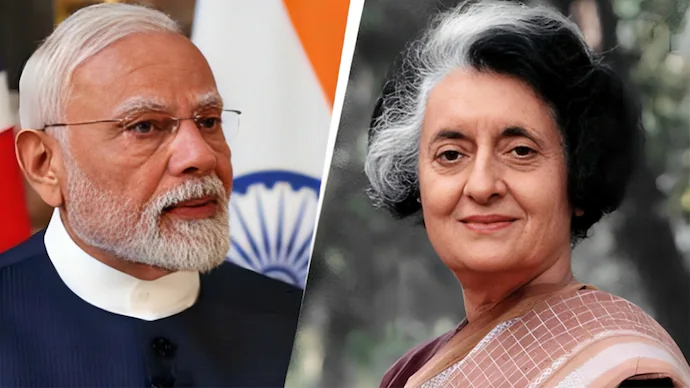
July 26, 2025 — Prime Minister Narendra Modi has achieved a significant political milestone by becoming India’s second longest-serving prime minister, surpassing the record held by former Prime Minister Indira Gandhi. As of July 26, 2025, Modi has completed over 10 years and 64 days in office since first assuming leadership in May 2014.
Modi began his first term on May 26, 2014, after leading the Bharatiya Janata Party (BJP) to a decisive victory. He was re-elected in 2019 with an even stronger majority, continuing his leadership into a second term. By completing 10 years and 64 days in office, he has overtaken Indira Gandhi’s combined tenure of 10 years and 63 days. Gandhi’s time as prime minister spanned two separate periods — from 1966 to 1977 and again from 1980 until her assassination in 1984.
Only Jawaharlal Nehru, India’s first prime minister, has served longer — holding office for 17 years and 286 days between 1947 and 1964. If Modi completes his current term and contests successfully in 2029, he could become the longest-serving prime minister in Indian history.
Throughout his tenure, Modi has implemented a range of key reforms. Major national initiatives such as Digital India, Make in India, and Atmanirbhar Bharat have aimed to boost manufacturing, technology adoption, and economic self-reliance. The introduction of the Goods and Services Tax (GST), direct benefit transfer schemes, and large-scale infrastructure development projects have also defined his government’s agenda.
On the international stage, Modi has strengthened India’s diplomatic ties with both regional neighbors and major global powers. His recent visits to countries like Russia, Austria, and the Maldives reflect a continued focus on strategic and economic cooperation.
Domestically, his leadership has drawn mixed responses. Supporters highlight strong economic measures, increased national security, and welfare outreach, while critics point to concerns regarding press freedom, democratic checks, and social divisions. Nonetheless, Modi’s political influence remains deeply rooted and continues to shape national discourse.
Political analysts view the overtaking of Indira Gandhi’s record as a major symbolic moment. Gandhi, one of India’s most formidable leaders, is remembered for her centralising governance style and key decisions such as the Emergency period. Modi’s long tenure invites comparisons, though his leadership style and political context differ significantly.
With over a year left in his current term, and growing anticipation about his possible candidacy in the next general election, Modi’s political journey appears far from over. His latest achievement adds another chapter to his already significant impact on Indian politics.