
July 31, 2025
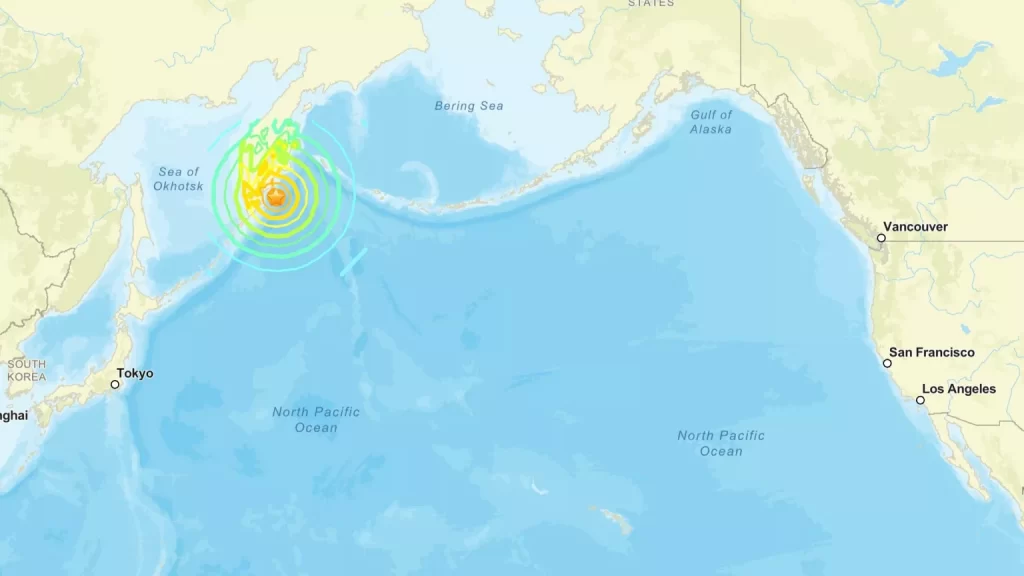
A massive 8.8-magnitude earthquake struck off the eastern coast of Russia late Wednesday morning, prompting tsunami warnings and evacuation orders across several countries bordering the Pacific Ocean, including Japan, Canada, the United States, and Russia itself.
The quake occurred at a depth of approximately 21 kilometers, with the epicenter located southeast of Petropavlovsk-Kamchatsky, within the seismically volatile Kuril-Kamchatka trench. The tremor was one of the most powerful recorded globally in recent years, triggering immediate concern over large-scale tsunami waves and aftershocks.
Tsunami Reaches Multiple Nations
Tsunami waves generated by the quake reached the Kuril Islands, where Russian authorities reported surges of up to five meters. Flooding was confirmed in several coastal settlements, leading to emergency evacuations and reports of moderate property damage. No casualties have been reported at this time.
In Japan, the Meteorological Agency issued tsunami alerts for northern coastal regions, including Hokkaido. Though wave heights remained under one meter in most locations, public safety protocols were enacted, including the suspension of local train services and advisories for residents to move to higher ground.
Tsunami advisories were also issued in Hawaii, Alaska, and along the U.S. West Coast, covering states such as California, Oregon, and Washington. According to the Pacific Tsunami Warning Center, waves ranging from 1 to 1.6 feet were observed in several coastal zones, prompting beach closures and precautionary evacuations.
Canada’s British Columbia coastline was similarly placed under advisory, with officials monitoring wave activity closely. No injuries or significant damage were reported across North America.
Aftershocks and Ongoing Monitoring
More than 30 aftershocks were recorded in the hours following the primary tremor, prompting continued seismic monitoring. Authorities also noted activity at the nearby Klyuchevskoy volcano, though geologists have not confirmed any direct connection between the quake and the volcanic unrest.
Emergency management officials praised the effectiveness of early warning systems, particularly those managed by the Pacific Tsunami Warning Center and national agencies, which enabled rapid communication and public response. “This event demonstrates how preparedness and real-time alerts can dramatically reduce risk,” said one official.
Precaution Over Panic
While the immediate danger has largely passed, experts continue to urge caution. Coastal populations are advised to stay alert for updates as seismic instability may persist in the coming days. Emergency services remain on standby, and local authorities are reviewing response strategies.
The event has renewed global attention on the Pacific Ring of Fire, an area known for its heightened seismic activity. Experts stress the importance of maintaining investment in early warning systems, community preparedness, and international cooperation to mitigate future natural disasters.

