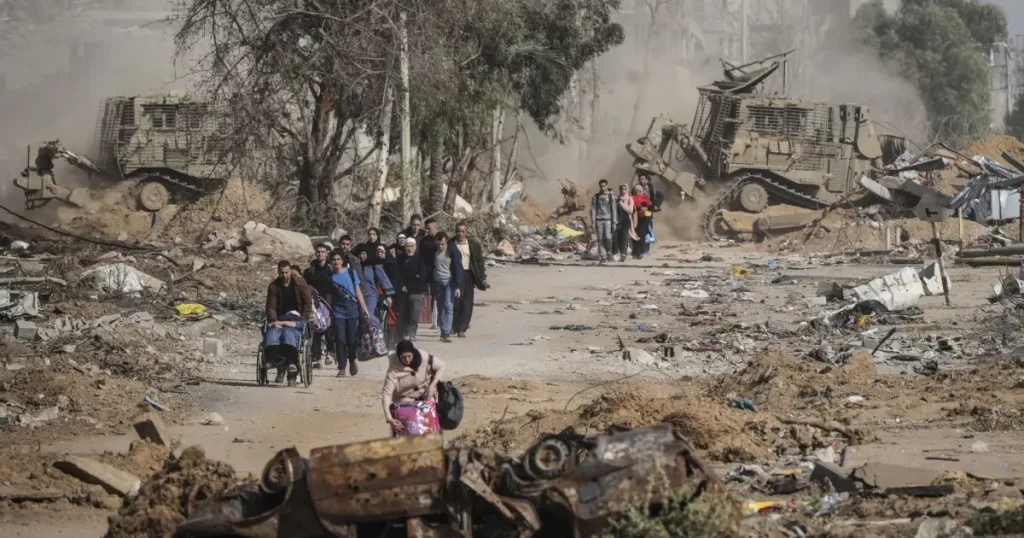
August 5, 2025 — The Israel-Gaza conflict has intensified sharply in recent days, with Israeli forces escalating their air and ground offensives across the Gaza Strip. As the bombardments continue, aid organizations have raised grave concerns over the deepening humanitarian crisis, particularly the widespread starvation now gripping the population.
According to the Israeli Defense Forces (IDF), the military operations are targeted at dismantling Hamas infrastructure and rescuing hostages still believed to be held in Gaza following the October 7 attacks. Israeli Prime Minister Benjamin Netanyahu stated that the campaign will continue “until Hamas is fully neutralized.” However, humanitarian groups and international observers warn that the increasing civilian toll and damage to essential infrastructure are pushing Gaza toward total collapse.
Gaza’s Health Ministry reported that thousands have been killed since the renewed escalation began, including a significant number of women and children. While these figures could not be independently verified, satellite images and local reports confirm heavy destruction in urban residential areas, hospitals, and refugee camps.
The humanitarian situation has reached a critical tipping point. The United Nations Relief and Works Agency (UNRWA) and the World Food Programme (WFP) have reported that more than 90% of Gaza’s 2.3 million residents are experiencing extreme food insecurity. With key border crossings such as Rafah and Kerem Shalom frequently closed or under attack, aid trucks have struggled to enter the territory. In many northern districts, no food deliveries have been made for weeks.
Philippe Lazzarini, UNRWA Commissioner-General, warned, “Gaza is being starved. This is not just a side effect of war—this is deliberate and devastating.” The World Food Programme has echoed these warnings, describing the situation as “catastrophic and deteriorating by the hour.”
International humanitarian law prohibits the use of starvation as a method of warfare. Human rights organizations, including Amnesty International and Human Rights Watch, have condemned the blockade and military strategy as a form of collective punishment. Jan Egeland, head of the Norwegian Refugee Council, stated, “We are witnessing the use of food deprivation as a weapon. This is not collateral damage—it’s a potential war crime.”
Despite growing international condemnation, diplomatic efforts have failed to produce a ceasefire. The United States and several European nations have reiterated Israel’s right to self-defense but have also called for proportionality and the protection of civilians.
In Gaza, the crisis continues to deepen. Medical facilities are overwhelmed, electricity remains scarce, and access to clean water is severely limited. Thousands of displaced families are sheltering in overcrowded UN schools and makeshift camps, with minimal supplies.
As Israeli strikes show no sign of slowing and aid remains largely blocked, the risk of full-scale famine in Gaza becomes more imminent by the day. The United Nations has urged an immediate humanitarian pause to allow safe aid delivery, but so far, no agreement has been reached.
The international community now faces mounting pressure to intervene diplomatically and prevent a deepening tragedy that, according to aid groups, is already unfolding on a massive scale.