
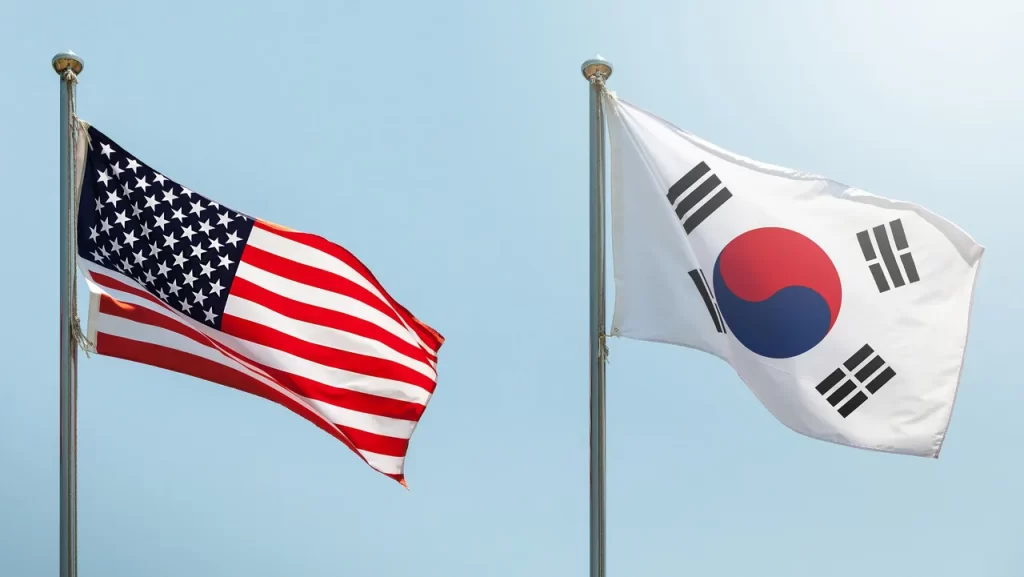
August 7, 2025 — The South Korean government has announced plans to roll out support measures for local companies likely to be affected by the latest round of tariffs imposed by the United States. The new U.S. trade restrictions, aimed primarily at Chinese imports, are expected to create indirect economic pressure on South Korean industries closely tied to the global supply chain.
According to the Ministry of Trade, Industry and Energy (MOTIE), the U.S. tariffs — which include steep duties on electric vehicles (EVs), batteries, solar cells, semiconductors, and steel products — could disrupt exports and increase production costs for South Korean firms that manufacture or source components from China.
In a public briefing, a senior MOTIE official stated, “Although the U.S. tariff policy is aimed at reducing its dependence on China, the fallout will likely affect South Korean exporters that operate across interconnected supply chains. The government is preparing a comprehensive response to support these businesses.”
Among the proposed measures are financial aid packages, tax relief, and trade diversification strategies. The government is also considering expanding diplomatic outreach to Washington to ensure South Korean firms are not unfairly disadvantaged due to their manufacturing ties with China. Special monitoring teams will be deployed to assess industry-specific impacts and adjust policy responses accordingly.
The announcement follows the U.S. government’s decision in May 2025 to significantly raise tariffs on over $18 billion worth of Chinese imports under Section 301 of the Trade Act. Electric vehicles imported from China, for instance, now face tariffs as high as 100%, while tariffs on lithium-ion batteries and critical minerals have also increased substantially.
Industry groups in South Korea have expressed concern over the ripple effects. The Korea International Trade Association (KITA) noted that many South Korean EV and battery makers rely on components sourced from China and could face competitive disadvantages in the U.S. market if their supply chains are not adjusted.
To mitigate this, the South Korean government is encouraging companies to explore alternate sourcing options, particularly within Southeast Asia and India. It is also expected to increase investment in domestic battery and semiconductor production capacity to reduce foreign dependence.
Economists have warned that the broader implications of the U.S.-China tariff escalation could include supply chain fragmentation and increased operational costs for South Korea’s export-driven economy. With nearly 40% of South Korea’s GDP linked to exports, any significant disruption in trade patterns may weigh on national growth prospects.
However, trade experts also believe that the current situation presents an opportunity for South Korea to position itself as a key alternative manufacturing hub, especially if it successfully expands strategic alliances with the U.S. and other Western nations through improved supply chain resilience and localization.
Conclusion:
While the full impact of the U.S. tariffs remains uncertain, South Korea’s proactive approach to shielding its industries reflects growing global concerns over trade protectionism. The effectiveness of these measures will depend on how swiftly companies adapt and how well government-industry coordination evolves in the face of ongoing geopolitical and economic shifts.

