
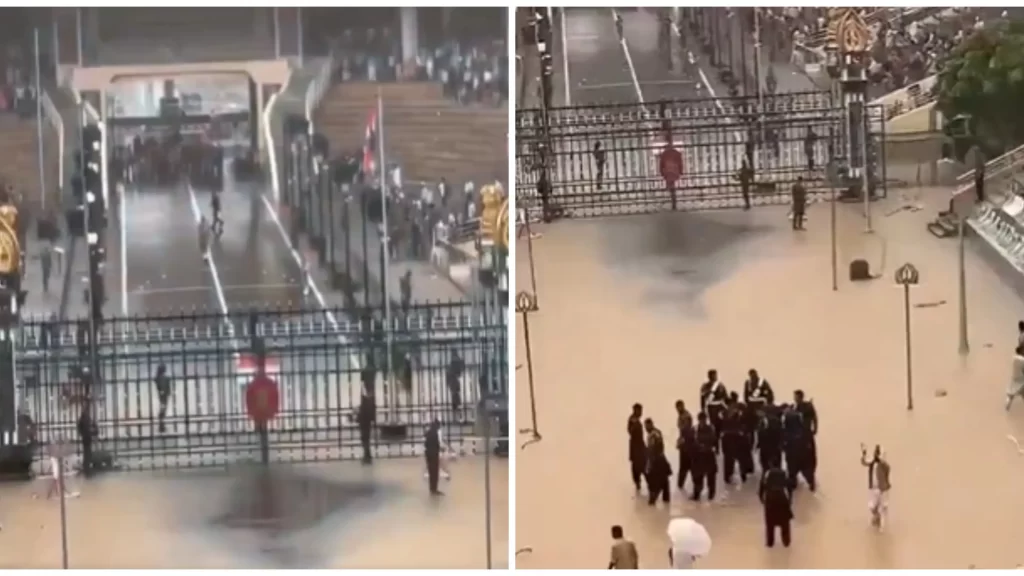
August 29, 2025: A viral video showing the Pakistani side of the Wagah-Attari border submerged in water during the “Beating Retreat” ceremony has attracted widespread attention and online ridicule. The footage, which sharply contrasts the dry and orderly Indian side, has reignited debates about infrastructure and governance differences between the two neighboring countries.
In the video, Pakistan Rangers are seen wading through knee-deep water, while Indian Border Security Force personnel perform the ceremonial drill on dry and well-maintained grounds. Social media users have been quick to draw comparisons, invoking the controversial “Mercedes versus dump truck” analogy made earlier this year by Pakistan Army Chief General Asim Munir.
Pakistan authorities have reportedly attributed the flooding to India’s elevation of the Grand Trunk Road, claiming that rainwater from the Indian side flowed into Pakistani territory. However, critics argue that the incident underscores deeper issues of infrastructure and administrative planning within Pakistan.
The “Mercedes vs. dump truck” remark, which General Munir used to compare India’s economic advancement with Pakistan’s resilience, had drawn sharp responses from Indian leaders. Defence Minister Rajnath Singh termed the statement a “confession of failure,” highlighting India’s perception of its own infrastructural strengths relative to its neighbor.
The Wagah-Attari “Beating Retreat” ceremony, a daily ritual marking the lowering of the national flags, has long been a symbol of both rivalry and mutual respect between India and Pakistan. The recent flooding incident has, however, brought attention to disparities that go beyond ceremonial display, emphasizing the importance of infrastructure development and effective governance.
Observers note that while the ceremony continues to attract visitors and serve as a diplomatic symbol, incidents such as these offer a stark reminder of the practical challenges faced by neighboring countries in maintaining public and ceremonial spaces.
The video has now gone viral across social media platforms, with thousands of users sharing, commenting, and highlighting the contrast between the two sides. It has become a talking point for discussions around national infrastructure, governance, and public administration in Pakistan.

