
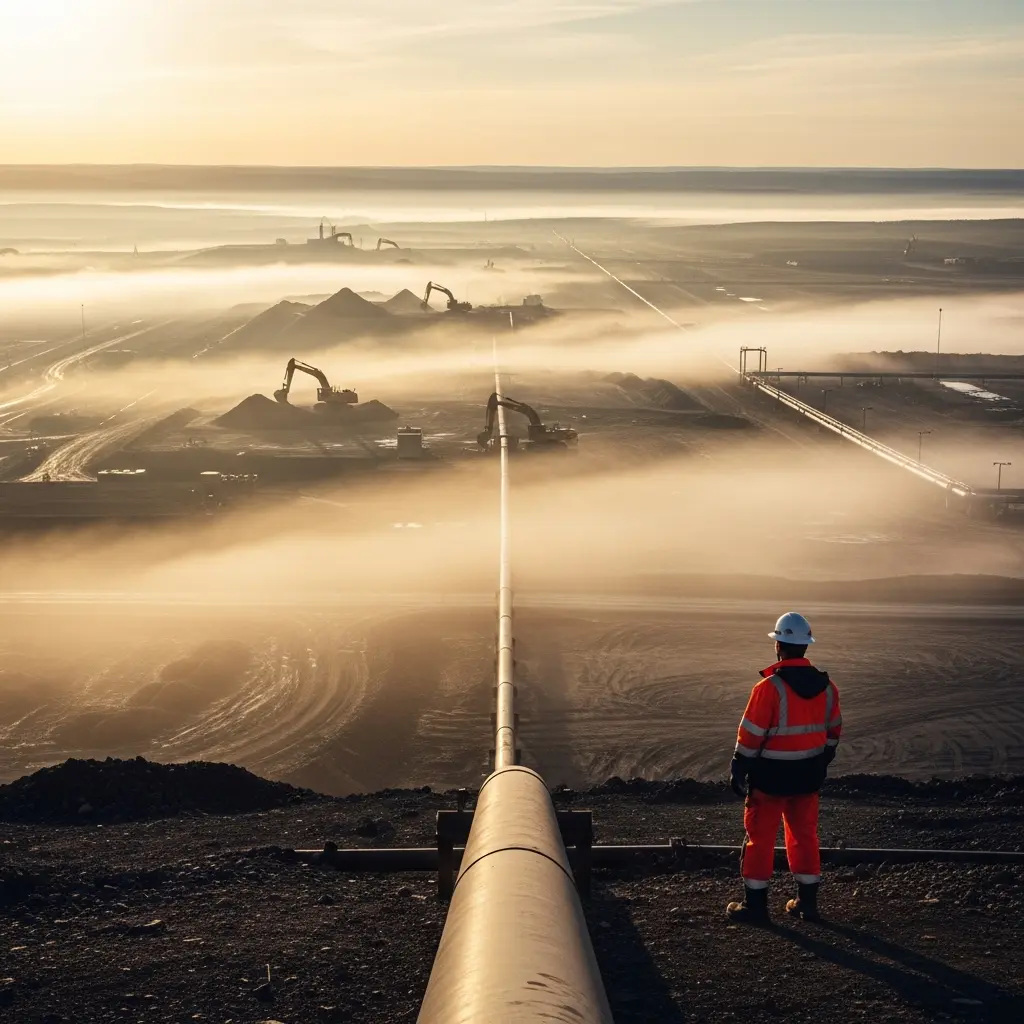
In a world suddenly short on reliable energy, Canada is making a move.
While the Persian Gulf burns and tanker traffic through the Strait of Hormuz slows to a crawl, a very different kind of energy story is taking shape in the oil sands of Alberta and the production fields of Saskatchewan. Starting in April 2026, Canada is preparing to increase crude oil production by approximately 140,000 barrels per day — a significant step that carries implications far beyond its own borders.
It is not the loudest headline of the week. There are no explosions, no emergency sessions, no evacuations. But in the quiet arithmetic of global energy supply, this decision may matter more than most people realize.
The Timing Is Not an Accident
Let us be clear about what is driving this. Canada’s planned crude oil production increase did not emerge from a vacuum. It is a direct response to the most severe supply disruption in the history of global oil markets — one triggered by the escalating Middle East conflict that has throttled Gulf exports and sent Brent crude soaring above $104 per barrel.
Energy officials in Ottawa and Alberta have been watching the Gulf crisis with the careful attention of people who understand that geopolitical instability in one part of the world creates both responsibility and opportunity for stable producers elsewhere. Canada already ranks among the top five oil producers globally, sitting alongside Saudi Arabia, Russia, the United States, and Iraq in terms of daily output. When major producers are constrained — voluntarily or by force — the world looks to those who can and will fill the gap.
Canada’s answer, for now, is 140,000 additional barrels per day. Starting April 2026, that crude will begin flowing — through pipelines, to export terminals, and ultimately into a global market that is hungry for supply from sources that do not involve navigating a conflict zone.
What 140,000 Barrels Actually Means
Numbers in the oil industry can be deceptive in both directions. Skeptics will note that 140,000 barrels per day is a fraction of the 8 to 10 million barrels per day that the Gulf crisis has removed from global supply. It will not single-handedly replace what has been lost. It will not bring Brent crude back to $70 on its own.
But that framing misses the point of how energy markets actually work. Oil prices are not just a function of absolute supply and demand — they are a function of confidence, trajectory, and signal. When markets see a reliable, geopolitically stable producer like Canada committing to a concrete production increase with a specific start date, that changes the calculus for traders pricing in future risk. It narrows the worst-case scenarios. It suggests that the supply response from non-Gulf producers is materializing.
Industry experts monitoring global energy trade have observed that even slight upticks in output from reliable producers can significantly sway market sentiment when crises arise.
Canada’s move, combined with similar responses from Norway, Guyana, and Brazil, is beginning to sketch the outline of a Western Hemisphere supply offset that markets have been waiting for.
The crude oil exports Canada is preparing to ship will flow primarily to the United States, which remains Canada’s dominant energy trading partner by an enormous margin. The Trans Mountain Pipeline expansion, which came online in 2024, has also opened meaningful new capacity to reach Asian markets via the British Columbia coast — meaning Canadian crude can now reach refineries in South Korea, Japan, and China with greater efficiency than at any point in history.
The Geopolitical Dimension
Canada’s ramp-up in oil production, however, isn’t just about barrels and price predictions. It’s a geopolitical statement, one that Ottawa is making quite intentionally.
Canada’s energy market strategy has evolved significantly over the past decade. The debate that once consumed Canadian politics — whether to expand oil sands production or pivot entirely to renewables — has given way to a more nuanced position: that Canada can be both a serious clean energy investor and a responsible conventional energy producer for as long as global demand requires it. The Middle East crisis has, if anything, accelerated that pragmatic realism.
Energy security has rejoined national security as a top-tier political priority across the Western world. NATO members are quietly reassessing their energy dependencies. The European Union, burned badly by its reliance on Russian gas, is diversifying its hydrocarbon sources with an urgency it did not have before 2022. Canada — politically stable, legally predictable, and geographically proximate to both Atlantic and Pacific markets — is positioning itself as the partner of choice for allies who want reliable energy from a country that will not weaponize supply.
That positioning has value that does not show up directly in the price of a barrel of crude, but shapes trade relationships, diplomatic leverage, and long-term investment flows in ways that matter enormously.
The Opportunity and the Obligation
Canada’s decision to increase production is the right call at the right moment. A world facing genuine energy insecurity needs producers who can respond quickly, predictably, and at scale. Canada is one of a small number of countries capable of doing exactly that.
But the opportunity comes with an obligation — to ensure that increased production is managed responsibly, that Indigenous consultation processes are respected, that environmental monitoring keeps pace with output growth, and that the revenue generated is invested with the long-term energy transition in mind rather than spent as though oil will be $100 a barrel forever.
The world needs what Canada has right now. The question is whether Canada uses this moment wisely.

