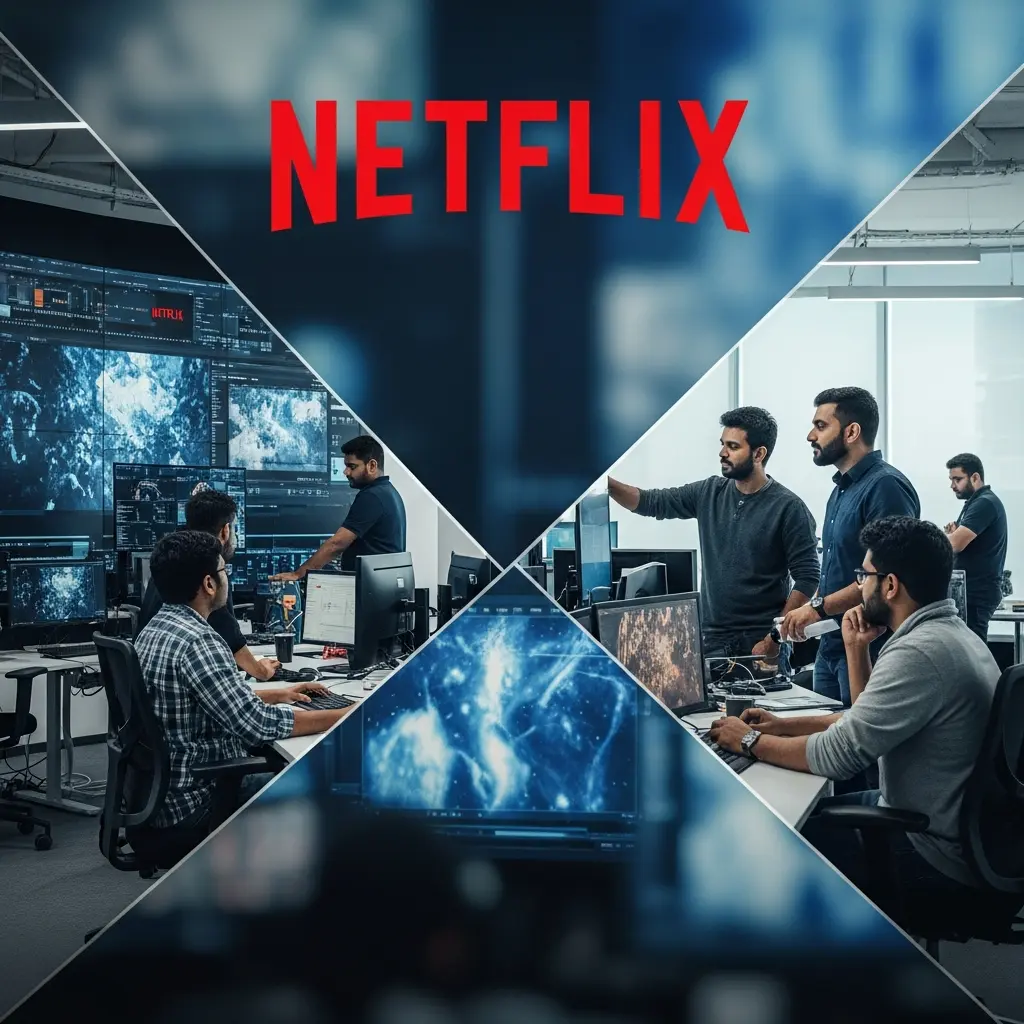
There’s a particular moment in any industry’s evolution when a single announcement signals something larger than itself — when one investment tells you not just what one company is doing, but where an entire sector is heading. Netflix’s decision to open a major visual effects facility in Hyderabad through its Eyeline Studios division is one of those moments.
On the surface, it’s a business story. A global streaming giant expanding its production infrastructure into a market with cost advantages, technical talent, and a growing creative ecosystem. But underneath that straightforward narrative is something more interesting — a story about how India’s entertainment industry is being rewritten, and who gets to be part of the rewriting.
Eyeline Studios and the Bet on India
Eyeline Studios is not a household name for most viewers. It operates in the invisible layer of filmmaking — the work that happens after cameras stop rolling, in the digital spaces where worlds are built, creatures are animated, explosions are composited, and the gap between what was filmed and what audiences see is carefully, painstakingly closed.
Netflix established Eyeline Studios with a specific ambition: to build production-quality visual effects capacity that serves its global content pipeline. The Hyderabad facility represents a significant expansion of that ambition. This isn’t an outsourcing arrangement or a cost-reduction experiment. Industry analysts who have examined the investment describe it as a genuine commitment to building high-end VFX capability in India — the kind of work that appears on global screens in major productions, not the kind that gets quietly farmed out and never acknowledged.
That distinction matters enormously for the Indian professionals who will work there.
Why Hyderabad, and Why Now
Hyderabad has spent the better part of two decades positioning itself as a serious destination for technology and media investment. The city’s infrastructure, its concentration of technical universities, its existing animation and gaming industry, and its relatively lower operating costs compared to Mumbai have made it an attractive proposition for companies looking to build creative production capacity in India.
The Netflix VFX studio in India adds a new chapter to that story. It joins a broader ecosystem that already includes significant animation studios, game development companies, and post-production facilities serving both Indian and international clients. The arrival of a brand name as globally recognized as Netflix — and a division as technically demanding as Eyeline Studios — sends a signal to other international studios that Hyderabad’s creative infrastructure is ready for serious global work.
The timing reflects something real about where the global streaming production landscape is heading. As platforms compete for content across multiple markets simultaneously, the economics of centralized, expensive production hubs in Los Angeles and London are coming under pressure. Building quality capacity in markets like India isn’t just about cutting costs — it’s about building pipelines that can sustain the volume of content that global streaming now demands.
What This Means for Indian Artists and Technical Professionals
This is where the story becomes genuinely human. Behind every dragon rendered, every cityscape extended, every visual that makes audiences lean forward in their seats is a team of artists — animators, compositors, lighting technicians, rigging specialists, environment artists — who spent years developing skills that most viewers never think about.
India has been producing these professionals for a long time. The country has strong training infrastructure in animation and VFX, feeding graduates into a domestic industry that has grown significantly but has often struggled to offer the most ambitious, high-profile projects. Many skilled Indian VFX artists have historically needed to emigrate to access the work that would stretch their abilities and build their reputations on a global stage.
The Eyeline Studios Hyderabad facility changes that calculus, at least partially. The collaboration with international creators that Netflix has described for the studio means Indian artists will be working on projects that reach global audiences — not as anonymous contractors on low-visibility work, but as contributors to productions that carry Netflix’s brand and ambition.
For recent graduates entering the VFX industry growth wave in India, the implications are significant. Career paths that once required relocation to London or Vancouver or Los Angeles now have a different shape. The most demanding, creatively rewarding work in visual effects is coming to them.
The Broader Ecosystem Effect
Individual facilities don’t exist in isolation. When an anchor tenant of Netflix’s stature commits to building serious VFX capability in Hyderabad, it creates ripple effects through the surrounding ecosystem.
Smaller studios gain proximity to a major client and partner. Training institutions have a clearer target to aim their curricula toward. Investors in digital media technology see validation of the market they’ve been watching. Talented professionals who might have been considering opportunities elsewhere have a reason to stay — or a reason to return.
The global streaming production landscape is shifting toward a more distributed model, and India is positioning itself to be one of the serious nodes in that network rather than a peripheral player. The Netflix investment accelerates that positioning considerably.
A Moment Worth Paying Attention To
It would be easy to read the Netflix VFX studio India announcement as just another corporate expansion — one line in a quarterly investor update, one ribbon-cutting ceremony among many. That would be a mistake.
What’s happening in Hyderabad is part of a larger reordering of where creative work gets done, who gets to do it, and whose talent the global entertainment industry is finally willing to invest in developing rather than simply borrowing when convenient.
India’s creative professionals have always had the skill. What they are getting now, increasingly, is the infrastructure, the investment, and the international platform to show the world what that skill looks like when it has everything it needs.
That’s a story worth watching — frame by frame.