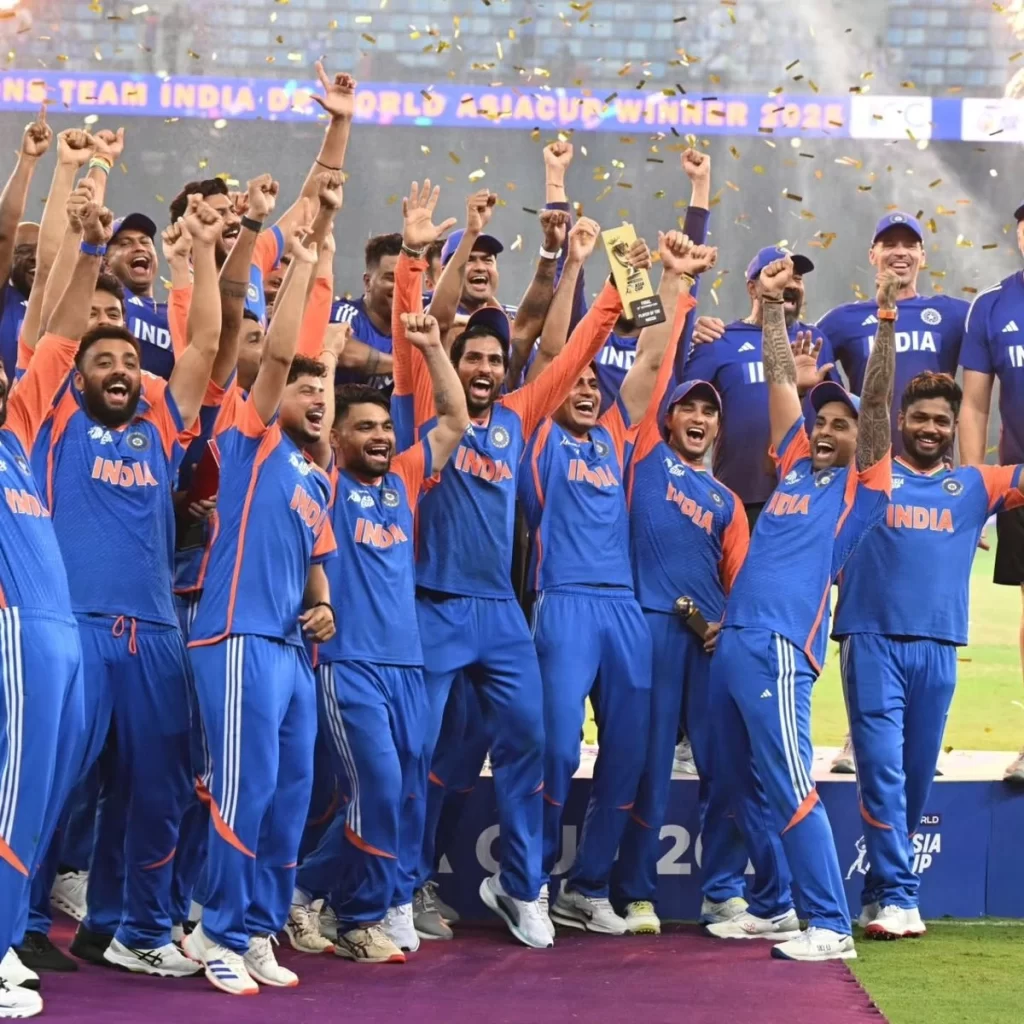
India has made history in cricket by winning their third ICC Men’s T20 World Cup title. They beat New Zealand by 96 runs in a dominant final at the Narendra Modi Stadium in Ahmedabad on March 8, 2026. India set a new record with a score of 255 runs for 5 wickets, thanks to Captain Suryakumar Yadav’s smart strategies. Then, in 19 overs, they bowled the Black Caps out for 159 runs. This historic win—their first back-to-back win and third overall—has sparked a billion-strong celebration. Searches for “India T20 World Cup 2026 champions,” “IND vs NZ final highlights March 8,” and “Suryakumar Yadav captaincy triumph” are all at the top of the list. India put their prior semi-final ghosts to rest in front of 86,000 screaming supporters under the night sky in Ahmedabad. They became T20’s uncontested kings.
In the 2026 edition’s final, held in India, New Zealand won the toss and chose to bat first under captain Mitchell Santner. But India’s months of hard work—high-altitude camps, dew simulations, and data-driven drills—led to a performance that combined blazing stroke play with ruthless execution, setting new T20 records on home soil.
Batting Armageddon: Openers Change the History of Powerplay
On Ahmedabad’s true pitch, India’s innings blew up right away. Abhishek Sharma and Sanju Samson, the first two batters, put on an amazing 98-run powerplay stand off 43 balls. This was the most explosive start in T20 World Cup final ever. Abhishek’s savage 52 off 21 balls, with 6 fours and 3 sixes at a strike rate of 247.62, destroyed New Zealand’s new-ball assault. He hit Trent Boult for 28 runs in one over, which is one of the most expensive in final history.
Sanju Samson, who was named Player of the Series after scoring 321 runs in the competition, showed off his 360-degree range by quickly reaching a half-century. Captain Suryakumar Yadav scored a calm 45 from 24 balls, with ramps over slips, delicate scoops, and daring lofts, as the middle order dealt with short bursts of pressure. Hardik Pandya’s late attack of 30* off 12 balls, which included three huge sixes, helped India reach 255/5, which is the highest score ever in a T20 World Cup final.
There were 18 sixes that went over Ahmedabad’s huge boundaries, and the team had a strike rate of more than 179. Every 2.8 balls, the boundaries flew. New Zealand’s bowlers, Boult (0/48) and Lockie Ferguson (1/55), were swamped, even though they had bet on the field initially and it had backfired in very little dew.
Jasprit Bumrah’s Bowling Magic: Chase Was Destroyed Without Mercy
India’s offense, led by Suryakumar Yadav, caused a lot of damage while defending 256. Jasprit Bumrah, who was justifiably named Man of the Match, took 4/15 in four overs, which stopped New Zealand’s chase with an economy rate of 3.75. His first ball knocked Devon Conway out of the game with a fast yorker, while his last ball knocked out skipper Kane Williamson’s prized wicket with a late-swinging inswinger.
During the powerplay collapse (45/3), Axar Patel took advantage of fast turn to trap Rachin Ravindra and Daryl Mitchell lbw. Mohammed Siraj’s death-over 2/18 put an end to any chance of a comeback, and Glenn Phillips’ tough 38 was New Zealand’s only response. Kuldeep Yadav’s enticing googly caused the last breakdown, sending the Black Caps home in 19 overs with their lowest World Cup final score.
India’s bowlers were in command, with a remarkable 52% dot balls. They completely dominated the powerplay, and in the death overs, they conceded just 35 runs off 5 deliveries, averaging over 8 runs per over. Tilak Varma’s spectacular catch at long-on to dismiss Jacob Duffy perfectly illustrated their fielding superiority, which ultimately translated into a 96-run win.
Captain Cool Suryakumar Yadav Changes His Fate
Suryakumar Yadav’s rise to captaincy was a change for the next generation. Even though he lost the toss, the 35-year-old’s gutsy instincts showed through when he brought in spin in the middle of the innings, trusted Bumrah’s new-ball menace, and backed young players like Abhishek Sharma. His IPL-honed game management led to an unbroken knockout streak, breaking India’s T20 World Cup semi-final curse.”Suryakumar Yadav T20 World Cup captain” went viral on social media, and Aaron Finch praised him, saying, “SKY’s natural leadership makes India unstoppable.”” Yadav’s dedication rang true after the match: “For every fan from Ahmedabad’s roar to the world’s dreams—this is ours.” The squad depth was impressive, with Arshdeep Singh and Washington Sundar ready to come in as impact subs.
The Road to Glory: The Tournament Saga Begins
India’s journey was a mix of drama and power:
Group stage sweeps over lesser opponents; tight Bangladesh pursuit.
Abhishek’s 92* in the Super Eights thriller versus Australia sealed a 6-wicket heist.
Semifinal against England (March 5, Mumbai): After England scored 246 runs in 7 overs, we defended 253 runs in 7 overs.
Sanju Samson’s 321 runs, Bumrah’s 20 or more wickets with an economy rate of less than 5, and Abhishek Sharma’s strike rate of more than 190 were all great performances in the tournament. “ICC T20 World Cup 2026 highlights” got over 500 million views, thanks in part to Ahmedabad’s drone tricolor displays.
The Brave Charge from New Zealand Hits the Indian Wall
Mitchell Santner’s Black Caps, who had just upset South Africa in the semifinals, fell apart under the final pressure. They lost their third World Cup final in a row (2021, 2022, and 2026), which makes them think. Coach Gary Stead said, “India’s depth was too much for us; our spin attack needs to change.” Still, their history of doing well with white balls, which has been a problem for India, earns them respect.
National Euphoria: 1.4 Billion Hearts in One Place
Ahmedabad’s Narendra Modi Stadium was full of feelings, and festivities spread from Mumbai’s Marine Drive to Kolkata’s Eden Gardens. “1.4 billion hearts united in pride,” said Prime Minister Narendra Modi. The home-hosted event boosted cricket’s economy by 25%, and IPL teams are now looking for players who fit the Abhishek-Samson mold in upcoming auctions.
As confetti fell, Rohit Sharma, the captain who won the 2024 World Cup, joined MS Dhoni to present the trophy. This showed how smoothly the legacy would be passed on.
India Sets New Standards for T20 Evolution
India is the first country to use the hyper-aggression format:
Finals often go beyond 250 runs.
Powerplay is becoming the norm above 90.
The Bumrah-Axar axis of pace-spin death bowling combinations is changing the way the last overs are played.
The 18 sixes in a final, the powerplay explosion analytics, and SKY’s tactical genius are all examples of how to run global T20 competitions.
Trials Mastered: From Crises of Injury to Rival Fires
India dealt with Shubman Gill’s hamstring injury (thanks to Abhishek Sharma’s rise), alarms in the semi-finals against England’s strong batting team, and New Zealand’s long history of World Cup failures. Expectations from the home audience turned into jet fuel instead of pressure.
Crystal Gazing: The Three-Peat Horizon Calls
India’s third victory puts them in a position to try for a remarkable three-peat in 2028. Abhishek Sharma’s growth goes well with Bumrah and Pandya’s peak, and Axar Patel and Arshdeep Singh’s depth makes sure of the future. T20 academies are popping up all over the world, and the IPL’s aggressive style is spreading to other countries. The strategic pivot is still workload rotation.
India Keeps the ICC Men’s T20 World Cup Title: Suryakumar Yadav Leads the Team to a 96-Run Victory Over New Zealand in Ahmedabad