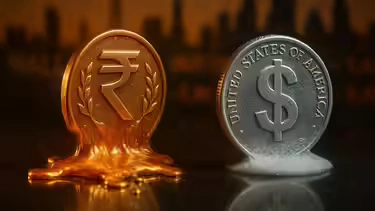
The Indian rupee tumbled to a historic low near ₹90.47–₹90.56 per U.S. dollar on Friday, extending its sharp depreciation trend and raising concerns among policymakers, investors, and consumers alike. The sustained depreciation — marking the rupee as one of the worst‑performing Asian currencies this year — reflects persistent dollar demand, foreign capital outflows, trade imbalances, and geopolitical headwinds that continue to weigh on India’s foreign exchange markets.
Market Dynamics Driving the INR Decline
At the heart of the rupee’s slide is the combination of strong U.S. dollar demand and subdued foreign investment flows. Traders report that importers — particularly those settling payments for crude oil, electronics, and other essential goods — are aggressively purchasing dollars, narrowing the supply of foreign currency in domestic markets.
Meanwhile, foreign portfolio investors (FPIs) have continued to withdraw funds from Indian equities and bonds, compounding the downward pressure on INR. Net outflows from foreign investors have been substantial throughout 2025, reflecting a broader shift toward safer assets amid global risk aversion.
Key factors behind the rupee’s slide include:
- 🔹 Persistent dollar demand from importers and corporates servicing foreign obligations.
- 🔹 Sustained foreign capital outflows, particularly from equity and debt markets.
- 🔹 A widening trade deficit, increasing the gap between dollar inflows and outflows.
- 🔹 Unresolved India‑U.S. trade negotiations, creating uncertainty for export growth and investor confidence.
- 🔹 Global market volatility and the relative strength of the U.S. dollar.
Impact on Economy, Consumers, and Markets
The rupee’s depreciation carries multifaceted implications for the Indian economy:
📈 Inflationary Pressures and Import Costs
A weaker rupee makes imported goods more expensive for Indian consumers and businesses. This dynamic could drive up the cost of essential commodities such as crude oil, edible oils, electronics, and industrial raw materials — potentially feeding into broader inflationary pressures across sectors.
📊 Corporate and Financial Sector Strain
Companies with foreign currency loans face higher debt servicing costs, while import‑dependent industries grapple with elevated production expenses. Consumer discretionary spending may also slow as inflationary impacts ripple through household budgets.
📉 Equity Market Sensitivity
Although Indian equity indices showed resilience with selective sector gains, continued currency weakness can temper market optimism, especially if capital outflows persist. Analysts emphasize that investor sentiment remains fragile in the face of macroeconomic uncertainty.
Policy Response and RBI Stance
The Reserve Bank of India (RBI) has been managing the rupee’s volatility with measured intervention, selling dollars in the spot market to cushion extreme swings while avoiding aggressive defense of a particular exchange rate threshold. Market observers suggest that this approach reflects a managed float currency regime designed to balance stability with open market dynamics.
Despite these interventions, analysts caution that further depreciation cannot be ruled out unless structural pressures ease — particularly around trade deficits and foreign capital flows. Some forecasts indicate the rupee could remain below the 90-per-dollar mark well into early 2026.
Outlook: Trade Negotiations and Future Trajectory
Much of the rupee’s near‑term outlook hinges on progress in international trade dialogues, especially with the United States. A finalized trade agreement or tariff relief could bolster export prospects and reduce systemic uncertainty around India’s external sector.
Table: Key Drivers of INR Exchange Rate Pressure
| Factor | Impact on INR |
|---|---|
| Foreign capital outflows | High downward pressure |
| Dollar demand from importers | Strong depreciation force |
| Trade deficit | Weakens external balance |
| Unresolved India‑U.S. trade deal | Investor uncertainty |
| RBI managed interventions | Moderates volatility |