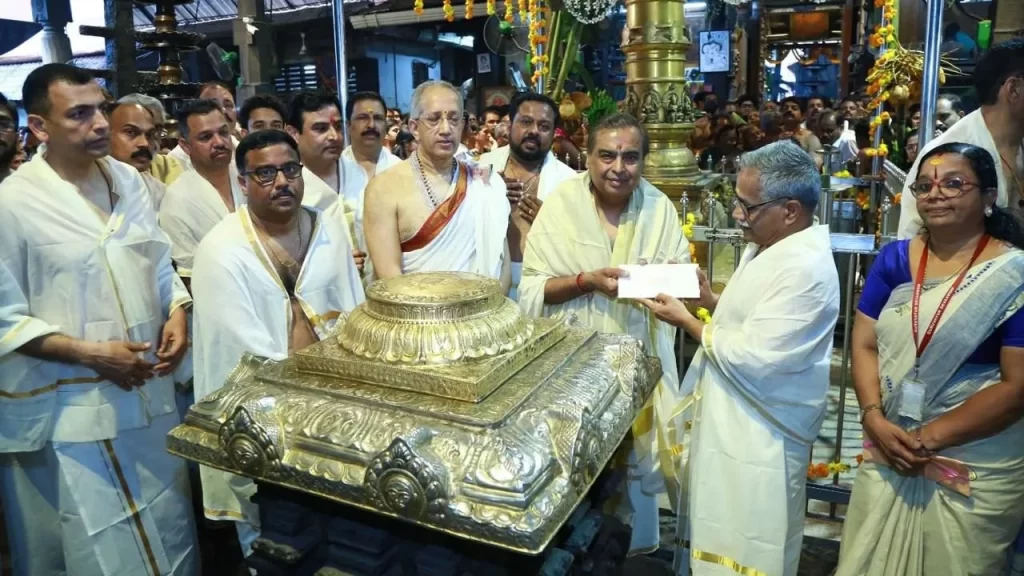
Prominent industrialist Mukesh Ambani, Chairman and Managing Director of Reliance Industries Limited, recently visited three major pilgrimage sites in India: Guruvayur in Kerala, Tirumala in Andhra Pradesh, and Nathdwara in Rajasthan. During these visits, he made significant donations pledged for healthcare infrastructure and devotee welfare — marking a notable philanthropic initiative tied to spiritual engagements.
On the weekend of November 9, 2025, Ambani’s itinerary commenced at the hill shrine of Tirumala, where he offered the morning Suprabhata Seva and paid homage to Lord Venkateswara. He noted the temple trust’s efforts in providing free meals to visiting devotees and pledged support for automated food-service systems at the site.
He then travelled to Guruvayur in Kerala, where he visited the famed Krishna temple. There he made an initial cheque of ₹15 crore towards a proposed multi-speciality hospital under the temple board’s planning. The hospital project aims to improve healthcare access for devotees and residents in the temple town, with facilities including emergency care, dialysis units, and specialized wards.
In Nathdwara, Rajasthan, Ambani attended the Bhog Aarti at the Shrinathji temple and announced the construction of a “Yatri Evam Varishth Seva Sadan” (Pilgrim and Senior Citizen Service Centre) estimated at over ₹50 crore. He donated ₹15 crore to initiate the project, which will include more than 100 rooms, a 24×7 medical unit, physiotherapy and satsang hall, and traditional dining areas for devotees.
This series of temple visits and philanthropic announcements highlights the growing connection between corporate social responsibility (CSR) and faith-based engagement. It reflects the increasing focus on pilgrim welfare, senior citizen accommodation, and healthcare expansion in India’s religious hubs. By earmarking large-scale donations to hospitals and service centres at major pilgrimage sites, Ambani’s initiative underscores how industry leaders are aligning with cultural and devotional causes.
Reports suggest that Ambani’s total pledges across the three temples exceed ₹35 crore. For the temple trusts, these funds could accelerate plans for upgraded facilities and benefactor-driven welfare schemes. The donations also demonstrate a broader vision of corporate philanthropy, where spirituality and social service converge to create long-term community benefits.
For the temple boards, receiving large donations from a high-profile corporate figure brings both opportunity and responsibility. The hospital project at Guruvayur addresses the need for advanced medical care in a pilgrimage town, while the welfare centre at Nathdwara caters to the growing population of elderly devotees seeking comfort and accessibility. From a CSR perspective, such philanthropic moves enhance Ambani’s public image and may inspire other business leaders to contribute to infrastructure and social impact projects linked to India’s heritage sites.
However, the partnership between corporate donors and religious institutions will also draw attention to governance and transparency in fund utilization. Ensuring that the donated money is effectively used for public benefit will be key to maintaining trust among devotees and the wider community.
Mukesh Ambani’s visits to Guruvayur, Tirumala, and Nathdwara, along with his substantial donations, mark a meaningful convergence of faith and philanthropy. As these projects move from announcements to implementation, they hold the potential to transform how pilgrimage destinations in India approach welfare, healthcare, and service for millions of devotees.