
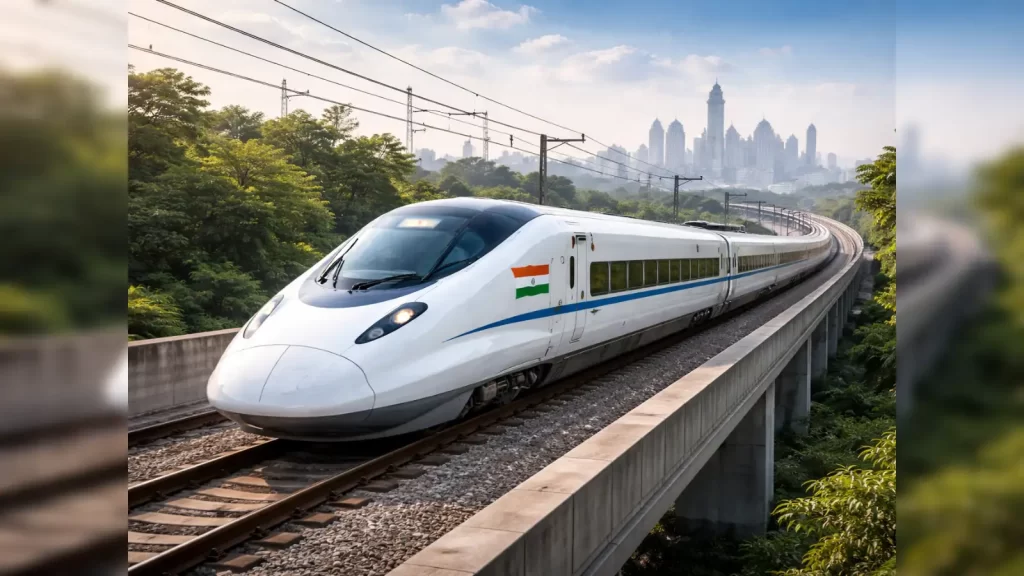
India’s long‑awaited Mumbai‑Ahmedabad High‑Speed Rail (MAHSR) project — the nation’s first bullet train corridor — has encountered substantial cost escalation and revised timelines as authorities detailed the latest developments. The ambitious flagship infrastructure initiative, now projected to cost approximately ₹1.98 lakh crore, is poised for a phased rollout with the first operational stretch slated to begin on August 15, 2027, government officials confirmed.
Rising Costs and Revised Budget Estimates
Initially sanctioned at around ₹1.08 lakh crore, the Mumbai‑Ahmedabad corridor’s estimated cost has nearly doubled to ₹1.98 lakh crore — an increase driven by extended project timelines, inflationary pressures, pandemic‑related slowdowns, and land acquisition challenges. Satish Kumar, Chairman and Chief Executive Officer of the Railway Board, underscored that the revised estimate, although still pending final Cabinet approval, reflects the realities of a complex megaproject now expected to be completed in phases.
This upward revision marks an 83% surge in projected expenditure, underscoring the financial challenges faced by large‑scale infrastructure initiatives in India. Delays of over four years have contributed significantly to this increase, amplifying both direct construction costs and associated overheads.
Phased Launch Strategy and Timeline
Union Railways Minister Ashwini Vaishnaw announced that the first stretch of the bullet train corridor — covering the Surat to Bilimora segment — will open on August 15, 2027, marking a symbolic launch on India’s 81st Independence Day. Subsequent phases will expand connectivity incrementally, extending from Vapi to Surat, then to Ahmedabad, and finally linking Thane and Mumbai to complete the entire 508‑kilometre corridor.
Officials highlighted that phased commissioning allows for enhanced operational testing and ensures safety protocols are meticulously upheld, while enabling earlier public use of completed stretches. Once fully operational, the high‑speed rail service is expected to drastically reduce travel times between Mumbai and Ahmedabad — potentially to under 2.5 hours, compared with the current 7‑9 hour journey by conventional rail or road.
Engineering Milestones and Infrastructure Progress
Significant construction milestones have been achieved across the corridor. Authorities recently announced a breakthrough in one of the major mountain tunnels in Maharashtra’s Palghar district, a key engineering feat that highlights the project’s steady progress. The corridor will feature 12 stations, from Mumbai and Thane in the south to Sabarmati and Ahmedabad in the north, enhancing regional connectivity and economic integration across key urban hubs.
Despite delays, the use of advanced technologies such as Shinkansen‑inspired design standards and state‑of‑the‑art safety systems aims to deliver one of the most sophisticated high‑speed rail networks in the region. Construction has also advanced on major viaducts and bridge structures, pillars of the corridor’s elevated alignment.
Broader Economic and Strategic Impact
Beyond transportation efficiency, the bullet train project is envisioned as a catalyst for broader economic transformation. Officials and analysts argue that high‑speed connectivity will stimulate commerce, reduce regional travel bottlenecks, and spur investment in ancillary sectors such as manufacturing, tourism, and urban development. Proponents also highlight its strategic value in positioning India as a future leader in modern rail infrastructure.
Looking Ahead: Delivery and Expectations
While the first operational segment by August 2027 represents a major milestone, full commissioning of the entire Mumbai‑Ahmedabad corridor is expected by late 2029. The project’s evolution reflects how India is navigating complex logistical challenges while balancing fiscal discipline and its ambitions to modernise national transport infrastructure.
As India edges closer to realising bullet train travel, stakeholders — from commuters to policymakers — await with keen interest how this transformative project will reshape travel patterns and regional growth in the decades to come.
Key Project At‑A‑Glance
- Total Route Length: 508 km
- Revised Project Cost: ~₹1.98 lakh crore
- First Launch Date: August 15, 2027
- Phased Completion: By late 2029
- Number of Stations: 12

