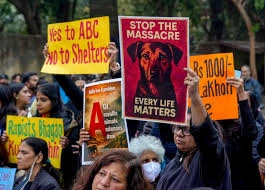
On a cold March weekend, thousands of protestors filled the streets of India’s capital, turning Jantar Mantar into a sea of signs and shouts calling for immediate changes to animal welfare legislation. This huge animal rights march in Delhi has sparked a national discourse about the need for tougher animal protection laws. It has also brought attention to problems with how the law is enforced and gaps in the current rules.
The Reasons for the Protest
The protest, which was put together by more than 20 animal rights groups, including PETA India, Humane Society International, and local groups like Friendicoes-SECA, drew almost 15,000 people from all over the country. Activists marched from India Gate to Parliament Street, holding up signs that said things like “Ban Animal Cruelty Now” and “Stricter Laws for Animal Welfare.” A number of high-profile events in the last few months led to the event, such as stories of street dogs being poisoned in Mumbai, illegal elephant rides in Kerala temples, and undercover footage from Punjab poultry units showing factory farm atrocities.
What started as a small protest has grown into a larger movement. The protesters pointed to the 1960 Prevention of Cruelty to Animals Act (PCA Act), which many people say is out of date and doesn’t do much. The maximum fine for breaking this legislation is only 50 rupees, or less than a dollar, for things like beating or overloading animals. Experts say that this doesn’t stop people from doing it in today’s economy. Dr. Aruna Miller, a veterinary surgeon and the main organizer, gave a heated statement in which she declared, “This march is a wake-up call for lawmakers.” “India’s 1.4 billion people live with more than 30 million stray dogs, 5 million sick cattle, and countless birds and other wildlife that are suffering because people don’t care.”
Important Issues and Key Demands
The march’s manifesto laid out five main objectives, each backed by evidence and real-life experiences to show how important it is to have tougher legislation to protect animals. First, activists wanted the PCA Act to be changed so that repeat violators would have to pay at least 50,000 rupees and go to jail, which is in line with what is done around the world. Second, they wanted a ban on live animal exports. They pointed out that India is still a significant exporter of cattle and goats for slaughter, with more than 1.5 million animals transported each year, even though the Supreme Court partially banned this in 2001.
Third, stopping the illegal wildlife trade was a top concern. Recent busts in Delhi marketplaces showed that exotic birds and endangered pangolins were being sold, which shows that border enforcement needs to be better. Fourth, it was stressed that factory farming should be regulated by making humane killing standards essential. This came after reports of overcrowded poultry farms where animals had their beaks cut off without anesthesia. Finally, protesters called for statewide Trap-Neuter-Release (TNR) programs instead of culling as a way to help stray animals. This worked well in Jaipur.
These requests struck a chord, and #AnimalRightsMarchDelhi got more than 2 million posts in 48 hours on social media. Many urban millennials who shared viral footage of abused strays joined rural farmers in speaking out against the exploitation of dairy cows. The 2025 Animal Welfare Board of India study paints a gloomy picture: 70% of the slaughterhouses that were surveyed do not have a veterinarian on staff, and 40% of the animals on the street have injuries that are not being treated.
What the government did and the political divide
The Delhi Police were there in large numbers, but they said the event was calm and there were no arrests. Bhupender Yadav, the Union Minister for the Environment, said in a statement that he understood the “valid concerns” and promised a review committee by April 2026. He remarked, “The government is committed to treating all living things with respect.” He was talking about the National Action Plan for Dairy Development, which has measures about animal welfare.
But the voices of those who disagreed were louder. Rahul Gandhi, a member of Congress, tweeted his support, calling present laws “colonial relics” and asking for a special session of Parliament. Animal rights became a hot topic in politics, with critics of the BJP saying that the organizers were “urban elitists” who didn’t care about the needs of farmers’ animals. This argument is like the conflicts in the world, like when the EU tied farm subsidies to welfare criteria in 2024.
Experts have something to say about both sides. Manoj Mishra, a wildlife lawyer, says that tougher animal protection regulations need to find a balance between compassion and jobs. One way to do this may be to give money to humane alternatives. On the other hand, livestock economist Dr. Priya Sharma says that too many rules could cause meat costs to go up by 20 to 30 percent, which would hurt low-income families the most.
The History of Animal Rights in India
India has a long history of caring for animals, but it’s also very strange. Article 48 of the Indian Constitution protects cows in most states since India is the birthplace of ahimsa (non-violence), which Mahatma Gandhi and Jainism promoted. But enforcement is slow: A FIAPO report from 2023 revealed that 80% of animal cruelty complaints were thrown out because the police weren’t strict enough.
Movements from the past can teach us something. The protests against the 2017 beef ban led to court action, while the 2022 Hyderabad dog culling scandal led to stronger rules for the city. India’s PCA Act has influenced Thailand’s 2014 Cruelty Prevention Act, however it doesn’t have the same inspection system as the U.S. USDA. Recent victories include the Delhi High Court’s 2025 rule that slaughterhouses must have CCTV, which was a direct result of activist lawsuits.
Voices from the Ground
Personal stories made the cause more real. Rhea Kapoor, a 28-year-old graphic designer from Gurgaon, told the story of saving a beaten stray: “I saw the pain in his eyes—laws must punish such barbarity.” Vishnu Das, a 72-year-old activist from Rajasthan, talked about how he has spent decades combating camel abuse at Pushkar fairs. He said, “Festivals glorify cruelty; it’s time for change.”
Veterinarians said that after the pandemic, incidents of animal cruelty rose by 25%. This was linked to financial stress. Dr. Neha Patel of Blue Cross India said, “Beating goes up when owners can’t afford feed.” Urbanization makes problems worse: Delhi’s 1.2 million stray animals fight for food with trash, spreading rabies that kills 20,000 people every year.
You could see that young people were involved. College students led flash mobs in animal costumes, while eco-blogger Ananya Singh got 500,000 views for her live broadcast. “This isn’t on the edge anymore; it’s mainstream now,” she remarked.
Wider Societal Effects
The implications of this movement extend far beyond animal welfare, affecting public health, economic stability, and ethical considerations.
Rabies, primarily transmitted by animals, results in an annual healthcare expenditure of $600 million for India.
Furthermore, research by the World Health Organization indicates that the widespread use of antibiotics in industrial farming contributes to the rise of antibiotic-resistant bacteria.
Ethical farming might open up a $10 billion worldwide humane market, which would help exports.
India is behind the UK, which has a 2006 Animal Welfare Act that imposes fines of up to £20,000 and jail time, as well as no-kill shelters. The US has a 1966 AWA that imposes fines of $10,000 and state-level TNR programs. Australia has state acts with AUD 50,000 penalties and statewide TNR. But the march puts India in a good position to jump ahead with technology like AI-monitored crops.
NGOs aim to follow up with petitions that need 1 million signatures and cases in the Supreme Court. Corporate India is taking action: Reliance and Tata promised to make their supply chains free of cruelty.
Problems on the way
Lobbyists from the meat industry are still against it, saying it may cost 5 million jobs. Some temples involve animal sacrifices as part of their religious rites, which makes reforms harder. For example, a Kerala prohibition in 2024 provoked opposition. Enforcement is still very important: there are only 900 Animal Welfare Board members for 700 districts, so not having enough staff would kill efforts.
According to ICAR data from 2025, heatwaves kill hundreds of street animals per year, which makes the situation more urgent.
The Way Ahead
The animal rights march in Delhi was a turning point that got people to embrace tighter regulations to protect animals. Lawmakers are under more and more pressure to update the PCA Act, and they might do so by the monsoon session in 2026.
India wants to be a leader in sustainability around the world, and treating animals ethically might be a big part of that. Polls suggest that 65% of people want stronger restrictions, which means that the debate will lead to lasting change. Will Parliament do something, or will the streets ring out again? The animals are waiting.
The Animal Rights March in Delhi starts a discussion about stronger laws to protect animals.