
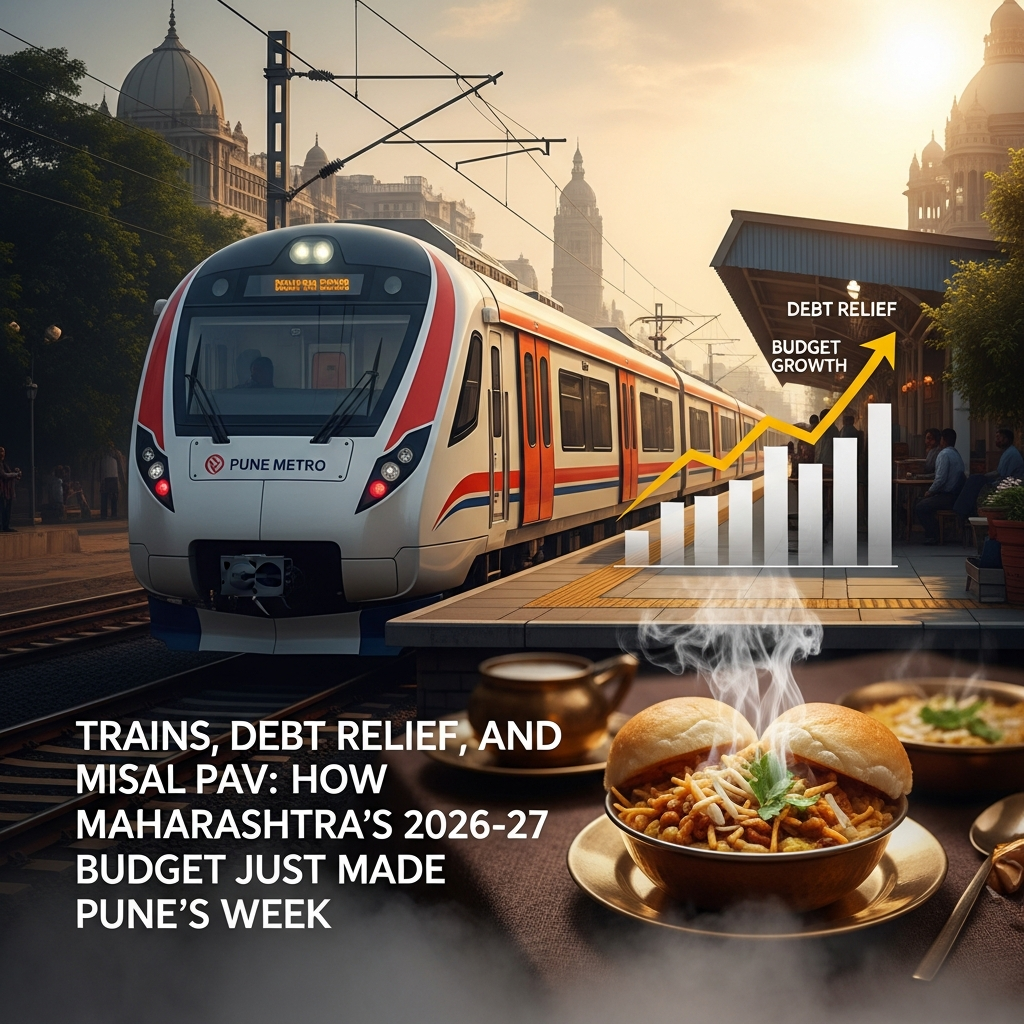
If you live in Pune, this week handed you a lot to process. A state budget landed with announcements that affect your morning commute, the farmer who grew the onions in your sabzi, and — in what might be the most joyful piece of news — the return of the Maha Misal Mahotsav to Sinhagad Road. Not bad for a Thursday.
The Maharashtra Budget 2026–27 was tabled this week, and while budget documents are usually the kind of thing that puts people to sleep, this one carries a few provisions that are genuinely worth paying attention to — especially if you live, work, or commute anywhere in and around Pune.
Here’s what it means for you, in plain language.
The Pune–Lonavla Rail Project: ₹5,100 Crore for a Corridor That’s Been Screaming for Help
If you’ve ever taken the Pune–Lonavla local train during the morning rush — sardine-packed coaches, trains running late, platforms overflowing — you don’t need a traffic study to tell you the corridor is overwhelmed. You’ve lived it.
The Maharashtra government has finally responded with real money: ₹5,100 crore has been approved for the construction of 3rd and 4th railway lines between Pune and Lonavla. This is not a feasibility study. It is not a working committee recommendation. It is a budget allocation — which means it’s as close to a firm commitment as these things get.
The stretch in question runs through the Pimpri-Chinchwad and Talegaon industrial belts, two of the most economically active zones in western Maharashtra. Thousands of workers make this journey daily — employees of auto-component factories, pharmaceutical units, warehousing hubs, and the hundreds of small-scale suppliers that keep large industries running. Right now, most of them have two options: fight for space on overcrowded trains, or lose hours of their day to highway congestion.
More rail lines mean more trains. More trains mean shorter headways, less crowding, and — critically — the ability to live in Talegaon, Dehu Road, or Malavli without treating your commute as a daily ordeal. For Pimpri-Chinchwad residents especially, who have been demanding better connectivity for years, this is long-overdue acknowledgment.
Implementation timelines will depend on land acquisition, tendering, and the usual machinery of infrastructure projects. But the funding is committed, and that matters. Pune’s rail future just moved meaningfully forward.
The Farmer Loan Waiver: ₹2 Lakh of Breathing Room Under Ahilyabai Holkar’s Name
There is a version of Pune’s story that rarely gets told in its shiny IT-corridor branding — the version that involves the farming districts surrounding the city, families growing sugarcane and onions and jowar on land that has absorbed both the hope and the heartbreak of several difficult agricultural years.
The Maharashtra Budget 2026–27 has announced a loan waiver of up to ₹2 lakh per eligible farmer under the Punyashlok Ahilyabai Holkar Scheme — named after the legendary 18th-century Maratha queen whose administration was defined by compassion, practicality, and an unwavering focus on the welfare of ordinary people. Naming a farmer relief scheme after Ahilyabai Holkar is not incidental. It is a deliberate invocation of a legacy that Maharashtrians across communities hold with deep pride.
For a farming household carrying institutional debt — taken during a bad monsoon year, or to pay for seeds that didn’t yield, or simply to survive a season when market prices collapsed — a ₹2 lakh waiver is transformative. It is the difference between starting the next crop season with possibility versus starting it already behind.
The honest caveat, worth stating plainly: Maharashtra has announced farm loan waivers before, and the gap between announcement and actual credit in a farmer’s account has sometimes stretched painfully long. Documentation requirements, bureaucratic bottlenecks, and eligibility disputes have historically diluted the impact of such schemes. This one will be judged not by its press release, but by how many farmers actually receive relief, and how quickly.
Farmer groups and opposition leaders are already asking those questions. They should keep asking them. Good policy announced is only halfway there. Good policy delivered is what counts.
Maha Misal Mahotsav Season 5: Sinhagad Road Is Ready for You
Now let’s talk about the news that has Pune’s food community genuinely, unreservedly excited.
The Maha Misal Mahotsav — Season 5 — begins today at Nahata Lawns on Sinhagad Road, and if your Saturday doesn’t already involve a visit, you’re doing the weekend wrong.
Misal pav in Pune is not a snack. It is a civic religion. The debates about whose usal has the right tarri-to-farsan ratio, which lane on Sinhagad Road has the most authentic flavour, whether you take it teekha or medium — these are Pune conversations that have been happening for generations and will continue long after any of us are around.
The Maha Misal Mahotsav, now in its fifth season, takes all of that passionate local food culture and concentrates it into one venue. Vendors from across Pune and Maharashtra, each bringing their own recipe, their own spice level, their own loyal following. Past seasons have drawn massive footfall and created the kind of warm, noisy, aromatic chaos that Punekars love. Season 5, riding the tailwind of Pune’s booming food festival culture, is shaping up to be the biggest one yet.
Nahata Lawns on Sinhagad Road is the perfect host — this stretch of the city has been a food landmark for decades, its dhabas and breakfast joints feeding everyone from college students to retired government officers since before Pune became a tech hub. The Mahotsav feels like a natural extension of everything this road has always stood for.
Go for the misal. Stay for the atmosphere. Argue pleasantly with a stranger about which stall is better. That’s the Pune way.
Why This Budget Week Feels Different for Pune
Three announcements. Three completely different communities. One budget week.
A city of commuters got a railway project that could genuinely change how they experience their workday. A community of farmers got a financial lifeline wrapped in the name of one of Maharashtra’s most beloved historical figures. And a city of food lovers got a reminder that Pune’s cultural identity — loud, proud, and always hungry — is alive and thriving on Sinhagad Road.
The Maharashtra Budget 2026–27 will be debated, critiqued, and picked apart in the weeks ahead. That’s how it should be. But for Pune residents this week, there is something worth pausing to acknowledge: for once, the fine print of governance landed somewhere close to home.

