Washington DC | March 14, 2026
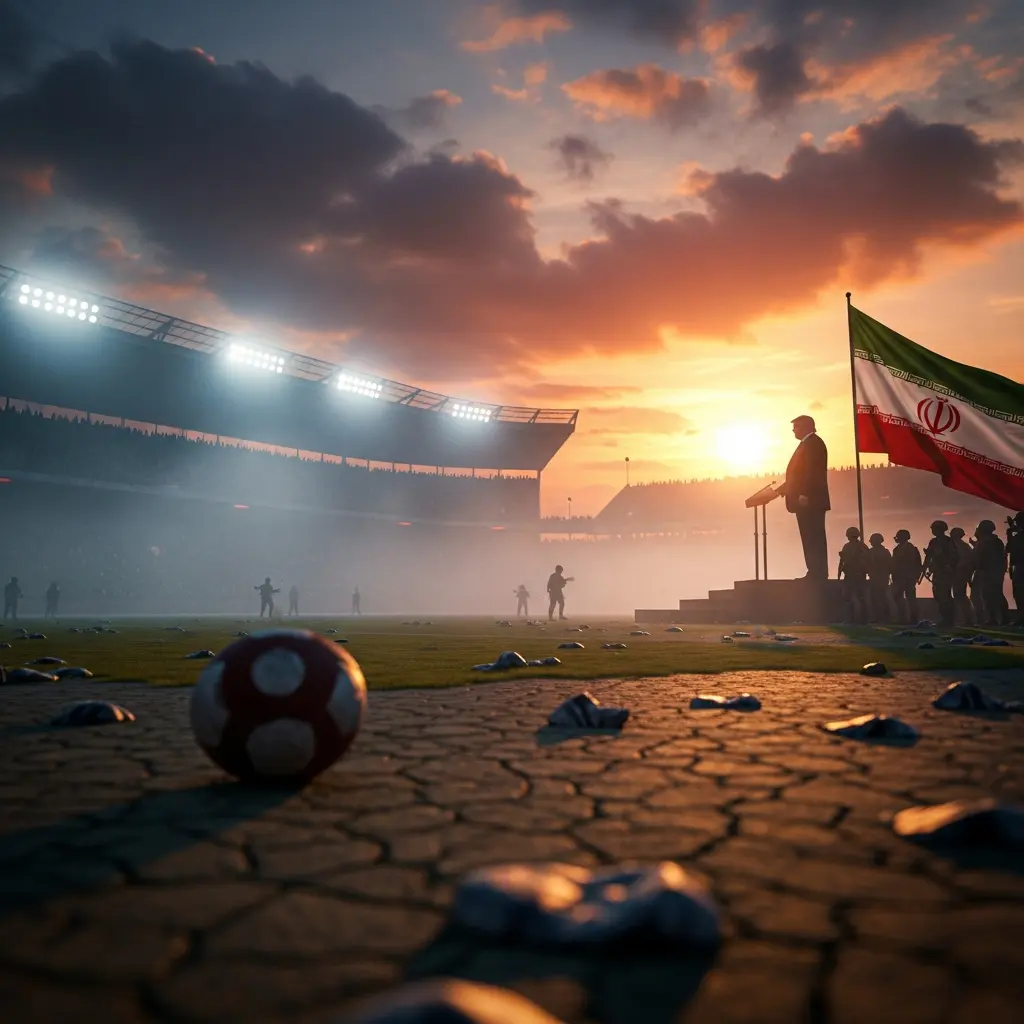
There is a certain kind of diplomatic language that even seasoned political observers struggle to decode. When President Donald Trump posted on Truth Social this week that Iran’s national football team was “welcome” to the 2026 FIFA World Cup — but that he did not believe “it is appropriate that they be there, for their own life and safety” — the message landed somewhere between warning, threat, and something nobody in the history of international football had quite said before.
The reaction was immediate, global, and deeply divided.
For context: the United States is actively at war with Iran. US and Israeli airstrikes that began on February 28 killed Iran’s Supreme Leader Ayatollah Ali Khamenei and other top officials. CNBC Against that backdrop, a sitting US president — and co-host of the tournament — telling an opposing nation’s athletes they might not survive attending a football match is not a diplomatic nuance. It is a rupture.
A Tournament Already Under Strain
Iran had already qualified for the 2026 World Cup through Asian qualifying and was drawn into Group G alongside Belgium, Egypt, and New Zealand. Their group-stage matches are scheduled to be played at SoFi Stadium in Inglewood, California and Lumen Field in Seattle. For months, Iranian footballers had been preparing for one of the biggest tournaments of their careers, on the grandest stage the sport offers.
Then the bombs fell.
Iran’s sports minister Ahmad Donyamali said earlier this week that the US-Israeli war against Iran made participation “not possible,” stating plainly that his country cannot be expected to participate in a World Cup hosted by a nation currently at war with them. That announcement came before Trump even posted his now-viral warning.
What followed was a diplomatic back-and-forth that brought geopolitics crashing into the world’s most-watched sporting event in a way that felt entirely new — and yet, in a dark way, historically familiar.
“No One Can Exclude Iran”
Iran’s national team did not stay quiet. In a sharp statement released on social media, the Iranian squad insisted that participation in the World Cup is governed by FIFA alone — not by any individual or host nation. They pointed out, with some bite, that the United States earned its place in the tournament not through qualification but as a co-host — and that if the US cannot guarantee the safety of competing teams, it should consider whether it has the right to host at all.
The statement closed with a line that ricocheted across global football media: “The only country that could be excluded is one that merely carries the title of ‘host’ yet lacks the ability to provide security for the teams participating in this global event.”
It was a striking counter-punch — turning the safety argument around and pointing it directly back at Washington.
FIFA Caught in the Crossfire
FIFA President Gianni Infantino found himself performing an increasingly uncomfortable balancing act. Just days before Trump’s Truth Social post, Infantino publicly confirmed that Trump had personally told him the Iranian team would be welcome to compete in the United States. The FIFA president posted about the conversation warmly, framing it as reassurance for the football world.
Two days later, Trump appeared to contradict himself entirely.
The White House did not immediately clarify what Trump meant by “life and safety” — specifically whether he was anticipating threats from civilians inside the US directed at Iranian athletes, or something else entirely. That ambiguity only deepened the unease.
FIFA’s own formal security assessment, conducted prior to the conflict, had rated the tournament’s safety plans as “low risk.” But that evaluation was made in a very different world.
A Break From Decades of Precedent
Trump’s insinuation that Iranian soccer players would not be safe on American soil is an exceedingly rare break from the global commitment to athlete safety that has governed international sport since the Munich massacre of 1972, when 11 members of Israel’s Olympic team were killed by Palestinian militants. That tragedy reshaped how the world thinks about the security of athletes at international competitions — and since then, nations hosting major tournaments have treated the protection of all participating teams as an absolute obligation.
What makes this moment particularly complex is the personal dimension. There are likely fears among Iranian footballers about playing in a tournament abroad where they could be approached by an anti-regime Iranian diaspora, while their families face uncertainty back home. UPI At the 2022 Qatar World Cup, the Iranian team silently declined to sing their national anthem before a match against England — a gesture widely interpreted as protest against their own government. Several players have since defected or sought asylum abroad.
These are not simply footballers caught in the crossfire of politics. They are individuals navigating extraordinarily difficult personal and political terrain.
What Happens Next?
Should Iran ultimately withdraw, FIFA would determine the replacement team — with Iraq, the highest-ranked Asian side that narrowly missed direct qualification, considered the most likely candidate. Al Italy has also been mentioned as a potential replacement.
But the question now extends well beyond one team’s participation. From the US boycott of the 1980 Moscow Olympics to the Soviet bloc’s retaliatory withdrawal from the 1984 Los Angeles Games, history has shown that when superpowers collide over the hosting of sport, the athletes always pay the highest price. Russia has been banned from both the Olympics and World Cup since 2022 following its invasion of Ukraine — a precedent that shows FIFA and the IOC can act decisively. But that decision came from the governing bodies themselves, not from a host nation.
This situation is different. A host nation is itself the belligerent party. The tension that creates — for FIFA’s authority, for the tournament’s integrity, and for the safety of every team traveling to North America — is without modern parallel.
Football has always claimed the power to transcend politics. FIFA President Infantino himself said this week that “we all need an event like the FIFA World Cup to bring people together now more than ever.”
Whether the world’s most popular sport can hold that line between June 11 and July 19, 2026 — as war rages in the Middle East and a host nation trades warnings with a qualifying team — remains one of the most uncomfortable open questions in the history of the sport.