
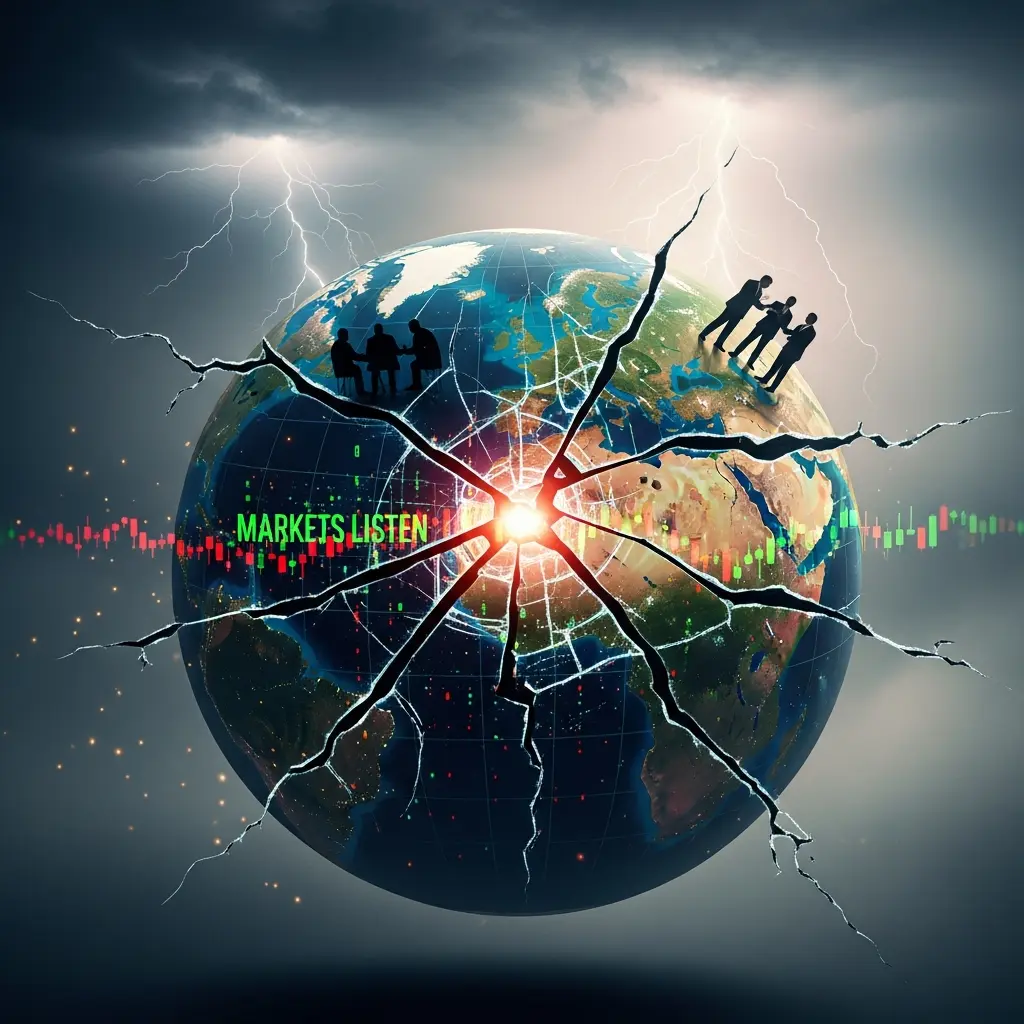
When the World Shakes, Markets Listen: Geopolitical Chaos and the Global Financial Reckoning
Markets are not emotional. That is what they teach you in economics class. Prices reflect information, rational actors respond to incentives, and over time, the numbers find their truth. It is a clean, satisfying theory.
Then the real world intervenes.
In March 2026, the real world has intervened decisively. Stock markets from Tokyo to Toronto, from Frankfurt to São Paulo, are swinging wildly — not because of earnings reports or interest rate decisions, but because of missiles, drone strikes, burning fuel depots, and a narrow waterway in the Persian Gulf that the world cannot seem to protect or replace. Global stock market volatility is no longer a technical term for traders. It is the daily reality for anyone with a pension, a savings account, or a stake in the economic future.
The relationship between global politics and financial markets has rarely been this visible, this raw, or this consequential.
Reading the Tape
When geopolitical tension spikes, money moves. It does not disappear — it relocates, rapidly and ruthlessly, from places that feel dangerous to places that feel safe. Understanding where money is going right now tells you almost everything you need to know about how investors are reading this crisis.
Energy stocks have surged. That is the most straightforward story on the board. When oil supply is threatened and Brent crude pushes past $104 per barrel, the companies that extract, refine, and distribute oil and gas become enormously more profitable overnight. ExxonMobil, Shell, BP, TotalEnergies, and their peers have seen significant share price gains as the market reprices their future earnings in a high-oil-price environment. For energy sector investors, the Middle East conflict has, perversely, been a windfall.
Defense stocks tell an equally clear story. Lockheed Martin, Raytheon, BAE Systems, and Rheinmetall have all seen increased investor activity as governments accelerate military spending and rearmament programs. The brutal logic of geopolitics is that conflict is, for defense contractors, a revenue event. Investor reaction to geopolitics in the defense sector has been swift and substantial, with several major defense indices hitting multi-year highs in recent weeks.
Commodities have followed a similar trajectory. Gold, always the instinctive refuge in times of fear, has climbed sharply. Copper, aluminum, and agricultural commodities have all moved higher as supply chain disruptions cascade through the global economy.
The Losers in This Equation
The other side of the ledger is where the broader economic pain becomes visible.
Technology stocks have faced meaningful declines. The reasons are layered. Higher oil prices feed into inflation expectations, which push bond yields higher, which reduces the present value of future earnings — and technology companies, valued largely on long-term growth projections, are particularly sensitive to this mechanism. Beyond the mathematical relationship, there is also a practical concern: semiconductor supply chains run through regions exposed to the conflict, and several major chip fabrication facilities rely on energy inputs now under strain.
Consumer discretionary stocks — retailers, restaurant chains, travel companies, automakers — have also retreated. The logic here is straightforward: when fuel costs more, everything costs more, and consumers under financial pressure buy less of what they want and focus on what they need. Airlines are caught in a particularly brutal squeeze, facing both higher jet fuel costs and softer demand as travelers grow cautious.
Financial market uncertainty has also put pressure on banks and financial institutions exposed to emerging market debt. Countries in Asia, Africa, and Latin America that borrowed heavily in dollars during the low-interest-rate era are now facing a toxic combination of rising oil import bills, currency depreciation, and tightening global financial conditions. The sovereign debt stress that has been quietly building for two years is beginning to surface.
The Flight to Safety
Gold has reclaimed its role as the ultimate store of anxiety, rising sharply as institutional and retail investors alike seek shelter from financial market uncertainty. Government bonds — particularly U.S. The flight to safety has been so pronounced that yields on some short-duration government bonds have actually declined even as inflation expectations rise, a paradox that reflects just how deep the uncertainty runs.
The Swiss franc and Japanese yen, traditional safe haven currencies, have strengthened. Bitcoin, which some proponents have promoted as a digital safe haven, has had a more mixed performance — suggesting that in moments of genuine systemic stress, investors still prefer centuries-old stores of value over relatively untested digital alternatives.
The economic outlook for 2026 is currently showing something economists have always known, even if markets sometimes forget: financial systems are connected to the physical and political world.
They are embedded in it, dependent on it, and vulnerable to it.
The platforms and algorithms that process billions of trades per second are, ultimately, processing human fear and human hope. Right now, fear is winning.
Markets will stabilize. They always do. The question that nobody can answer with confidence yet is what the world will look like when they do — and whether the losses absorbed along the way will leave lasting marks on the economies and households least equipped to bear them.
That is the part no trading model can calculate.
Markets are not emotional. That is what they teach you in economics class. Prices reflect information, rational actors respond to incentives, and over time, the numbers find their truth. It is a clean, satisfying theory.
Then the real world intervenes.
In March 2026, the real world has intervened decisively. Stock markets from Tokyo to Toronto, from Frankfurt to São Paulo, are swinging wildly — not because of earnings reports or interest rate decisions, but because of missiles, drone strikes, burning fuel depots, and a narrow waterway in the Persian Gulf that the world cannot seem to protect or replace. Global stock market volatility is no longer a technical term for traders. It is the daily reality for anyone with a pension, a savings account, or a stake in the economic future.
The relationship between global politics and financial markets has rarely been this visible, this raw, or this consequential.
Reading the Tape
When geopolitical tension spikes, money moves. It does not disappear — it relocates, rapidly and ruthlessly, from places that feel dangerous to places that feel safe. Understanding where money is going right now tells you almost everything you need to know about how investors are reading this crisis.
Energy stocks have surged. That is the most straightforward story on the board. When oil supply is threatened and Brent crude pushes past $104 per barrel, the companies that extract, refine, and distribute oil and gas become enormously more profitable overnight. ExxonMobil, Shell, BP, TotalEnergies, and their peers have seen significant share price gains as the market reprices their future earnings in a high-oil-price environment. For energy sector investors, the Middle East conflict has, perversely, been a windfall.
Defense stocks tell an equally clear story. Lockheed Martin, Raytheon, BAE Systems, and Rheinmetall have all seen increased investor activity as governments accelerate military spending and rearmament programs. The brutal logic of geopolitics is that conflict is, for defense contractors, a revenue event. Investor reaction to geopolitics in the defense sector has been swift and substantial, with several major defense indices hitting multi-year highs in recent weeks.
Commodities have followed a similar trajectory. Gold, always the instinctive refuge in times of fear, has climbed sharply. Copper, aluminum, and agricultural commodities have all moved higher as supply chain disruptions cascade through the global economy.
The Losers in This Equation
The other side of the ledger is where the broader economic pain becomes visible.
Technology stocks have faced meaningful declines. The reasons are layered. Higher oil prices feed into inflation expectations, which push bond yields higher, which reduces the present value of future earnings — and technology companies, valued largely on long-term growth projections, are particularly sensitive to this mechanism. Beyond the mathematical relationship, there is also a practical concern: semiconductor supply chains run through regions exposed to the conflict, and several major chip fabrication facilities rely on energy inputs now under strain.
Consumer discretionary stocks — retailers, restaurant chains, travel companies, automakers — have also retreated. The logic here is straightforward: when fuel costs more, everything costs more, and consumers under financial pressure buy less of what they want and focus on what they need. Airlines are caught in a particularly brutal squeeze, facing both higher jet fuel costs and softer demand as travelers grow cautious.
Financial market uncertainty has also put pressure on banks and financial institutions exposed to emerging market debt. Countries in Asia, Africa, and Latin America that borrowed heavily in dollars during the low-interest-rate era are now facing a toxic combination of rising oil import bills, currency depreciation, and tightening global financial conditions. The sovereign debt stress that has been quietly building for two years is beginning to surface.
The Flight to Safety
Gold has reclaimed its role as the ultimate store of anxiety, rising sharply as institutional and retail investors alike seek shelter from financial market uncertainty. Government bonds — particularly U.S. The flight to safety has been so pronounced that yields on some short-duration government bonds have actually declined even as inflation expectations rise, a paradox that reflects just how deep the uncertainty runs.
The Swiss franc and Japanese yen, traditional safe haven currencies, have strengthened. Bitcoin, which some proponents have promoted as a digital safe haven, has had a more mixed performance — suggesting that in moments of genuine systemic stress, investors still prefer centuries-old stores of value over relatively untested digital alternatives.
The economic outlook for 2026 is currently showing something economists have always known, even if markets sometimes forget: financial systems are connected to the physical and political world.
They are embedded in it, dependent on it, and vulnerable to it.
The platforms and algorithms that process billions of trades per second are, ultimately, processing human fear and human hope. Right now, fear is winning.
Markets will stabilize. They always do. The question that nobody can answer with confidence yet is what the world will look like when they do — and whether the losses absorbed along the way will leave lasting marks on the economies and households least equipped to bear them.
That is the part no trading model can calculate.

