
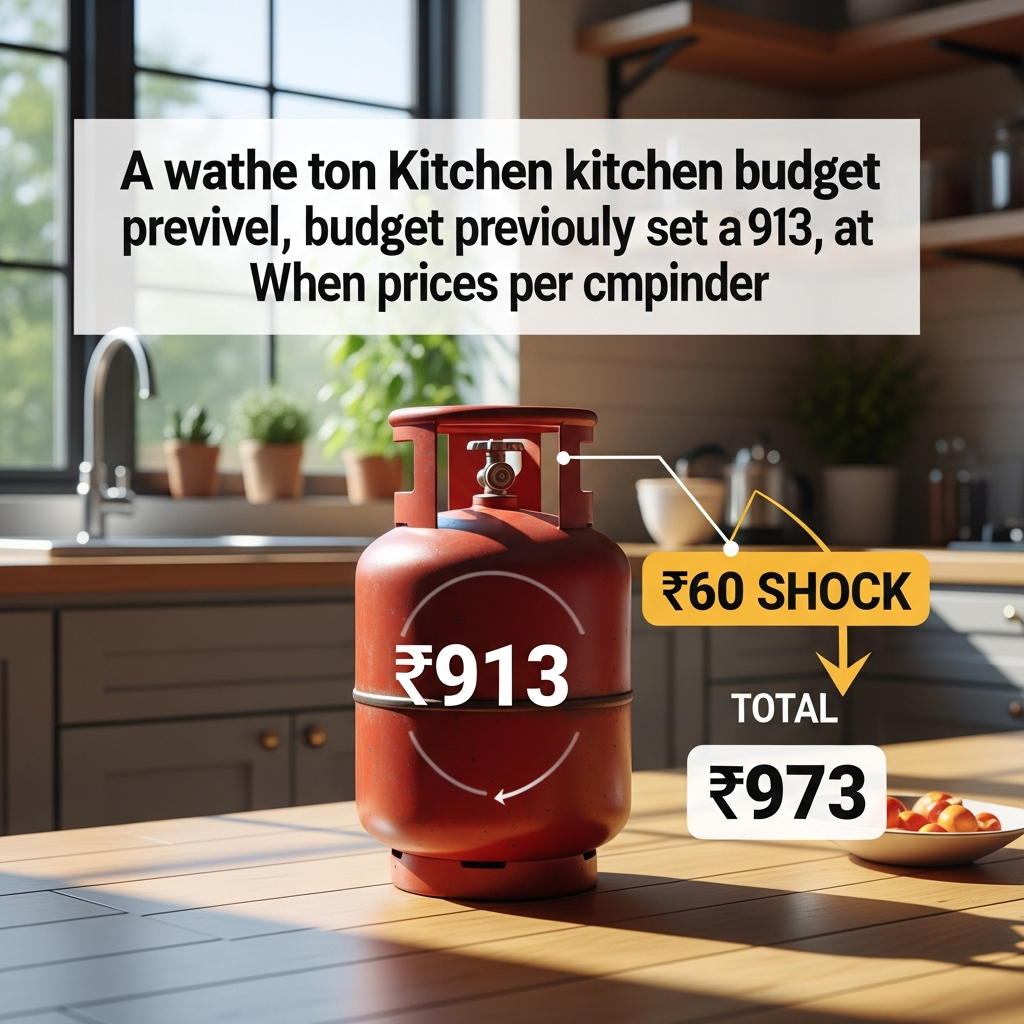
The smell of dal cooking on the stove. The sound of a pressure cooker whistling. The soft hiss of an LPG burner lighting up at 7 in the morning. Cooking gas isn’t just a utility for hundreds of millions of Indian homes; it’s the heart of the kitchen. And today, that heartbeat costs a little more.
Starting today, the price of a domestic LPG cylinder has gone up by ₹60, making the price in most major cities about ₹913 per cylinder. That’s an extra ₹120 leaving the house every 30 days for a middle-class family that fills up two cylinders a month. They could have used that money for vegetables, school supplies, or just to save a little.
What Triggered This Hike?
The short answer: war, oil, and the ocean between them.
The escalating conflict in West Asia has rattled global energy markets with a ferocity not seen in recent years. When tension flares in the Gulf region — home to some of the world’s largest oil and gas producers — supply chains get nervous, tanker routes get rerouted, and crude oil prices spike almost reflexively.
But this time, the anxiety runs deeper. Reports have emerged of U.S. submarines targeting Iranian vessels in the Indian Ocean, a development that has sent shockwaves through international shipping lanes. The Indian Ocean is not just geography — it is the artery through which India receives a significant portion of its crude oil imports and LPG supply. Any disruption there directly feeds into what oil marketing companies (OMCs) like Indian Oil, Bharat Petroleum, and Hindustan Petroleum calculate as their “supply risk premium.”
In plain terms: when the world feels unstable, fuel costs more. And right now, the world feels very unstable.
The Real Impact: A Kitchen Budget Under Stress
Let’s be honest about who bears the brunt of this hike.
It isn’t the wealthy family ordering restaurant meals three times a week. It is the salaried worker in Nagpur who carefully tracks every cylinder booking. It is the small dhaba owner in Ludhiana who runs his entire operation on commercial gas and is already squeezed by rising vegetable prices. It is the homemaker in Chennai who stretches a cylinder for six weeks to save money, cooking on lower flames and covering pots religiously.
The ₹60 hike may look modest on paper. But in a country where per capita income in many states barely crosses ₹15,000 a month, a ₹913 cylinder is not a small ask. And this comes on top of already elevated food inflation, rising electricity tariffs in some states, and a general cost-of-living squeeze that has been building quietly for months.
For BPL (Below Poverty Line) households enrolled under the Pradhan Mantri Ujjwala Yojana (PMUY), the burden is sharper still. While subsidized refills exist under the scheme, the gap between the subsidized amount and the market price has widened, making every refill a financial decision, not a routine task.
The Global Chain That Ends at Your Stove
Understanding why your cooking gas costs what it does requires a quick look at the chain connecting West Asian oil fields to your kitchen burner.
India imports roughly 60% of its LPG requirements. The pricing is benchmarked against Saudi Aramco’s Contract Price (CP), which itself tracks global crude and naphtha markets. When international LPG prices rise — as they have sharply in recent weeks amid the West Asia conflict — domestic prices follow, though often with a slight lag as OMCs absorb some shock before passing it on.
The rupee-dollar exchange rate adds another layer. A weaker rupee means India pays more for every barrel of imported energy, even if global prices stay flat. Combine a volatile rupee with spiking global LPG prices and you get exactly what we’re seeing today: a ₹60 jump that feels sudden but has been building for weeks.
When Might Prices Cool Down?
This is the question on every household’s mind — and the answer, frustratingly, depends on factors far beyond India’s control.
Best-case scenario: A ceasefire or de-escalation in West Asia could ease supply fears within weeks, bringing international LPG contract prices down by October–November. If global crude dips below $80 per barrel sustainably, domestic prices could see a rollback of ₹30–40 by early next quarter.
Realistic scenario: Tensions remain elevated through the year, keeping global energy prices in a volatile band. Domestic prices may hold at current levels or see another small hike before the situation stabilizes.
Worst-case scenario: If the conflict widens and Indian Ocean shipping lanes are genuinely disrupted, India could face both supply constraints and significantly higher import costs — a scenario that could push LPG prices well past ₹950 per cylinder.
The government has limited fiscal room to absorb shocks through subsidies the way it once did, especially in a non-election year. Consumers should plan for prices to remain elevated at least through the next two months.
What Can You Do Right Now?
While geopolitics is beyond your control, a few practical steps can soften the blow:
- Book early to avoid peak demand windows when stock runs thin in your locality.
- Switch to induction cooking for low-heat tasks like boiling water or reheating — it reduces LPG consumption significantly.
- Check your PMUY eligibility if your household income qualifies for subsidized cylinders.
- Use the PAHAL/DBT subsidy portal to ensure your direct benefit transfer is active and updated.
The kitchen crisis is real. But it is also, hopefully, temporary — tied to a geopolitical storm that the world is working, however haltingly, to resolve. Until then, cover your pots, cook on medium flame, and know that millions of households across India are doing the same math you are.

