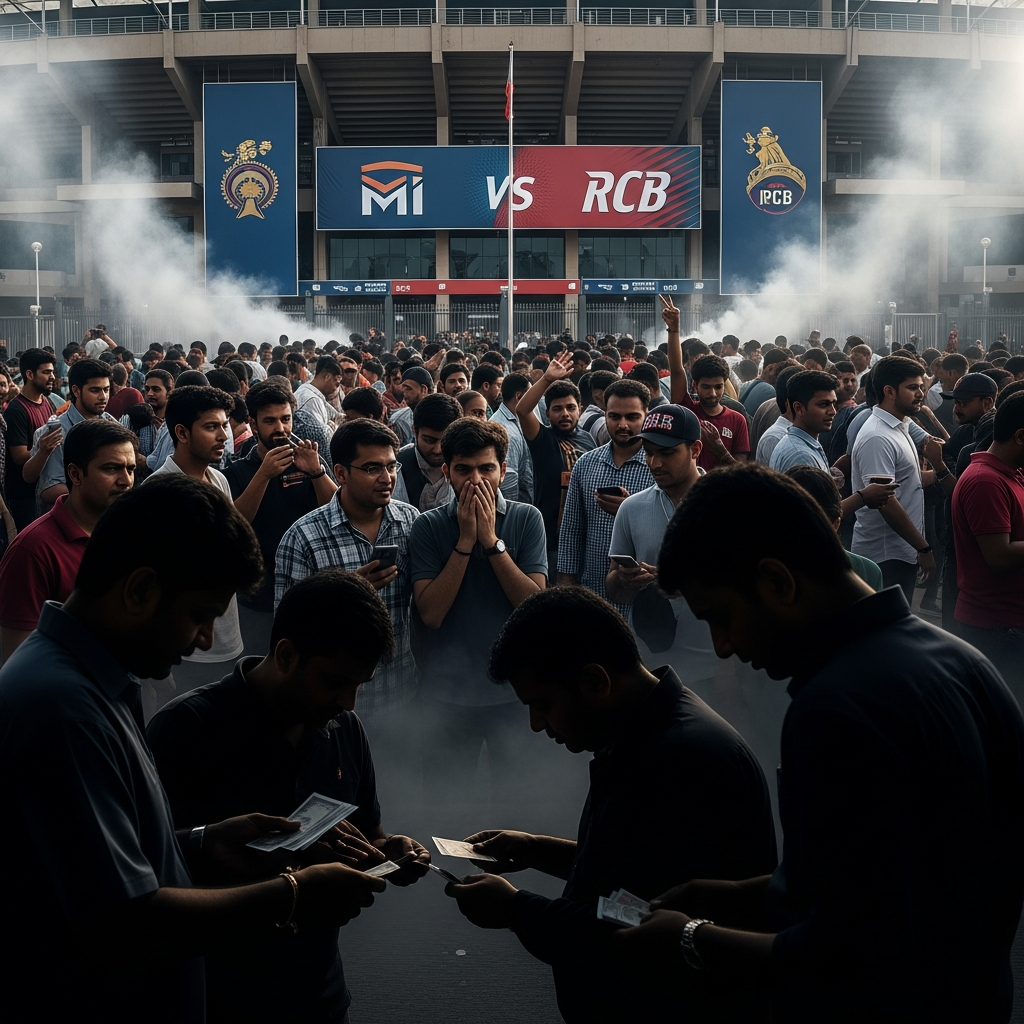
There are few things in Indian sport that carry the emotional weight of an MI vs RCB match. It isn’t just cricket. It’s an event. It’s the kind of fixture that stops office conversations mid-sentence, fills family WhatsApp groups with predictions, and turns otherwise calm, rational adults into nervous, superstitious creatures refreshing their phones at odd hours of the night.
So when tickets for this clash sold out in what felt like the blink of an eye — only to reappear minutes later on third-party platforms for ₹1 lakh or more — the anger that erupted online was entirely predictable. And entirely justified.
Gone in Seconds, Back for a Price
If you tried to buy a ticket through official channels this season, you already know how this story goes. The sale opens. The website slows to a crawl or crashes outright. You wait in a virtual queue that moves with the urgency of a government office on a Friday afternoon. And then, just as you get close, the tickets are gone.
Not gone because 40,000 fellow fans got there first. Gone because a significant portion of available inventory appears to have been absorbed — through means that remain conveniently opaque — by resellers who have no intention of watching the match. Their intention is profit. And with IPL ticket prices for MI vs RCB climbing to obscene heights on unofficial platforms, profit is exactly what they’re getting.
Fans have been sharing screenshots across social media showing third-party ticket listings for this fixture at anywhere from ₹25,000 for basic stands to over ₹1 lakh for premium seats. These are not hospitality packages or exclusive experiences. These are regular match tickets. Bought for a fraction of the price and flipped for sums that most working Indians simply cannot afford.
The Human Cost of Ticket Scalping
It’s easy to frame IPL ticket scalping as a minor inconvenience — the kind of thing that draws Twitter complaints and then fades away. But that framing ignores who actually gets hurt.
The fans who lose out most aren’t the ones who can absorb a ₹1 lakh expense without blinking. They’re the ones who saved up, took time off work, promised their kids a live match experience, or travelled from another city specifically for this game. They’re the college students who refreshed the booking page forty times. The middle-class families for whom a live IPL match is a genuine treat, not a casual outing.
For these fans, the IPL ticketing crisis isn’t an abstract problem. It’s a locked door with a ridiculous price tag on the other side. And the people who put that price tag there didn’t earn it — they gamed a broken system.
A System That Seems Built to Fail Fans
Here’s what makes this situation so infuriating: none of it is accidental. The conditions that enable ticket touting IPL matches at these prices exist because the systems meant to prevent it are either inadequate or unenforced.
Official platforms lack robust verification mechanisms to stop bulk purchases. There is no serious cap on how many tickets a single account or device can buy. There is no meaningful secondary market regulation that prevents resale above face value. And there is no transparent public accounting of how many tickets actually enter the general sale versus how many are allocated to corporates, sponsors, hospitality packages, and other channels before the average fan even gets a look in.
The result is a booking experience that feels less like a fair queue and more like a lottery — one where some participants have clearly been given better odds.
BCCI and the franchise ecosystem have built IPL into one of the most valuable sporting properties on the planet. The Mumbai Indians vs RCB fixture alone generates media coverage, advertising revenue, and cultural conversation that most sports organisations can only dream of. And yet the mechanism for getting actual fans into the actual stadium feels like it was designed in 2009 and never seriously revisited.
What Fans Are Demanding
The IPL fan outrage spilling across social platforms right now isn’t just venting. Buried within it are some very reasonable demands.
Fans want transparent ticket allocation — a public breakdown of how many seats go to general sale versus other channels. They want genuine purchase limits enforced technically, not just stated in terms and conditions nobody reads. They want official secondary market options that allow resale at or near face value, removing the incentive for scalpers to dominate the space. And they want actual consequences for platforms that knowingly facilitate above-face-value resale of sports tickets.
None of these are radical asks. Several European football leagues and music event organisers have implemented versions of these protections with real success. The technology exists. The will to use it is what’s missing.
Cricket Belongs to the Fans — Or It Should
There’s a version of this story where IPL organisers look at the chaos of every ticket sale and see validation — proof of how desperately people want to attend their product. That reading is dangerously self-satisfied.
The desperation fans feel isn’t a compliment to the system. It’s an indictment of it. When genuine supporters are priced out by scalpers and left watching from their couches while ₹1 lakh tickets sit in the hands of resellers, something fundamental has gone wrong.
MI vs RCB is more than a cricket match. It deserves better than this. More importantly, the fans who make it what it is deserve better than this.
The stands should be filled with people who earned their seat by loving the game — not by gaming a broken booking system.