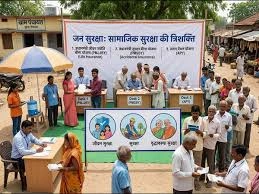
India’s Jan Suraksha schemes have crossed a meaningful milestone, with the government marking 11 years since the launch of PMJJBY, PMSBY and APY. Together, these programmes have become one of the country’s most visible efforts to extend low-cost life insurance, accident cover and pension support to millions of ordinary citizens.
A social security push with mass reach
Launched on May 9, 2015, the three Jan Suraksha schemes were built around a simple idea: make financial protection affordable enough for people who usually stay outside the formal safety net. That includes workers in the unorganised sector, small account holders, daily wage earners and low-income families who often have little room to absorb a medical shock, accident or sudden loss of income.
The scale is what makes the story stand out. According to the government figures highlighted this week, PMJJBY has crossed 27 crore enrolments, PMSBY has moved past 58 crore, and APY has recorded more than 9 crore enrolments. Claims settled since launch have also reached a large cumulative amount, showing that these are not just enrolment-heavy schemes on paper, but active financial support systems in real life.
What each scheme does
The three programmes serve different needs, and that is part of their strength. PMJJBY offers life insurance cover, PMSBY provides accident insurance, and APY is designed to create a retirement income stream for workers who may not have any pension at all.
A quick snapshot helps clarify the difference:
PMJJBY: life cover for death due to any cause, for savings account holders in the eligible age group.
PMSBY: accidental death and disability insurance at a very low annual premium.
APY: a pension scheme that promises a monthly pension after age 60, depending on contribution level.
That combination matters because India’s social security gaps are not all the same. Some families need immediate support after a death. Others need help after an accident. Millions more need a retirement buffer. The Jan Suraksha framework tries to touch all three problems at once.
Why the schemes matter now
The timing of the 11-year milestone is important. India’s informal workforce remains large, household savings continue to face pressure from inflation and health costs, and many families still do not have a formal insurance habit. In that setting, schemes with very low premiums and easy access through banks and post offices can become the first line of protection rather than the last.
For policymakers, the appeal is obvious. These schemes widen financial inclusion without asking citizens to navigate expensive products or complex paperwork. For households, the appeal is even simpler: for a small annual payment, they get some protection against events that can otherwise wipe out years of savings. How many families can afford to self-insure every unexpected shock? Very few.
Premiums and cover
The affordability factor is central to the Jan Suraksha model. PMJJBY provides Rs 2 lakh life cover, while PMSBY offers Rs 2 lakh in case of accidental death or total disability and Rs 1 lakh for partial disability. APY, meanwhile, gives subscribers a guaranteed monthly pension between Rs 1,000 and Rs 5,000 after the age of 60, depending on contribution.
The schemes are distributed through participating banks and post offices, which has helped them scale quickly across states and income groups. That distribution model has also made them part of the broader push for financial inclusion in India, especially for people who may already have a savings account but not much else in the way of formal protection.
Claims and real-world impact
The headline numbers become more meaningful when seen through claims settlement. According to the government updates reported this week, PMJJBY has accounted for more than Rs 21,500 crore in claims, benefiting over 10.7 lakh families. PMSBY has paid close to Rs 3,660 crore to more than 1.84 lakh families.
Those figures matter because they show the schemes working in the moments that count most. A claims payout after a death or accident is not abstract policy success; it is money that can help a household pay for basic expenses, manage debt, or stay afloat during a crisis. That is the kind of impact that rarely makes a loud headline but changes lives quietly.
India’s wider financial inclusion story
Jan Suraksha is also part of a larger shift in India’s financial architecture. Over the past decade, the country has seen deeper banking access, wider digital account usage, and greater awareness of formal savings and insurance products. The Jan Suraksha schemes fit neatly into that shift because they use existing banking rails instead of requiring a brand-new system.
That design has two advantages. First, it lowers distribution costs. Second, it makes the schemes familiar and easy to integrate into daily banking behaviour. For a customer who already uses a savings account, the jump to an auto-debit insurance or pension scheme is far easier than buying a standalone policy from scratch.
The policy challenge ahead
Even with strong numbers, the deeper challenge is not only enrolment but retention, awareness and meaningful coverage. A scheme can touch millions of accounts, but if subscribers do not understand the benefit structure or renew on time, the protection can weaken quickly. That is a familiar issue in mass welfare and insurance programmes alike.
There is also the question of whether the coverage amounts keep pace with rising costs. Rs 2 lakh may still be a meaningful sum for a sudden loss, but in many urban and semi-urban settings, the financial damage from a serious event can easily exceed that. Should social protection products stay ultra-low-cost even if the cover feels modest, or should they gradually evolve into deeper protection? That debate is likely to intensify as the schemes mature.
What the milestone signals
The 11-year mark shows that Jan Suraksha has moved from a launch-phase idea to an established part of India’s social protection landscape. The schemes have reached large-scale enrolment, generated substantial claims payouts and become a familiar name in the public finance conversation. That is not a small achievement in a country as large and diverse as India.
At the same time, the milestone also raises a broader question about the next phase of financial security in India. Coverage expansion is important, but so is depth of protection, awareness at the household level and long-term trust in the system. The Jan Suraksha schemes have built a foundation. The next test is whether that foundation can support a stronger and more resilient social security net in the years ahead.
11 Years of Jan Suraksha Schemes: How PMJJBY, PMSBY and APY Built India’s Affordable Social Security Net