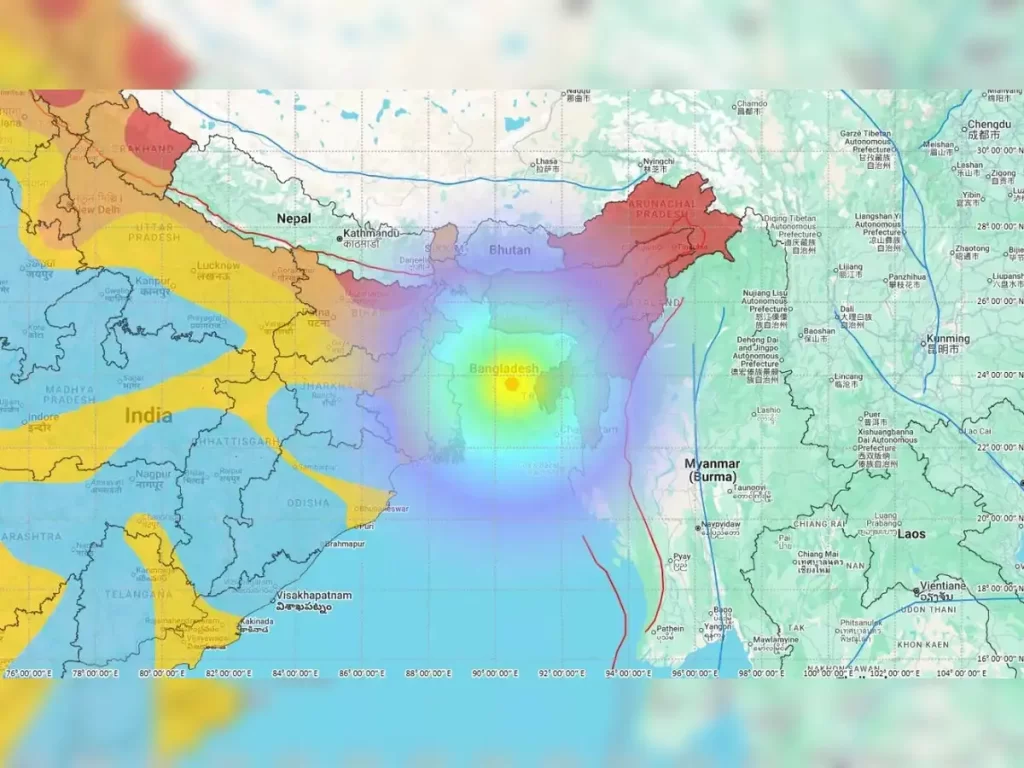
A significant seismic event rocked central Bangladesh on Friday morning, as a 5.7‑magnitude earthquake struck near the district of Narsingdi at approximately 10:08 AM local time. The tremor, occurring at a relatively shallow depth of about 10 km, sent shockwaves across neighbouring eastern India, with residents of cities such as Kolkata and parts of the Northeast reporting strong shaking. In Bangladesh, the quake caused multiple casualties and prompted urgent emergency responses.
The earthquake’s epicentre was pinpointed about 13 kilometres south‑southwest of Narsingdi, with a hypocentral depth of approximately 10 km — a factor that often amplifies the felt intensity of shaking. At least six people have died in Bangladesh, with dozens injured as buildings — especially older or inadequately reinforced structures — experienced damage or collapse. In one tragic instance, the railing of a five‑storey building gave way in the Bongshal area of Dhaka, killing three pedestrians.
In India, the effects were felt most strongly in West Bengal and the Northeast. Many residents in Kolkata and surrounding districts rushed out of homes and workplaces as a precaution. Although there are no immediate reports of structural damage or casualties within India, the incident underscores the shared seismic risk in this region.
Key Details at a Glance:
| Parameter | Detail |
|---|---|
| Magnitude | 5.7 |
| Depth | ~10 km |
| Epicentre | ~13 km SSW of Narsingdi, Bangladesh |
| Time of Occurrence | Around 10:08 AM local |
| Casualties (Bangladesh) | At least six dead |
| Reported Effects in India | Tremors felt, no major damage confirmed |
Analysis and Context:
This seismic event highlights the vulnerability of the Bengal-Bangladesh region to earthquakes, even those of moderate magnitude. While Bangladesh and eastern India are not typically associated with the highest magnitude quakes globally, the proximity of population centres to tectonic boundaries — where the Indian Plate converges with the Eurasian and Burma micro-plates — elevates risk. The shallow depth of this quake exacerbated its impact, causing more intense shaking at the surface.
The fact that tremors were widely felt beyond Bangladesh’s borders serves as a reminder of the transnational nature of seismic risk. For urban centres in India such as Kolkata, which host dense populations and ageing infrastructure, this event may act as a wake-up call for disaster preparedness and retrofitting of vulnerable buildings.
As emergency teams in Bangladesh assess damage and respond to injured citizens, and as authorities in India monitor for any aftershocks or secondary effects, the broader implication is clear: seismic awareness and structural resilience must be priority areas in South Asia’s planning frameworks. While today’s quake did not trigger major damage in India, the regional ripple-effect underlines the need for cross-border coordination, robust building standards, and public safety systems. Heightened vigilance remains essential in the coming days.