
Introduction:
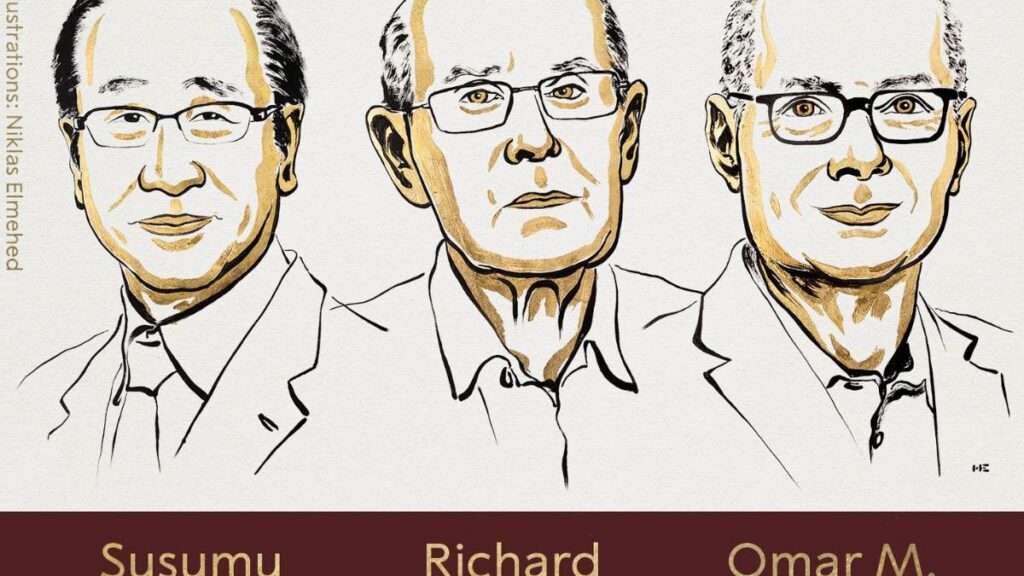
The 2025 Nobel Prize in Chemistry has been awarded to Susumu Kitagawa, Richard Robson, and Omar M. Yaghi for their groundbreaking research in the development of metal-organic frameworks (MOFs). These innovative materials, known for their extraordinary porosity, have opened new avenues in chemistry, environmental science, and technology.
Innovative Molecular Architecture:
Metal-organic frameworks are crystalline structures where metal ions are connected by organic molecules, creating intricate networks with large internal cavities. These frameworks possess exceptional properties, including the ability to capture and store gases, enhance chemical reactions, and conduct electricity. Their versatility has led to applications in carbon dioxide capture, water extraction from arid environments, and purification of toxic substances from water.
Richard Robson first laid the foundation for MOFs in 1989 by combining copper ions with organic linkers, establishing the structural principles of these materials. Later, Susumu Kitagawa and Omar Yaghi expanded this research by improving the stability and functionality of MOFs, enabling practical applications across multiple industries.
Environmental and Technological Impact:
MOFs have significant potential for environmental sustainability and technological advancement. They can capture greenhouse gases such as carbon dioxide, which helps combat climate change. Additionally, MOFs can harvest water from desert air, offering solutions to water scarcity in arid regions. Their capacity to store gases like hydrogen and methane also presents opportunities in energy storage and transportation, marking a major step forward in clean energy technologies.
Global Recognition and Future Prospects:
The Nobel Committee recognized the laureates for creating materials with unique internal cavities that can interact with specific molecules. This breakthrough allows the design of customized materials with new and precise functionalities. The awarding of the Nobel Prize highlights the transformative impact of MOFs on modern chemistry and materials science.
As research in this field continues, MOFs are expected to provide innovative solutions to some of the most pressing global challenges, ranging from climate change mitigation to sustainable energy and water management.
Conclusion:
The 2025 Nobel Prize in Chemistry celebrates the remarkable achievements of Susumu Kitagawa, Richard Robson, and Omar M. Yaghi. Their pioneering work on metal-organic frameworks has not only advanced scientific knowledge but also created practical tools that address critical global issues. This recognition marks a milestone in the pursuit of sustainable, innovative solutions in chemistry and beyond.

