
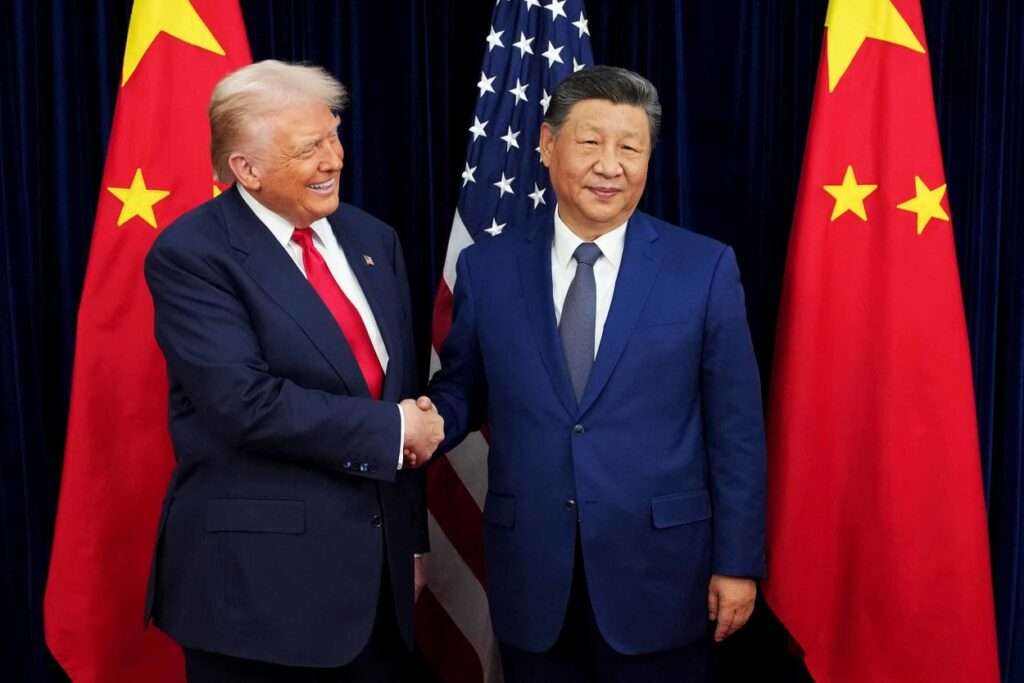
On Thursday, 30 October 2025, U.S. President Donald Trump and Chinese President Xi Jinping met in the South Korean port city of Busan on the sidelines of the Asia-Pacific Economic Cooperation (APEC) Summit. It marked their first face-to-face encounter since Trump’s return to the White House in January and arrived amid renewed tensions over trade, tariffs, and critical raw-materials supply. Both sides described the meeting as an opportunity to stabilise relations between the world’s two largest economies.
The Trump-Xi rendezvous came after months of escalating strain between Washington and Beijing. The United States had threatened sweeping tariffs—up to 100 percent—on Chinese imports in response to China’s newly expanded controls over rare-earth minerals vital to high-tech manufacturing. In turn, China signalled a willingness to delay those export curbs and resumed purchasing U.S. soybeans, moves widely seen as tactical de-escalation ahead of the summit.
President Trump, ahead of the meeting, described Xi as a “very tough negotiator” and suggested that a trade deal “could be” signed during the talks. In his remarks, Xi emphasised that “friction is natural” but insisted that U.S.–China ties “must be on the right course.” Both leaders appeared intent on projecting optimism despite deep-rooted policy divides. The agenda covered tariffs, export controls on rare-earth elements, U.S. demands for Chinese cooperation on fentanyl interdiction, and the global supply-chain disruptions stemming from their economic rivalry. The meeting, held at a modest facility on a South Korean military base, offered a pragmatic yet symbolic backdrop for what could become a pivotal diplomatic moment.
Analysts caution, however, that while the summit offers short-term relief in the trade standoff, deep-seated strategic competition remains unresolved. Observers note that the emerging framework appears to be “short-term stabilisation dressed up as strategic progress.” For global markets, the impact was immediate: equities and commodity prices showed signs of relief following news of the meeting, reflecting hopes that the world’s two largest economies may be moving toward a trade-war truce.
The Busan meeting between President Trump and President Xi represents a potential turning point in U.S.–China relations. While the discussions opened the door to a possible trade deal and signalled a willingness on both sides to manage escalation, the underlying structural tensions—ranging from technology competition to supply-chain decoupling and geopolitical rivalry—remain unresolved. The success of the summit will depend not on diplomatic statements but on whether both nations can translate rhetoric into tangible policy action. For global businesses and observers alike, the focus now turns to the negotiating teams tasked with transforming this moment of cautious optimism into a sustainable economic framework.

