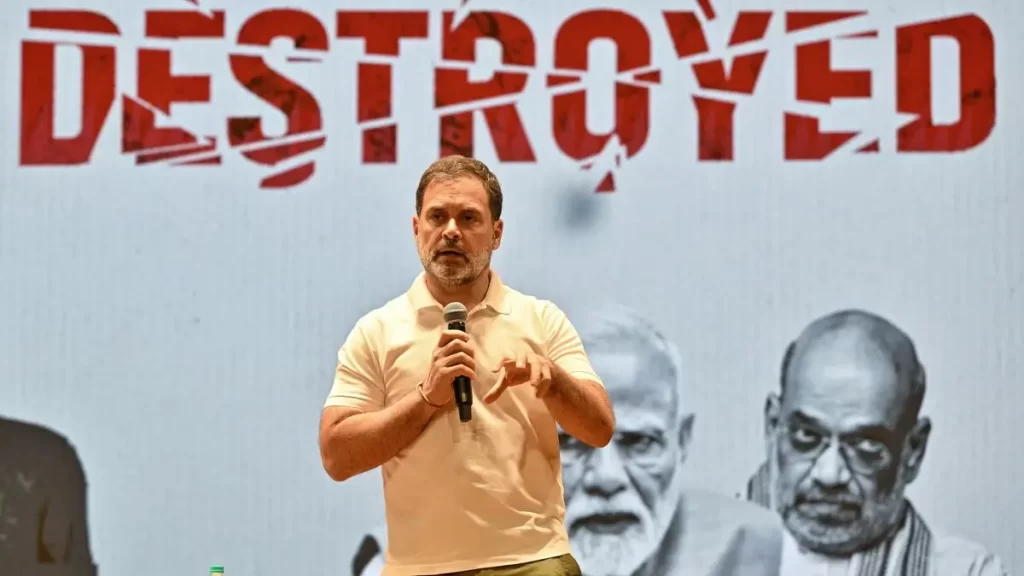
In a dramatic address on Wednesday, Congress leader Rahul Gandhi accused the Election Commission of India (ECI) and the ruling Bharatiya Janata Party (BJP) of “criminal fraud” in the recent Haryana Assembly elections. Gandhi claimed that around 25 lakh votes in the Haryana polls were bogus—equivalent, he said, to one in every eight voters in the state. Among his most startling allegations was that a stock photo of a Brazilian model had been used to create multiple voter IDs, appearing 22 times across different booths under various names.
Gandhi described the alleged manipulation as a “state-wide centralised operation” aimed at undermining the democratic process. According to him, about 2.5 million fake voters were listed in Haryana’s electoral rolls, representing roughly 12.5 percent of the state’s two-crore electorate. He further alleged that the same photograph—belonging to a Brazilian model—was used to cast votes 22 times in ten different polling booths, under names such as “Seema,” “Sweety,” and “Saraswati.”
The Congress leader also pointed to discrepancies between postal votes and the final booth results. He claimed that in several constituencies, Congress had secured a higher number of postal ballots but eventually lost in the final tally, suggesting tampering during the counting process. Gandhi asserted that the Election Commission’s inaction and silence amounted to collusion with the ruling party, accusing the BJP of “stealing” the mandate through systematic voter fraud.
In his address, Gandhi questioned how exit polls that initially favoured the Congress turned into results showing a BJP lead after the final count. He demanded a comprehensive forensic investigation into the voter list and the counting process, insisting that the issue was “not about one election but about the future of Indian democracy.” His remarks quickly gained traction on social media, with hashtags like #VoteChori and #HaryanaElections trending nationwide.
The BJP and the Election Commission of India swiftly dismissed the allegations as “false, baseless, and politically motivated.” ECI sources noted that the Congress party had filed no official objections during the voter roll verification phase, raising doubts about the timing and intent of Gandhi’s claims. BJP leaders accused the Congress of spreading misinformation to divert attention from its poor electoral performance. Senior BJP figures, including Deputy Chief Minister Devendra Fadnavis, referred to Gandhi as a “serial liar,” arguing that his statements were designed to discredit India’s democratic institutions ahead of upcoming state elections.
Political analysts have observed that the gravity of Gandhi’s allegations, if proven true, could have far-reaching consequences for public trust in India’s electoral process. They note that voter roll integrity and election transparency have become recurring concerns, particularly with the rise of digital manipulation and identity fraud. However, experts caution that such claims must be verified through proper legal channels and independent investigations before drawing conclusions.
Rahul Gandhi’s accusations have reignited national debate over the credibility of India’s election machinery. As both the BJP and Congress prepare for high-stakes contests in states like Bihar, the controversy has placed the Election Commission under increased scrutiny. The demand for greater transparency in voter verification, booth management, and result auditing is likely to dominate political discourse in the coming months. Whether Gandhi’s “vote chori” allegations lead to official action or fade amid political rhetoric remains to be seen, but the issue has already cast a shadow over the trust that underpins India’s democratic system.