
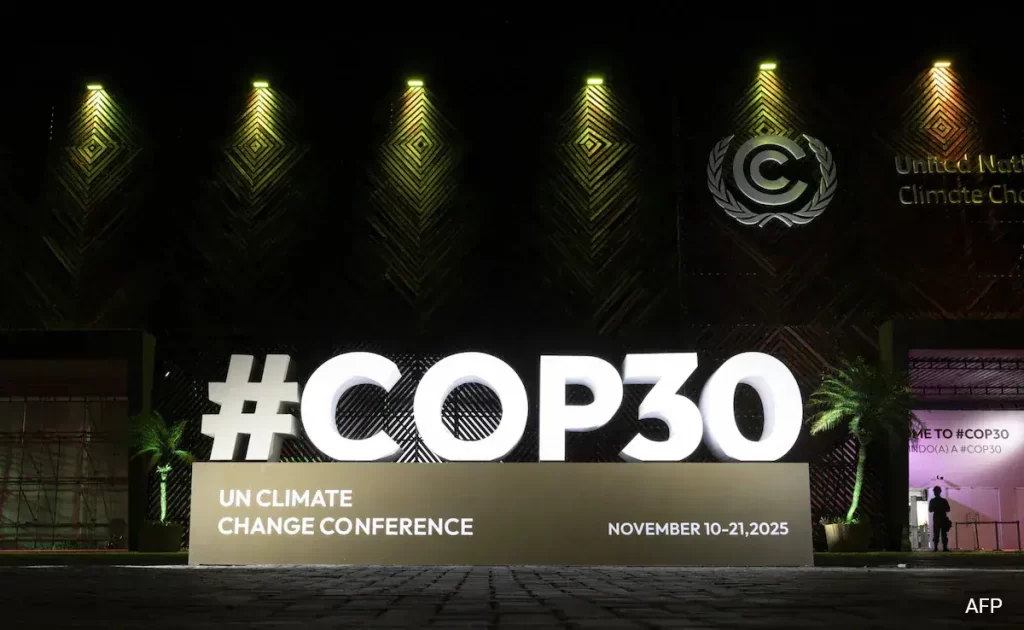
At the COP30 climate summit held in Belém, Brazil from 10-21 November 2025, India reaffirmed its climate commitments and announced that it will join the newly launched Tropical Forests Forever Facility (TFFF) as an observer. With global attention on tropical-forest preservation and nature-based solutions, India’s move underscores its support for multilateral environmental cooperation and forest-finance innovation.
The Tropical Forests Forever Facility, a Brazil-led blended finance mechanism, aims to mobilise approximately USD 125 billion to protect tropical and subtropical moist broadleaf forests. Under this mechanism, returns from capital-market investments will generate payments to eligible forest countries that maintain or increase forest cover, thereby shifting the paradigm from short-term grants to long-term performance-based compensation.
At the Leaders’ Summit ahead of COP30, India’s Ambassador to Brazil, Dinesh Bhatia, delivered India’s statement reaffirming the country’s commitment to climate action rooted in the principle of “common but differentiated responsibilities and respective capabilities” (CBDR-RC). India highlighted its progress in reducing emission intensity, reporting a 36 % reduction between 2005 and 2020. Non-fossil fuel power capacity now accounts for over half of India’s total installed capacity, and the country achieved its revised Nationally Determined Contribution (NDC) targets ahead of schedule. India has also expanded its forest and tree cover, creating an additional carbon sink of more than 2.29 billion tonnes of CO₂ equivalent between 2005 and 2021.
By joining the TFFF as an observer, India signals its intent to collaborate internationally in forest-conservation finance, while emphasising that developed countries must honour their climate-finance commitments, accelerate emission cuts, and support adaptation and resilience for developing nations.
Brazil has taken a leading role in shaping this global initiative. The TFFF launch declaration has already been endorsed by 53 countries, including 19 potential sovereign investors, with initial pledges exceeding USD 5.5 billion. This initiative marks a significant shift in how tropical-forest countries are compensated, moving away from traditional aid to finance mechanisms that treat intact forests as natural capital.
For India, participation in the TFFF aligns with its own environmental priorities, including expanding forest cover and accelerating renewable-energy adoption. With a renewable-energy capacity nearing 200 GW, India ranks as the world’s third-largest producer. The country’s involvement also builds upon its leadership in south-south cooperation through global climate partnerships such as the International Solar Alliance.
Analysts note that for the TFFF to achieve its goals, it must attract both public and private investment, establish transparent monitoring mechanisms, and ensure that financial benefits reach Indigenous and local communities rather than remaining at the national-government level. India’s observer status allows it to participate in the governance and rollout of the facility while retaining flexibility in its domestic climate strategies.
Ambassador Bhatia stated that India stands ready to collaborate with all nations in ways that are ambitious, inclusive, fair, and equitable, based on the principles of CBDR-RC and national circumstances. This position highlights India’s consistent call for equity and fairness in global climate negotiations.
India’s decision to join the Tropical Forests Forever Facility as an observer at COP30 reinforces its dual commitment to forest preservation and equity-based climate action. As the facility seeks to channel large-scale finance into forest conservation, India’s engagement reflects both its growing climate leadership and its insistence that ambition must go hand in hand with fairness and support for developing countries. With the eyes of the world on Belém and the Amazon basin, the TFFF’s success could mark a turning point in global forest finance—and India’s role may well prove significant in shaping that transition.

