
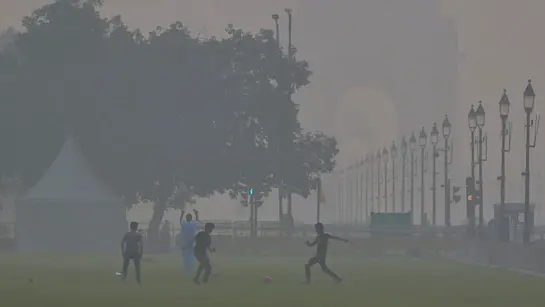
The air quality in the national capital region has shown a slight improvement, prompting the Commission for Air Quality Management (CAQM) to decide against implementing Stage 3 of the Graded Response Action Plan (GRAP) for now. Yet despite this reprieve, the situation remains serious: Delhi’s air quality remains entrenched in the “very poor” category as of Monday morning, November 10, 2025.
According to official data, the capital recorded an Air Quality Index (AQI) reading in the “very poor” band (301–400) across multiple monitoring stations. While this marks a marginal improvement compared with earlier peaks, it remains far from safe levels. Authorities note that although the AQI has not crossed into the “severe” category (401+) that would automatically trigger Stage 3 of the GRAP, the margin is narrow and the risk remains elevated.
The CAQM and its sub-committee reviewed meteorological forecasts and pollution trends and concluded that despite the hazardous context, conditions do not yet warrant the activation of Stage 3 restrictions. They cited favourable—but still fragile—improvements in wind speed and pollutant dispersion, along with a relatively lower contribution of agricultural stubble burning compared with previous years. The decision underscores a balancing act: avoid overly restrictive measures prematurely while staying ready to scale up if air quality worsens.
Winter-time weather inversion, slow wind speeds, and regional emission sources continue to hamper clean-air efforts in Delhi. Though this November appears to show better readings compared with the same period in 2024, the situation is still worrying. Furthermore, experts warn that even small shifts in wind patterns or emission loads could push the AQI into the “severe” zone, triggering tougher curbs.
Holding off on Stage 3 means that businesses, vehicles, and public institutions will not yet face the stricter restrictions associated with that level—such as heavy curtailment of diesel generators, limitations on construction and vehicular use, and possible school closures. However, authorities are maintaining close monitoring and have emphasised that they stand ready to activate Stage 3 at short notice. Citizens are being urged to adopt precautionary behaviour—especially children, the elderly, and those with respiratory or cardiovascular ailments.
While the marginal improvement in Delhi’s air quality offers a brief welcome respite, the situation remains far from secure. The CAQM’s decision to delay invoking Stage 3 of the GRAP reflects cautious optimism—but also recognition of persistent risk. With air quality still firmly in the “very poor” category, sustained vigilance, stricter enforcement of emissions control, and public cooperation are essential if the capital is to avoid slipping back into the “severe” zone. The coming days will be critical in determining whether this trend continues or reverses.

