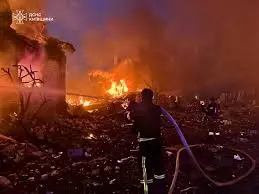
In the early hours of 14 November 2025, intense aerial assaults rocked both the Ukrainian capital of Kyiv and the Russian port city of Novorossiysk, underscoring a significant escalation in the ongoing war between Russia and Ukraine. Ukrainian officials reported that Russian forces launched hundreds of drones and missiles against Kyiv, causing multiple casualties and major infrastructure damage. Meanwhile, Ukrainian forces carried out a drone strike on an oil terminal in Novorossiysk — a key Russian export hub — igniting fires and raising alarms about the widening geographic scale of the conflict.
In Kyiv, Ukrainian authorities reported that at least four people were killed and dozens wounded in a coordinated overnight strike combining drones and guided missiles. Around 430 drones and 18 missiles were used. The attack impacted high‑rise residential blocks, schools, and medical facilities across multiple districts, including Dniprovs’kyi, Desnians’kyi and Podil. Kyiv’s mayor warned of possible disruptions to heating, power and water services as critical utilities were damaged.
On the Russian side, Ukrainian drones struck the Sheskharis oil terminal in Novorossiysk, triggering a significant fire. The terminal, operated by the state‑owned Transneft, is a major node for Russian oil exports via the Black Sea, capable of storing some 820,000 cubic metres of crude. Local authorities reported that debris from intercepted drones caused damage to adjacent apartment buildings and injured crew aboard a civilian vessel.
Analysts note that the simultaneity of these attacks represents a clear shift in both strategic scope and symbolic messaging. Russia appears to be intensifying strikes on Ukrainian urban centres and infrastructure ahead of winter, aiming to undermine civilian morale and utilities. Meanwhile, Ukraine’s ability to reach into Russian territory — especially targeting energy export infrastructure — signals its intent to impose economic as well as military cost on Moscow. The fire at Novorossiysk underscored that even deep‑rear logistic hubs are now exposed.
From a broader perspective, these developments raise pressing questions about the conflict’s trajectory. Western allies of Ukraine, encouraged by Kyiv’s resilience, may feel renewed urgency to boost air‑defence systems, long‑range strike capabilities and sanctions enforcement against Russian energy exports. At the same time, Moscow’s willingness to launch large‑scale attacks on civilian infrastructure suggests an acceptance of higher escalation risks.
The overnight drone and missile offensives that battered Kyiv and struck Novorossiysk mark a pronounced intensification in the Ukraine‑Russia war. With civilian infrastructure in Ukraine under further strain and Russian export hubs increasingly vulnerable, the conflict’s frontiers are no longer confined to the battlefield. As winter looms and diplomatic avenues remain stalled, the humanitarian, economic and strategic stakes are rising sharply. The events of 14 November 2025 reinforce that both sides are now operating with broader theatres of engagement — and the international community will watch closely how allies respond and whether escalation can be contained.