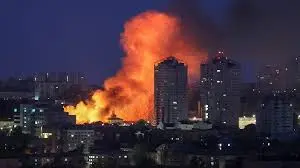
In the early hours of November 14, 2025, the capitals of war‑torn Europe and Russia’s southern Black Sea coast were jolted by simultaneous attacks. The Ukrainian capital of Kyiv was struck by a sustained aerial assault of drones and missiles believed to be launched by Russian forces, while the Russian port city of Novorossiysk came under a retaliatory drone attack by Ukrainian forces targeting a major oil terminal. The twin strikes reflect a sharp intensification in the conflict, signalling both sides are broadening their scope of targets.
According to Ukrainian authorities, the attack on Kyiv involved roughly 430–480 drones and 18 to 18+ missiles launched overnight, targeting residential buildings, schools, medical facilities and infrastructure across nearly every district. The city’s mayor, Vitali Klitschko, reported that at least four civilians were killed and more than 20 injured—including a pregnant woman and children. Fires broke out in multi‑storey apartment blocks, heating networks were disrupted, and power and water supplies faced outages.
The assault appears to form part of a winter strategy by Russian forces to degrade Ukraine’s civil infrastructure and diminish morale, with energy facilities and high‑density urban areas now clearly in the crosshairs.
In parallel, Ukrainian drone strikes hit the Black Sea port of Novorossiysk, where a fire broke out at the Sheskharis oil terminal after drone debris impacted the facility. Russian officials claim three people were wounded in that attack and that more than fifty firefighting units were deployed to contain the blaze.
Together, these attacks underscore that both Kyiv and Moscow are now striking beyond narrow front‑lines. The targeting of energy and logistics hubs, ports, and urban population centres signals a further escalation and a shift to infrastructure‑centric warfare.
The timing of the strikes—just as Europe braces for winter—suggests a deliberate effort to inflict maximum disruption. Ukraine’s leadership has warned that attacks on residential buildings and utility networks are part of an attempt to force societal collapse rather than purely military defeat.
For Russia, degrading Ukraine’s capital and disrupting heating, power and water services ahead of colder months could be aimed at shaping public sentiment, complicating Ukraine’s defence efforts and increasing pressure on its allies. Meanwhile, Ukraine’s counter‑strikes into Russian territory reflect a strategic pivot of its own: moving from defensive posture to one that threatens Russia’s energy export infrastructure and supply chains.
The attacks will likely complicate diplomatic efforts and raise fresh calls from Western states for increased military and economic support to Ukraine. At the same time, Russia may face increased isolation and pressure as its strikes on civilians and infrastructure draw greater scrutiny and condemnation.
The overnight strikes of November 14 mark a significant escalation in the Russo‑Ukrainian conflict. With Kyiv hit by a massive wave of drones and missiles, and Novorossiysk targeted by Ukrainian drones, both sides are clearly moving their battlefields into critical infrastructure and civilian‑heavy spaces. The implications are profound: winter survival, morale, and international support are all on the line. As the conflict evolves, these attacks may well define the next phase—where the war is fought not just on front‑lines, but deep into cities, energy grids and economies.