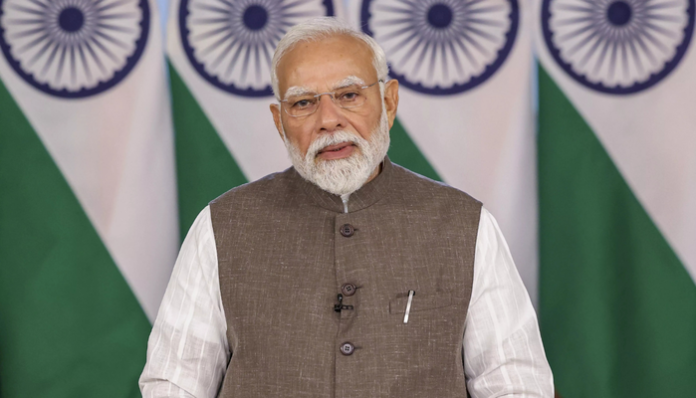
Prime Minister Narendra Modi has ignited a nationwide debate with his call for a “decolonised education” system in India, invoking the legacy of Thomas Babington Macaulay’s 1835 ‘Minute on Education’. Unveiling a 10-year roadmap, the Prime Minister urged citizens and policymakers to dismantle what he described as a “slavery mindset” embedded in the education framework and to revive Indian languages, traditional knowledge systems, and indigenous intellectual heritage.
A Vision to Reclaim India’s Intellectual Legacy
Addressing a large gathering, Modi emphasised the need to break free from the colonial-era ideology that prioritised Western education over India’s own civilisational wisdom. He argued that Macaulay’s system created a hierarchy of languages and knowledge, placing English and Western thought above India’s cultural roots. The Prime Minister clarified that the goal is not to reject the English language but to challenge its dominance as a symbol of colonial inheritance. He pointed to East Asian nations that modernised without relinquishing pride in their native languages, positioning India for a similar transformation.
The Macaulay Legacy and Its Long Shadow
Macaulay’s 1835 policy played a decisive role in shaping modern Indian education, promoting English instruction to create a class of Indians “English in tastes and intellect.” The policy led to the marginalisation of local languages and traditional knowledge systems, effects that scholars argue continue to shape educational preferences and societal attitudes to this day.
In the decades following independence, successive commissions acknowledged the deep imprint of the colonial framework, yet structural reforms remained limited. This enduring legacy forms the backdrop against which the current debate is unfolding.
A Heated National Debate
Modi’s remarks have sparked widespread discussion among historians, educators, and political commentators. Opinions remain sharply divided.
Some experts contend that English-medium education, despite its colonial origins, has served as a powerful tool for social mobility, particularly for marginalised communities. They argue that access to English has expanded opportunities in administration, academia, and global industries.
Others maintain that true educational reform requires a root-level shift away from Western-centric curricula and toward the inclusion of India’s scientific, cultural, and philosophical traditions. Proponents of this view stress that reclaiming indigenous knowledge is essential for restoring cultural confidence and redefining national identity.
Still others caution against any move that may weaken India’s global competitiveness if English proficiency declines without a comprehensive alternative strategy.
Key Themes Shaping the Discourse
| Theme | Core Question | Implication |
|---|---|---|
| Colonial Mindset | Does Macaulay’s system perpetuate cultural inferiority? | Renewed push to value indigenous knowledge |
| Language Hierarchy | Is English a tool for progress or a relic of colonial rule? | Need to balance global access with cultural pride |
| Social Mobility | Has English uplifted marginalised groups? | Risk of limiting access if vernacularisation is rushed |
| Curriculum Reform | Should education reflect Indian civilisational knowledge? | Potential need for large-scale policy overhauls |
Looking Ahead
The Prime Minister’s 10-year pledge aims to align India’s education system with its civilisational ethos by 2045, coinciding with 200 years of Macaulay’s Minute. The plan may involve expanding Indian-language instruction, revising curricula to include traditional knowledge systems, and promoting India’s cultural heritage across academic disciplines.
However, implementation will require careful balancing. Policymakers must ensure that efforts to decolonise education do not inadvertently reduce global competitiveness or restrict access to opportunities linked to English proficiency.