
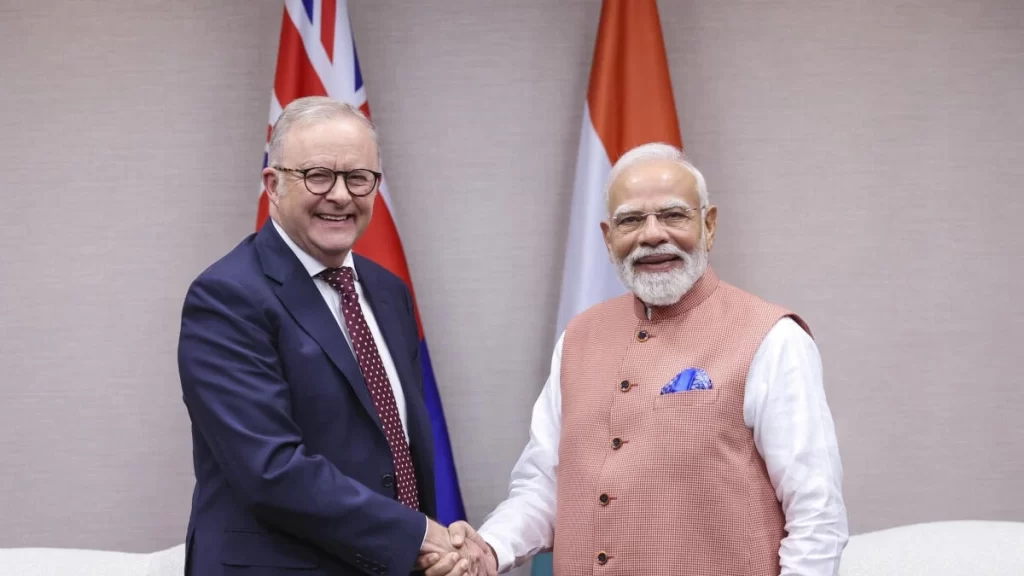
Indian Prime Minister Narendra Modi and Australian Prime Minister Anthony Albanese held a significant bilateral meeting on the sidelines of the G20 Leaders’ Summit in Johannesburg, reaffirming their commitment to deepening cooperation across defence, trade, critical minerals, and strategic technologies. The meeting marked a pivotal moment in the evolution of the India–Australia Comprehensive Strategic Partnership, as both nations seek to strengthen regional stability and economic resilience.
Stronger Strategic and Defence Collaboration
A major highlight of the discussion was the emphasis on expanding defence and security cooperation. Both leaders underscored the importance of enhancing military collaboration through joint exercises, maritime security partnerships, and increased information-sharing. With the Indo-Pacific facing evolving strategic challenges, India and Australia reaffirmed their shared commitment to a free, open, and stable region.
Defence industry cooperation, submarine rescue collaboration, and advanced security frameworks were underscored as key pillars for future engagement. The leaders expressed satisfaction with ongoing defence dialogues and agreed to elevate them further to meet emerging security needs.
Boost to Trade, Critical Minerals, and Technology
Economic partnership remains a driving force in the bilateral relationship. Modi and Albanese reviewed progress in trade and investment flows, noting strong momentum since the elevation of ties to a Comprehensive Strategic Partnership five years ago.
A key focus of the meeting was the strengthening of supply chains for critical minerals, an area where Australia holds strategic importance as a global leader in lithium, cobalt, and rare earth elements. Both nations highlighted the need for diversified, resilient, and future-ready mineral supply networks to support clean energy technologies and defence manufacturing.
In the field of strategic technology, the leaders discussed expanding cooperation in quantum computing, artificial intelligence, cybersecurity, and digital infrastructure. Joint research and innovation initiatives were identified as priority areas for deeper collaboration.
Advancing Energy Partnerships
Energy security and sustainability featured prominently in the talks. The two Prime Ministers reviewed progress under existing renewable energy partnerships and reaffirmed their commitment to scaling up cooperation in solar energy, green hydrogen, and energy storage technologies. Nuclear energy was also discussed as a future domain of cooperation, reflecting the long-term strategic alignment in clean energy ambitions.
Mobility, Education, and People-to-People Links
The leaders recognized the importance of strengthening educational exchange, skills development, and mobility pathways between the two nations. With Australia hosting a significant number of Indian students, both sides highlighted the value of fostering inclusive and future-focused people-to-people ties.
Shared Vision for the Indo-Pacific
Modi and Albanese exchanged perspectives on regional and global developments, reiterating their shared vision for a secure, rules-based Indo-Pacific. They acknowledged the importance of high-level engagement in promoting regional peace, ensuring economic stability, and addressing global challenges such as terrorism, climate change, and supply-chain vulnerabilities.
Key Takeaways from the Meeting
| Area | Strategic Focus |
|---|---|
| Defence & Security | Military cooperation, maritime security, defence industry links |
| Critical Minerals | Strengthened supply chains for clean energy and technological manufacturing |
| Energy | Renewable energy, nuclear collaboration, green hydrogen initiatives |
| Trade & Investment | Expanding market access, mobility, education partnerships |
| Indo-Pacific Strategy | Shared commitment to regional peace, stability, and a rules-based order |

