Introduction
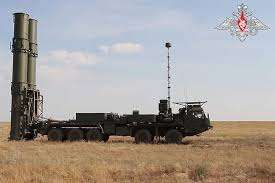
Russia’s introduction of the S-500 “Prometheus” has marked a major shift in global air and missile defence strategy. As nations race to counter hypersonic weapons, long-range ballistic missiles, and emerging space-based threats, the S-500 positions itself as a next-generation system built for an evolving battlefield. While the S-400 Triumf has been widely regarded as one of the most advanced surface-to-air missile systems in the world, the S-500 expands far beyond its predecessor’s capabilities — bridging the gap between air defence, missile interception, and near-space warfare.
Extended Range and Higher Altitude Interception
The most defining difference between the S-400 and S-500 lies in their engagement range and altitude capacity. The S-400, primarily designed for conventional air defence, can neutralize targets at distances up to around 400 kilometres. The S-500 pushes this envelope to an estimated 600 kilometres, allowing it to engage threats far beyond the reach of older systems.
More significantly, its interception altitude reaches near-space levels. While the S-400 is limited to atmospheric targets, the S-500 can reportedly intercept ballistic missiles and other high-speed threats at altitudes approaching 200 kilometres. This capability transforms it from a surface-to-air system into a system capable of countering objects travelling in the upper atmosphere and lower exosphere.
Countering Hypersonic, Ballistic and Space-Based Threats
Modern warfare increasingly involves hypersonic glide vehicles, manoeuvring ballistic missiles, and eventually space-based weapons. The S-400, despite its potency, was not designed to comprehensively counter such threats.
The S-500, however, is engineered specifically for them.
Key advancements include:
- Interception of hypersonic missiles travelling at extremely high speeds and unpredictable trajectories.
- Neutralisation of intermediate-range ballistic missiles, expanding its utility from tactical to strategic defence.
- Potential engagement of low-orbit satellites, reinforcing its role in counter-space operations.
This broad threat engagement capability places the S-500 among the few systems in the world that can simultaneously defend against air, missile, and near-space attacks.
Faster Response and Advanced Radar Systems
Reaction time is another area where the S-500 surpasses the S-400. The Prometheus system features a significantly reduced launch-reaction time, enabling operators to respond to rapidly approaching, high-velocity targets. This improvement is particularly essential in the context of hypersonic weapons, which provide limited warning before impact.
The S-500 also incorporates a new generation of radars capable of detecting stealth aircraft, supersonic missiles, and objects travelling at extreme altitudes. Its multi-band radar architecture allows high-precision tracking of numerous threats simultaneously, offering layered defence performance superior to the S-400’s already advanced radar suite.
Strategic and National Security Implications
While the S-400 is considered a theatre-level defence system ideal for protecting cities, military installations and critical infrastructure, the S-500 is built as a national and strategic shield. It is designed to form the foundation of Russia’s future aerospace defence network, providing coverage that blends missile defence, air defence, and space surveillance capabilities.
For countries exploring long-term air defence strategies, the S-500 represents a leap toward integrated aerospace protection. Its ability to counter hypersonic and near-space threats showcases a global trend in defence modernization — shifting from traditional air defence to holistic multi-domain defence systems.
Conclusion
The S-500 distinguishes itself from the S-400 not merely through incremental enhancements but through a complete redefinition of air and missile defence capability. With its extended range, near-space interception, anti-ballistic and hypersonic engagement features, and lightning-fast reaction time, the S-500 positions itself as a cornerstone of next-generation aerospace defence. As global security challenges evolve, the S-500 reflects Russia’s attempt to stay ahead of future threats — setting a benchmark that is likely to influence defence strategies worldwide.