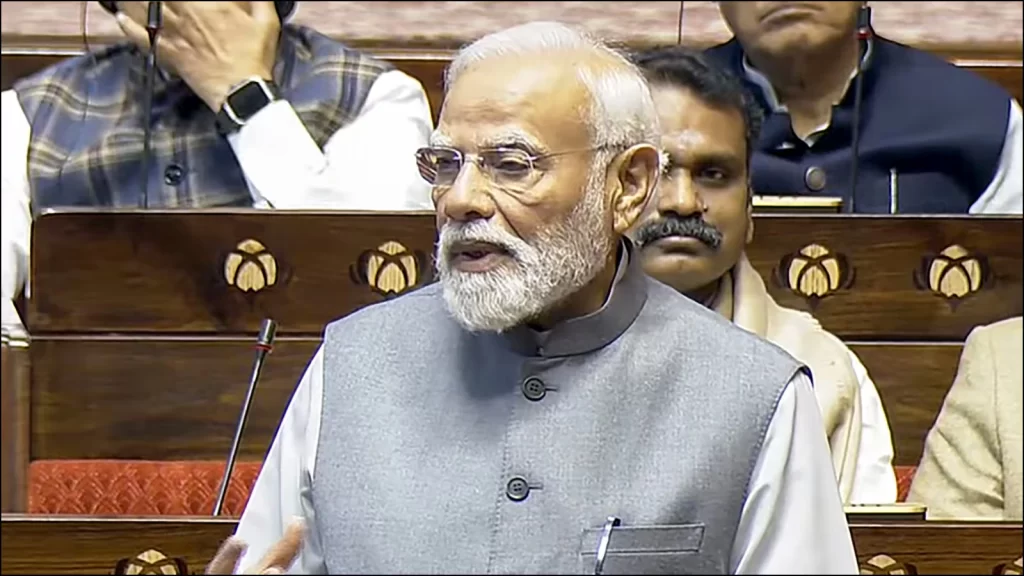
Prime Minister Narendra Modi on Monday triggered a charged debate in the Lok Sabha as the House marked the 150th anniversary of the national song Vande Mataram. The Prime Minister accused the Congress party of committing a “historic injustice” by adopting only the first two stanzas of the song in 1937, arguing that the decision diluted its spirit and contributed to later divisions in the country. The remarks immediately escalated into a sharp political confrontation, with Congress leaders defending the decades-old move as a conscious step toward inclusivity.
Historical Decision Under the Spotlight
Vande Mataram, written by Bankim Chandra Chattopadhyay in the late 19th century, played a defining role in India’s freedom struggle and was first sung publicly at a Congress session in 1896. While the complete composition contains several stanzas rich in devotional and martial imagery, the Congress Working Committee in 1937 approved only the first two stanzas for official use. The remaining verses, containing specific religious references, were excluded to ensure that the national movement remained inclusive of India’s diverse communities.
Congress leaders at the time stated that the truncated version upheld the universal, unifying values of the freedom struggle. The party maintains today that the decision was neither censorship nor compromise, but a deliberate effort to protect India’s pluralistic character.
PM Modi’s Charge: “A Song Broken Into Pieces”
Addressing the Lok Sabha, PM Modi argued that the 1937 decision amounted to fragmenting a powerful national symbol. He suggested that omitting the later stanzas weakened the emotional unity of the nation and sowed the “seeds of separation” that would later culminate in Partition. Modi framed the anniversary as an opportunity to restore the full dignity of Vande Mataram and revisit the historical choices that shaped India’s national identity.
He further stated that revisiting the song’s legacy was essential not just for cultural reaffirmation but also for strengthening the sense of national pride, unity, and civilisational continuity.
Congress Pushes Back: A Call for Historical Context
Congress leaders responded strongly, accusing the Prime Minister of politicising a historical and cultural moment. They said the 1937 decision was made by a committee comprising towering national leaders who were committed to ensuring harmony at a time of growing communal tensions. The party cautioned that reopening old debates with a modern political lens could deepen divisions rather than heal them.
Congress further argued that focusing on the omitted stanzas risks undermining the inclusive foundations on which India’s independence movement was built.
Why the Debate Holds National Significance
| Key Concern | Significance |
|---|---|
| National Identity | Revisiting Vande Mataram shapes how India defines its cultural and historical identity. |
| Inclusivity | Debate centres on balancing heritage with sensitivity to India’s religious and cultural diversity. |
| Political Tensions | The dispute highlights how historic symbols can become tools in contemporary political narratives. |
| Collective Memory | Reopens discussion on decisions made in the final decade before independence. |