Tensions along the Thailand-Cambodia border intensified sharply on Monday after the Thai military launched targeted airstrikes in response to a deadly cross-border clash that killed a Thai soldier. The renewed hostilities have shattered the fragile ceasefire agreed upon earlier this year and triggered widespread fear and displacement in one of Southeast Asia’s most volatile border regions.
Rising Hostilities and Military Response
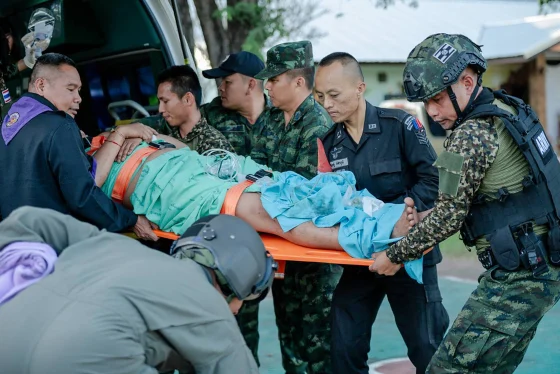
According to Thai military officials, Cambodian forces allegedly opened fire near a contested stretch of territory in Thailand’s Ubon Ratchathani province, resulting in the death of a Thai soldier and injuring several others. In a swift retaliation, Thailand deployed fighter jets and conducted airstrikes on what it described as Cambodian military positions across the disputed border zone.
Cambodia strongly rejected Thailand’s account, accusing the Thai military of launching unprovoked attacks and reporting multiple civilian casualties, including at least four deaths. Phnom Penh condemned the airstrikes as a “serious violation” of its territorial integrity, escalating an already volatile situation as both sides exchanged blame for the outbreak of violence.
The use of air power marks the most severe escalation in months, raising concerns among regional observers that the conflict could spiral beyond localized skirmishes.
Humanitarian Impact and Mass Displacement
The renewed fighting has had significant humanitarian consequences. Thai authorities reported that approximately 385,000 residents have been evacuated from high-risk areas near the border amid fears of further artillery exchanges and aerial assaults. Cambodian officials also confirmed that more than 1,100 families have been relocated to safer zones as tensions continue to rise.
Evacuated civilians described scenes of chaos as artillery fire and airstrikes intensified, forcing families to abandon homes, livestock, and livelihoods. Schools, markets, and key border checkpoints have been closed, disrupting local economies and essential services across the conflict-affected regions.
Long-Standing Dispute Reignited
The Thailand-Cambodia border has been the site of recurring clashes for decades, stemming from disagreements over maps drawn during the colonial era and overlapping territorial claims. The dispute spans an 817-kilometre undemarcated border, with several flashpoints historically prone to military confrontation.
Earlier in 2025, the region saw sporadic violence involving artillery exchanges and landmine explosions that claimed multiple lives. Although a ceasefire was brokered in October with hopes of restoring stability, the agreement had already begun to unravel following recent accusations of landmine deployments and border violations.
Key Developments at a Glance
| Indicator | Latest Update |
|---|---|
| Thai military casualties | 1 soldier killed, several injured |
| Cambodian civilian casualties | At least 4 reported dead, others injured |
| Thai civilian evacuations | Approx. 385,000 displaced |
| Cambodian evacuations | Over 1,100 families relocated |
| Ceasefire status | Ceasefire effectively collapsed; tensions escalating |
Diplomatic Concerns and Path Ahead
Regional leaders and international observers have urged both nations to exercise restraint and re-engage in diplomatic dialogue to prevent the Thailand-Cambodia border tensions from escalating into a larger conflict. Despite mounting pressure, both governments remain firm in their positions, with Thailand defending the airstrikes as necessary for national security and Cambodia condemning them as disproportionate military aggression.
As the situation continues to evolve, concerns are mounting that without urgent diplomatic intervention, the renewed clashes could destabilize broader Southeast Asian regional security and exacerbate humanitarian suffering.