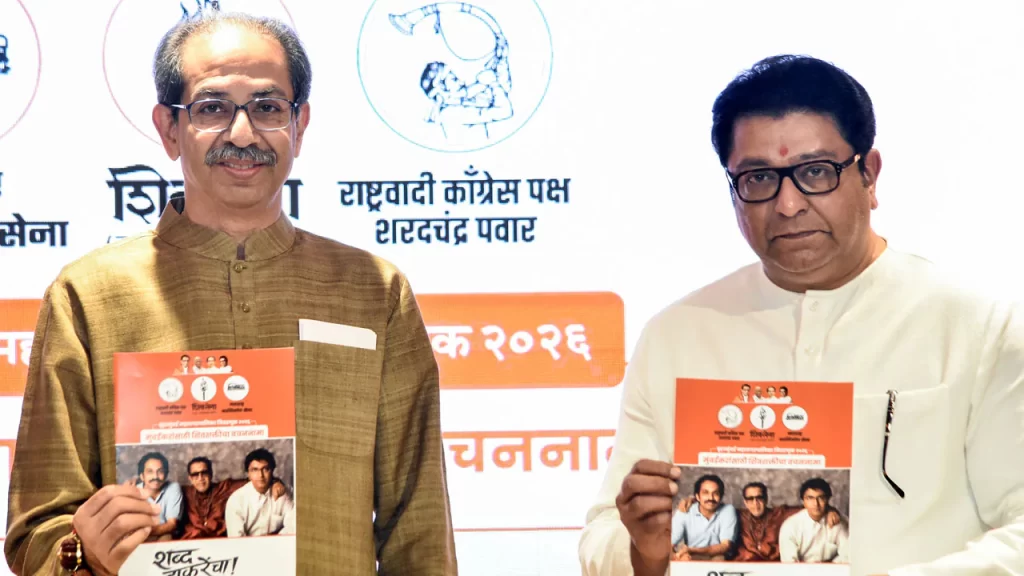
In a landmark political development that has sent ripples across Maharashtra’s political landscape, estranged cousins Raj Thackeray and Uddhav Thackeray formally reunited at Shiv Sena Bhavan in Mumbai on January 4, 2026 to launch a joint manifesto titled “Vachan Nama” for the upcoming Brihanmumbai Municipal Corporation (BMC) elections. This event marked Raj Thackeray’s first return to Shiv Sena’s headquarters nearly two decades after his departure in 2005 — a moment that underscores a significant shift in regional power dynamics ahead of the January 15 polls.
A Political Homecoming After 20 Years
Raj Thackeray, founder of the Maharashtra Navnirman Sena (MNS), stepped into Shiv Sena Bhavan — long the bastion of his erstwhile political roots — drawing significant media attention for the emotional resonance of the occasion. The officials of Shiv Sena (UBT), led by Uddhav Thackeray, greeted him warmly, symbolically bridging a historic intra‑party divide that began more than two decades ago.
At a packed press event, the two leaders presented a unified front, addressing the media and outlining their collaborative vision for Mumbai’s future governance. The manifesto release was widely interpreted as a strategic alliance aimed at consolidating the Marathi voter base and challenging the incumbent Bharatiya Janata Party (BJP) and its allies in the civic polls.
‘Vachan Nama’: Key Promises & Populist Policies
The Vachan Nama manifesto includes several high‑impact proposals tailored to urban voters and economically vulnerable groups:
- Monthly ₹1,500 “Swabhiman Nidhi” allowance for domestic workers and women from the fishing community.
- 100 units of free electricity for residents.
- Property tax waivers for homes up to 700 square feet.
- Affordable housing initiatives for lower‑income Mumbai residents.
- Pledges to improve public health services, decentralized community kitchens offering ₹10 meals, and pet support infrastructure across the city.
- Commitment to bolster public transport and expand education and employment services for youth.
Political analysts note that these citizen‑focused commitments seek to resonate deeply with everyday Mumbaikars by addressing immediate socio‑economic concerns, a tactic expected to enhance the alliance’s traction in key wards.
Sharp Attacks & Electoral Strategy
Beyond policy pledges, the joint appearance also served as a platform for pointed political rhetoric. Uddhav and Raj Thackeray launched strong criticisms against the ruling Mahayuti alliance — particularly the BJP — accusing it of fostering what they termed “mobocracy” and undermining democratic norms during the election process. Raj Thackeray, in his trademark assertive style, accused the state government of transforming Maharashtra into a political milieu resembling Uttar Pradesh and Bihar.
Both leaders also emphasized the importance of ensuring that the Mumbai mayor’s post remains with a Marathi representative, projecting cultural identity politics as central to their campaign narrative.
Manifesto Highlights at a Glance
| Policy Area | Key Pledge |
|---|---|
| Social Welfare | ₹1,500 monthly allowance for domestic workers |
| Utilities | 100 units of free electricity per household |
| Tax & Housing | Property tax waiver for homes up to 700 sq ft |
| Urban Services | ₹10 meal schemes, enhanced public health services |
| Employment | Training and job support for youth |
| Compiled from public disclosure of the Vachan Nama manifesto |
Opposition Response & Political Fallout
The political reverberations were swift. Maharashtra Chief Minister Devendra Fadnavis reacted strongly, characterizing the alliance as confusion‑ridden and opportunistic, while rival camp leaders questioned the credibility and implementation feasibility of the manifesto promises.
Meanwhile, intra‑party tussles and realignments continue across the state’s political spectrum as parties gear up for the civic polls, making this strategic reunion a centerpiece of Maharashtra’s evolving electoral battle.
Looking Ahead: Electoral Implications
The Thackeray cousins’ public reconciliation and collaborative campaign effort represent not only a dramatic personal rapprochement but also a potentially transformative force in Mumbai’s electoral politics. With polling day close at hand, Vachan Nama’s impact on voter sentiment, turnout, and alliance dynamics will unfold in the coming weeks, shaping the governance trajectory of one of India’s largest civic bodies.