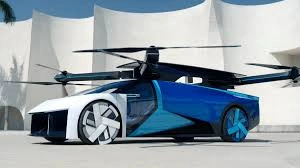
The government is helping a lot with flying cars and electric vertical takeoff and landing (eVTOL) planes. China is the best country for flying at low altitudes. The low-altitude economy is going to change the way people move about in cities, how products are moved, and how tourists travel all over the country.
Policies made by the government lead to growth.
The central government’s major strategic interests are the low-altitude economy, biomanufacturing, and commercial space exploration. The Civil Aviation Administration of China (CAAC) says that by the end of 2025, the market will be worth 1.5 trillion yuan. It will be worth 3.5 trillion yuan by 2035. More than 30 provinces include this subject in their yearly work reports. They have also developed more than 50 precise rules about things like safety, constructing infrastructure, and how to use it in the real world.
Shenzhen’s new local guidelines for coordinated flight management and Shaoxing’s ambitious 2.05 billion yuan project to develop takeoff and landing sites for eVTOLs, helicopters, and drones are two good examples. Every year, Sichuan gives out 300 million yuan, and the best enterprises can win up to 20 million yuan. Chongqing gives 20 million yuan in help. These kinds of developments have opened up more than 400,000 square kilometres of airspace in Sichuan. That means flights can leave with only an hour’s notice.
Pioneer’s Flying Cars for Big Companies
XPeng AeroHT, the biggest flying car company in Asia, started making test cars at its Guangzhou factory in November 2025. The goal is to make 10,000 cars every year. The new “Land Aircraft Carrier” from the business is a six-wheeled vehicle that can drive on land and features an eVTOL module that can be taken off. It can go 130 km at a speed of 120 km/h, and it has already received more than 7,000 requests from all around the world. Dubai, for instance, has secured a contract for 600 units worth 1.2 billion yuan.
The CAAC has given EHang the first type certification for the EH216-S, an eVTOL that can carry people. This eVTOL can fly on its own at speeds of up to 130 kph and over distances of up to 30 km. Aerofugia is working on securing approval for its six-seater AE200 and making it ready for small-scale production, which should start in 2026. The GAC GOVY AirJet can go more than 200 kilometres and reach speeds of up to 250 km/h. It will be ready for test flights in the Greater Bay Area by 2027. Changan Automobile and EHang are working together on a 20 billion yuan investment that will last for five years to speed things up.
Real-Life Uses and Infrastructure
To keep up with this increase, local governments in all provinces are quickly building more vertiports and integrated networks. Shaoxing’s tourism strategy includes takeoff spots, and Chengdu is the first city to offer commuter flights, such the eight-minute trip from Dujiangyan to Qingcheng, which cuts down on travel times from hours on busy highways. Over 5,000 people have signed up for experimental flights on West Lake in Hangzhou. The price of each seat is 680 yuan. This means that a lot of people are interested. Guangzhou created a whole provincial flight management platform in December 2025 to make things easier.
Drones can do a variety of things, including deliver packages to the rough mountains of Yunnan or check on more than 30 places with i-KINGTEC’s AI-powered drones. Sichuan has 327 approved places where 200 operational routes can be deployed. The most recent expo in Tianjin showed off a lot of eVTOL designs based on orcas that are made for rescue operations.
There are a few main places where practical use stops working:
- Urban air mobility makes it easier to go around and cuts down on traffic jams on the ground.
- Logistics uses heavy-lift drones to quickly deliver goods to hospitals and rural areas.
- Scenic aerial tours are a big part of tourism and bring approximately 6 billion yuan.
- CATL and EVE Energy’s work on batteries and Huawei’s AI-powered air traffic control systems have made it possible to scale up on a huge scale.
Your main concerns should be safety and problems.
Because things are growing so quickly, safety must always come first. This is why there is a tough three-tier certification process that checks the type design, the quality of the production, and the operational airworthiness. By the beginning of 2026, six different eVTOL vehicles will be almost ready to get complete airworthiness approval. They get most of their parts from their own country. Ning Zhenbo of AVIC and other aviation experts call the trip a “marathon,” which stresses the need for innovative ideas based on demand rather than quick commercialisation.
It’s still very important to earn the public’s trust. For example, Li Luying from Chengdu wants it to be easier to get flight test data. The CAAC’s special rules for XPeng’s modular flying cars illustrate that rules and regulations are continually becoming better.