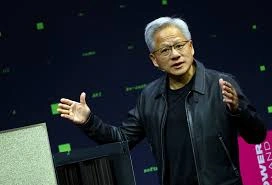
People all across the world are buzzing about Jensen Huang, the CEO of Nvidia who has great plans. He has talked to President Trump about the “AI bubble” and the digital war with China that is likely to happen. These thoughts, which originate from recent high-profile interviews, show how AI could change the world and how politics are affecting the future of the field. Huang’s ideas are very significant for investors, lawmakers, and engineers who are trying to figure out this vital time, since Nvidia is leading the way in faster computing.
The End of the AI Bubble Myth
Huang does not agree with the concept that AI is getting too much attention. He doesn’t believe that the money being spent on computers right now will make a big difference. He believes that the shift from general-purpose computing to accelerated computing, which Nvidia’s GPUs support, is not simply a wild guess; it’s a big transformation in the company. Huang told TIME in an interview at Nvidia’s Bay Area headquarters in November 2025 that the company’s investments are little relative to the trillions of dollars in the global computing market, especially with artificial general intelligence on the way.
People in the market don’t agree with this approach, especially since Nvidia’s value has gone up by more than $1 trillion since early 2025, making it worth an amazing $4.5 trillion. Huang said that Nvidia’s technologies, models, and algorithms improve by 5 to 10 times per year. This might lower the price of tokens by a billion times over ten years while keeping demand high. Investing properly in AI firms like OpenAI helps make the world a better place for the company to grow over time, even while they don’t make a lot of money.
Huang is excited about how AI will change the way people work. Like improvements in technology have done in the past, AI will create new professions in many fields. Partnerships, like the one with Synopsys for design tools that employ GPUs to speed up the process, desire to make engineering and other fields worth trillions of dollars and cut down on work time from weeks to hours.
Huang’s Nice Words for President Trump
Huang has said kind things about President Donald Trump, calling him a “thoughtful and practical leader” who surprised him by how quickly he remembered things and how straightforward he was. Huang remarked on the Joe Rogan Experience podcast in December 2025 that Trump recalls everything they talked about and thinks about policy in a way that makes sense for the U.S. This happened following a conference in Washington about sending AI chips to other countries. While the Biden administration was discussing about relaxing limitations, Trump called Huang a “smart man.”
Their relationship got better, and they were able to adjust their rules in ways that helped them win. For instance, Trump persuaded Nvidia to promise billions of dollars for a chip building in Arizona, got rid of tariffs on AI products, and made it easier to send goods to China and the Gulf States. Trump talked to Saudi Crown Prince Mohammed bin Salman, and as a result, tens of thousands of Nvidia chips were released, which made markets profitable again. Huang added that Trump is a “anti-politician” who likes simple language over convoluted terminology. He is especially interested in how America can come back by leading in technology and industry.
This relationship goes along with Trump’s Genesis Mission, which is like the Manhattan Project for AI in science and places Nvidia at the core of it all. Huang remarked that this kind of partnership keeps business and safety in balance. For instance, the U.S. uses its resources to make its military stronger.
The AI Arms Race with China Is Getting Worse
Huang says there is a serious AI arms race going on, and China is a big concern. He tells the US to get going. In November 2025, he told the Financial Times, “China is going to win the AI race.” He also noted that China has half of the world’s AI researchers, the greatest open-source models, and is making quick progress even though there are limits. The Stanford 2025 AI Index says that Beijing holds 70% of AI patents, while the U.S. only has 14%.
China is really strong, yet it doesn’t have a lot of rules. This lets businesses like DeepSeek, Alibaba, and Moonshot develop models that work better with fewer chips. Beijing’s embargo on Nvidia chips affected China’s economy, but it also sparked new ideas in China, which could be bad for the long term. Huang added that selling Nvidia chips to China will damage local efforts and maintain the U.S. in charge: “We want America to be the richest country so it can pay for the strongest military.”
The new rules are better than the old ones since they permit H200 chips be supplied to foreign countries, but they are not as good as the Blackwell chips sold in the U.S. This holds the value of markets and security in check by tens of billions of dollars. It’s more dangerous to attack people online now that Chinese AI does 80–90% of the job for them. Huang says, “The US has to keep going at an incredible speed.”
Effects on technology all across the world that are larger
Huang’s ideas affect the economy, technology, and government policy. Investors still believe in AI infrastructure because they don’t anticipate there will be a bubble. Trump’s ties helped him win big, like when Arizona fabs became the first in the U.S. to create advanced semiconductors. But it’s difficult to compete with China. When individuals are away from home, rules make them more independent, but Nvidia wants people to get up and move.
What’s Next
Huang believes that AI will change every area, beginning with Nvidia’s graphics devices. We need to be careful not to fall behind since China is a competitor. Policies that help the economy grow under Trump might make things worse. Huang’s plan for 2026—small investments sparking revolution, Trump friends opening markets, and strategic ties with China—makes AI the next great thing in computing. Those who are taking part in this arms race need to pay attention. It will decide who has the finest technology, and safety and prosperity are at risk.