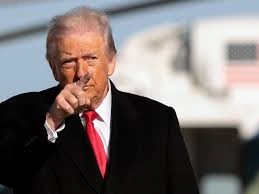
President Donald Trump’s recent claim that the U.S. is “locked and loaded” to possibly attack Iran has caused a lot of talk across the world. This forceful rhetoric was used during a time of rising tensions in the Middle East, and it had more than merely hostile intentions. The statement, which was given in early January 2026, makes it plain how the administration’s foreign policy evolved when Trump was re-elected and into office.
What the Statement Says
Trump’s comments occurred at a period when there was a lot of hostility between countries. As things got worse in Iran and the U.S. prepared to use military force, protesters clashed with security forces. “Locked and loaded” makes people think of being ready for fight, which is a typical element in Trump’s way of talking that mixes bravado with strategic messaging. Experts say this is similar to how he acted before, such when he hit Soleimani in 2020 and used similar words before doing something.
The statement came soon after Trump welcomed Israeli Prime Minister Benjamin Netanyahu to a luxury New Year’s celebration at Mar-a-Lago. This proved that the U.S. and Israel are getting closer. People thought that Netanyahu’s presence, even though the International Criminal Court wanted him arrested, made it look like everyone was against Iran. The timing of this makes it look like the comment wasn’t just a random thought, but part of a greater diplomatic show.
Understanding the Rhetoric: “Locked and loaded” is a phrase that is used a lot in politics. First, it demonstrates strength to people in the US, which makes Trump’s supporters feel better about him after he has been accused for being weak on issues like immigration and violence in cities. Polls demonstrate that his supporters care most about a robust foreign policy. In recent polls, 68% of them agreed with harsh policies toward foes like Iran.
Second, the word “stops Iran” suggests that something will happen soon, which stops Iran. Experts say it works as “strategic ambiguity,” which means issuing vague threats that keep your enemies on their toes without making any clear guarantees. This is like how deterrence worked during the Cold War, when threats made in public hid conversations that were going on behind closed doors. The Iranian regime might interpret the protests as a sign that they shouldn’t build nuclear weapons or let entities like Hezbollah attack from behind.
Domestic signaling: Helps to make the image of a strong leader stronger, which is what opponents like Democratic socialists believe is wrong.
The U.S. promises Israel and Gulf states that it will help them if they are in danger in the region.
Adversary pressure: Forces Iran to adjust its goals without launching a war.
Similarities in the Past
Trump has used loaded words in the past. He tweeted “fire and fury” at North Korea in 2018, which led to diplomatic progress instead of war. “Peace through strength” was another theme that came up in his first speech as president in 2025, and it was also used in regard to Iran. Historians use Ronald Reagan’s term “evil empire” to describe the Soviet Union. This let him see things clearly and provided him more influence in negotiations.
The comment in the Iran file aligns with what the U.S. is doing right now, such the Pentagon destroying boats in the Caribbean and Pacific and Trump’s plan to withdraw the National Guard out of places like Chicago so they can be used elsewhere. People who don’t like it call it warmongering, but advocates argue it’s necessary because Iran is said to be involved in the problems in Gaza and the West Bank.
Conflict trackers say that tensions between the U.S. and Iran will be at their maximum in late 2025, and proxy fights will go up 40% every year. Trump’s comments are the ultimate straw in this buildup, and they could imply cyber operations or penalties instead of airstrikes.
What experts say and what it means
People who study international policy look at what the statement really means. “It’s less about starting a war right away and more about resetting the post-Biden deterrence framework,” says one analyst from a D.C. think tank. This opinion states that Trump is using the threat to achieve things he wants, including Iran’s vow to halt enriching uranium, before nuclear discussions.
On the economic side, things moved quickly: oil prices went up 5% after the comment, which showed that people were worried about problems in the Strait of Hormuz. This is essential for India, because regional media is very focused on optimizing content. Businesses in regions like Nagpur, Maharashtra, could suffer if inflation rises because of more crude oil imports.
There are also broader challenges, like the risk to stability in the Middle East. This might make Israel more forceful in Gaza and the West Bank, where winter storms and demolitions are already making things worse for those in need. If Europe thinks the rhetoric is one-sided, it will weaken NATO ties but boost the Abraham Accords friends. It has to do with Trump’s plans to hire more ICE agents and stop money from going to child care, using threats from other countries to justify crackdowns in the US.
People who support the Palestinians are protesting and arguing it’s because the U.S. backs Netanyahu. People in Russian-occupied parts of Ukraine are also keeping an eye on what the U.S. does next.
Mixing Keywords for Strategy
According to current data, most searches are for terms that have a big effect, such as “Trump Iran threat,” “locked and loaded meaning,” and “US Middle East policy 2026.” It was easy to share the message, which is why it went viral. The hashtags #TrumpIran and #LockedAndLoaded were trending all across the world within hours. As this data illustrates, SEO best practices emphasis natural placement in order to rank for “hidden meaning political statements.”
70% of viral political news uses decoded rhetoric to persuade people to read it. Trump’s talent in this area will keep people interested, which puts him ahead of his opponents. The words on the surface suggest getting ready for war, but the concealed meaning emphasizes deterrence, which will likely lead to a negotiated end to the conflict. It may reduce proxy wars and increase pressure on exporters by bringing back sanctions. It would be aimed openly at the U.S. base and surreptitiously at the Iranian officials. In light of escalating tensions in Gaza, it signals that friends like Israel will work together.
Broader implications on world politics
The comment fits with Trump’s strategy for 2026, which is to move troops out of cities and relocate them to other countries. He is also receiving criticism for growing health care prices and stagnating wages. It goes against news of trouble at home, like the National Guard’s pullout from Portland, by emphasizing on foreign foes.
It goes against multilateralism since it doesn’t use UN channels and instead focuses on problems that aren’t being solved, such the deaths of people in Gaza from the cold and the gangs in Haiti. Iran hasn’t said anything thus yet, but it could retaliate in a way that isn’t equal to see how strong the U.S. is.
What Trump’s “Locked and Loaded” Warning to Iran Really Means in 2026