DNA studies on bodies found in Sweden with weapons have shown that there were female Viking warriors. People have traditionally imagined that men and women had different roles in Viking culture, but this is not true. The new evidence from the Birka cemetery Bj 581 shows that women not only fought in wars, but they also worked as professional soldiers in high-ranking positions.
The Birka Discovery: A Warrior’s Grave Found In the 1870s, researchers found grave Bj 581 in Birka, a Viking Age trading town on Björkö Island, which is today near Stockholm, Sweden. There were a lot of fascinating weapons in the grave, such a sword, an axe, a spear, two shields, armor-piercing arrows, a fighting knife, and the bones of two horses, one mare and one stallion.This proved that the man was a high-ranking warrior on horseback.
A full set of game pieces and a board were used for strategic preparation, just like in modern chess, which made the occupant’s role as a strategist and leader even more clear. Because of these weapons and how people thought back then, a lot of people thought it was a man at first. But in the 1970s, osteological studies proved that the person possessed female traits, such as narrow cheekbones and broader hips. Skepticism lasted until 2017, when scientists from Uppsala and Stockholm University obtained DNA from a tooth root and an arm bone.
Genomic Confirmation: A High-Ranking Female Warrior
The DNA test showed that there were two X chromosomes and no Y chromosomes. This showed that the bones belonged to a biological woman who was about 30 years old and about 5 feet 6 inches tall, which is rather tall for the Viking age. Mitochondrial DNA (mt-haplogroup T2b) and nuclear genome sequencing confirmed the integrity of the remains as a distinct individual displaying authentic ancient DNA characteristics.
Strontium isotope analysis of her teeth indicated early-life mobility, implying she traveled before to her arrival in Birka, likely from regions such as the British Isles, North Atlantic, Scandinavia, or Eastern Baltic Europe, based on genetic affinities. This woman wasn’t a symbol; the peculiar number and type of weapons found in her grave show that she was a professional warrior and a competent mounted archer.
Charlotte Hedenstierna-Jonson, the main researcher, remarked, “We didn’t study a Valkyrie from the sagas; we studied a real-life woman who is a military leader.” The study was published in the American Journal of Physical Anthropology. It warns against making generalizations about gender in the past.
Viking Legends About Shieldmaidens: From Story to Truth
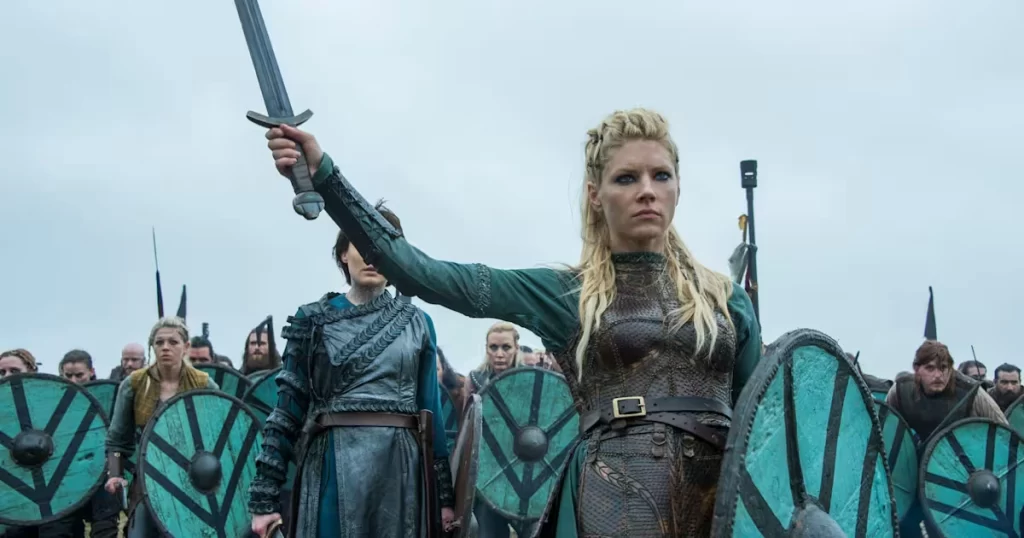
Shieldmaidens have existed in Norse mythology and Viking sagas for a long time. They are fierce female fighters, like Lagertha from the Saga of Ragnar Lodbrok or Hervor from the Saga of Heidrek. You can see them fighting with swords and shields next to men. Modern texts, like as Saxo Grammaticus’s 12th-century Gesta Danorum, discuss heroines like Hede and Visna who commanded armies with masculine valor while inhabiting female forms.
Scholars in the 20th century usually thought these stories were just old wives’ tales. They believed that weapons found in women’s graves were family heirlooms, symbols, or signs of rank, not personal items. The Birka DNA evidence changes everything by establishing for the first time that there was a high-ranking female Viking fighter. This proves that shieldmaidens were genuine and not simply a fable.
There is more and more evidence of female fighters outside of Birka. Birka Bj 581 is probably the most noteworthy case, but other Swedish and Scandinavian sites also show that Viking women were soldiers. In Norway, a cemetery had a lady buried with a sword, spear, and shield, which is similar to how men were buried. People believed the Gerdrup Grave in Denmark was strange because it contained a woman with a lance, but DNA research indicated that she was related to the people who lived there. People still thought weapons were a sign of status.
There are around 3,000 tombs in Birka, and many of them haven’t been dug up yet. Some of the burials of women include weapons that were not found earlier. Neil Price’s 2019 reevaluation indicated that Bj 581 was a fighter. He argued that the same standards should be used for both men and women. These facts show that Viking women, especially those of high status, were trained to fight, which goes against what most people think.
Some important things that were found in the graves of female warriors are swords for slicing, spears and arrows for long-range battle, shields for protection, and horses for getting about.
Strategic aspects: The gaming sets suggest that the deceased was a leader and knew how to use strategies, which is not something that happens in typical graves.
Isotope data indicates that numerous individuals led itinerant lifestyles, aligning with the raiding lifestyle.
Viking Society: Gender Roles and Warrior Training
Women in Scandinavia during the Viking Age (793–1066 CE) had more rights than women in prior ages. For example, they could own land, get a divorce, and run a farm while the attacks were going on. Highborn women ran homes, but new evidence shows that some of them opted to become warriors and learned how to use weapons, ride horses, and plan attacks from a young age.
Birka’s location as a military and economic center made this even more crucial. There, warriors planned campaigns in the Baltic. Genetic relationships between different Europeans demonstrate how raiding groups mixed and how skilled fighters moved up the ranks based on their skills. Some individuals think that weapons were a way for people to hide their true identities, but the fact that there are similar male burials and saga consistency proves that this is not true. The obvious and logical conclusion is that professional female troops were engaged.
This affects how people think about Viking combat. It wasn’t simply men who battled; there were also amazing women who fought well enough to have elite funerals.
Scholarly Discourse and Modern Reassessments
There was a lot of talk about the study from 2017. Some people thought that weapons were more about family responsibilities than personal battles. But writings from 2019 and after, like Price’s, use the same standards of proof to support the warrior view. There is no DNA evidence that goes against this. Instead, areas like Sollerön, Sweden, depict women holding weapons.
“We need to make sure that the same rules of logic, evidence, and data apply to both men and women,” says Neil Price. Recent arguments from 2024 to 2025 show that shieldmaidens were real people who lived in the Viking Age. This evidence requires the reassessment of thousands of graves globally.
Broader Impacts on Viking History and Archaeology
DNA tests in Sweden have proven that Viking women were trained to battle. This makes us see Norse civilization in a more equitable way, with power moving between men and women. It supports shieldmaiden sagas, which adds to the cultural legacy and fights against the idea that Viking women were weak.
More digs at Birka and other places in the future, using genomes, are likely to turn up more items, possibly even shieldmaiden regiments or combat wounds on female corpses. Hedenstierna-Jonson adds that this gives us a unique glimpse at Viking culture, how it was built, and how it was different from other cultures.
These skillful fighters show us that Viking history isn’t simply about stories. It’s about everyone who had a sword.