
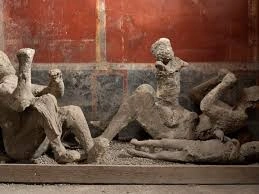
The devastating eruption of Mount Vesuvius in 79 AD buried the Roman city of Pompeii under layers of ash. The body casts of the victims look hauntingly real and illustrate what happened in the dying moments of their deaths. These natural molds formed as ash hardened around bodies that were rotting. They reveal faces of dread, desperation, and even giving up. They provide us a unique glimpse at ancient tragedy. Recent advances in science have been able to combine archaeology with modern genetics and chemistry to rewrite personal stories that have been frozen in time.
A Timeline of Destruction: Vesuvius’s Rage
For years, Mount Vesuvius, a stratovolcano that looks down on the Bay of Naples, had been sending out warning flags. For instance, a big earthquake in 62 AD destroyed the buildings of Pompeii. The eruption began at 1:00 p.m. on a day in late summer or early fall in 79 AD, maybe between October 24 and November 1, based on current graffiti analysis and evidence from the season, including wine and fruit stores. The initial Plinian phase launched a gigantic column of superheated tephra and gases into the air. It reached 33 kilometers high and released 1.5 million tons of material every second. Pumice and ash fell for 18 to 20 hours, stacking up to 2.8 meters high in Pompeii and causing roofs to fall in. Pliny the Younger, who was there and saw it from Misenum 29 kilometers away, said that the cloud looked like a pine tree and changed color from bright to black.
By midnight or early the next day, the column broke up, spewing out pyroclastic surges. These are fast-moving flows of hot gas and rock that may reach speeds of 124 mph and temperatures of up to 500°C. These surges killed people in seconds by either burning them or cutting off their air supply. As the bodies broke down, they transformed soft tissues into gas and left holes in the ash. In just two days, surges and fallout buried Pompeii under 4 to 6 meters of debris, killing most of the 20,000 people who lived there.
Surge 1–3: Hit Herculaneum first, where the temperature was between 180 and 260 degrees Celsius.
Surge 4–5: Destroyed Pompeii, causing dead bodies to contort and spasm from thermal stress.
The last surge of ash added another meter to the city, closing it off.
This sequence, which was made from different layers of rock, demonstrates why there are more than 1,500 casts at Pompeii than skeletons at Herculaneum, which is hotter.
Fiorelli’s great concept was to make body casts out of ash from volcanoes.
As director of Pompeii in the 1860s, Giuseppe Fiorelli revolutionized the way things were preserved. At that time, excavations were haphazard. He noticed holes in the ash that looked like people. These were produced by dead bodies that were rotting and the dirt around them. He filled the holes with liquid cement and let it dry before digging them up. The “Fiorelli Process,” which was first perfected in 1863, could keep not just outlines but also little details like creases in clothes and features of the face.
There were more than 100 casts made by 1875. Some of them were of a chained dog in the House of Orpheus and a couple in cloaks. Modern scans show that a lot of them contain bones and teeth within, which proves that they are actual remains. These Pompeii body casts turned empty spaces into moving pictures of real people, which got more people interested and made more money.
The process works on more than just individuals; it also keeps waves on Herculaneum’s shore, doors, and furniture safe. There are still moral debates about whether or not to take out real bones and replace them with copies, but these bones are still important.
Haunting Portraits: The victims’ last moments are shown.
The volcanic ash body casts of the Pompeii victims freeze them in misery, and their poses tell stories that have never been told before. A famous couple from Civita Giuliana shows a rich man in a wool coat cuddling a small son in a tunic. Under six feet of ash, they are both frozen in thermal shock. An elemental analysis of the Porta Nola castings reveals that the individual succumbed to hypoxia induced by inhaling ash. The bones are chemically identical to those of cremated remains that have been soaked in phosphate.
In the House of the Golden Bracelet, a cast that was thought to be a woman holding her child turned out to be a man with a child who was not linked to him by DNA. This goes against romanticized stories. Genetic tests on 14 restored castings show that they came from different locations of the eastern Mediterranean, just like the people who moved to Pompeii. Some individuals believe that lying down in a relaxed position might quickly kill you before you are buried.
In other images, a woman is carrying coins and jewels while a youngster is close. In another scene, groups of people in a boat home turn into gas around 400°C. More than 1,044 castings, 62% of which are in surge deposits, reveal that the heat caused the contortions, not long-term agony. These features, such garments hanging like statues, make me think of the chaos that happened as people went for cryptoporticus shelters, only to be faced by a pyroclastic calamity.
The secrets of Pompeii are revealed by modern science.
In 2024, DNA extractions from shattered bones in casts went beyond plaster and changed narrative. They also proved what scholars thought over what the public thought. Chemical tests suggest that the temperatures in Pompeii were from 140 to 360 degrees Celsius. The ruins were cooler because the buildings worked together in a certain way.
Ongoing projects worth €100 million use satellites to discover subsidence, IoT devices to find tremors, and drones to produce 3D maps. AI can determine when something is going to break, and bio-consolidants, which are microorganisms that create limestone, can fix walls without damaging them. Digital twins work like preservation, and robots put frescoes back together adjacent to casts.
These steps, which were part of the Great Pompeii Project, made 39 structures safer and cut the amount of repairs by 40% since 2020. Even though nano-coatings now protect casts from salts, there are still concerns like tourism (3.5 million visits a year) and the weather.
CT and X-ray pictures enable you see bones and teeth without damaging them, which lets you acquire DNA samples from 14 casts. AI pattern recognition is 50% more accurate at predicting when things will get worse, while nano-protectants keep water and pollution away from plaster so that salt doesn’t crystallize. Digital twins enable you test the restoration process in a fake environment that mimics what happens to remnants when there is a surge.
Enduring Legacy and the Need to Keep It Safe
The volcanic ash body casts from Pompeii are more than just antiques; they make a disaster that killed thousands feel more real, and their eerie details keep people fascinated. Pliny’s writings and contemporary genetics both show us what life was like in Rome: it was full of different people, vigorous, and ended suddenly.
To keep things safe, we need to pay attention all the time. The threats we face now are similar to those of the past, but technology can help us. When they start digging again in Regio V, they locate thermopolia next to casts. The site shows us how weak we really are. The paradigm of Pompeii enables cultural sites all around the world stay alive for a long time.
Quantum modeling and biotechnology could lead to big discoveries, such brains that have been frozen or family ties that have been lost. These castings remind us that nature can be very angry and quite destructive.

