
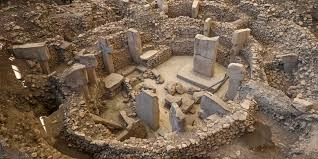
New archaeological finds have revolutionized what we thought we knew about ancient human societies. Göbekli Tepe is a massive site in Turkey that is more than 11,000 years old. It illustrates how skilled Stone Age people were at constructing, which makes us wonder when sophisticated societies first started to form.
Finding Göbekli Tepe and dating it
Göbekli Tepe is one of the oldest known huge structures built by hunter-gatherers. It is about 6,000 years older than Stonehenge, which is well-known. In the mid-1990s, German archaeologist Klaus Schmidt began digging and discovered a number of large T-shaped limestone pillars arranged in circles. Some of these pillars were 20 feet tall and weighed 10 tons. Radiocarbon dating shows that the primary building phase of the site happened around 9600 BCE, during the Pre-Pottery Neolithic period. This illustrates that people could create things long before they learned how to farm or use metal tools.
These buildings include intricate carvings of people, animals, and abstract shapes that seem like people. This shows that they were utilized for religious or ceremonial purposes rather than merely living in. It looks like Göbekli Tepe was a place where people from far afield came to practice their spirituality together. Stonehenge was utilized for astronomical alignments and funerals, which is not the same as this. This discovery indicates that organized religion or communal rituals may have spurred societal complexity, contesting the traditional view that settled agriculture was the catalyst for such advancements.
A timeline that shows how Stonehenge fits in with other events
In England’s Wiltshire countryside, Stonehenge began as a simple circular ditch approximately 3100 BCE. About 2500 BCE, the famed sarsen stones were placed up. In contrast, the enclosures at Göbekli Tepe were buried on purpose around 8000 BCE, possibly as part of a ceremony to end their use. This preserved them in perfect form for thousands of years. This burial process stopped the pillars from breaking down, which is why modern archaeologists have found 20 of the 200 stone circles that were there.
The site at Karahan Tepe, which is only 35 kilometers away and dates back to roughly 9500 BCE, contains similar T-pillars and enclosures, therefore it could be a modern site. Another example of an early communal building with carved megaliths is Jerf el Ahmar in Syria, which dates back to about 9600 BCE. This means that the Fertile Crescent probably had more prehistoric megastructures. These findings cumulatively demonstrate that Stone Age humans, across several regions, were capable of organizing labor for substantial tasks in the absence of hierarchical systems or written communication.
The timeline shows the following order of important dates: The Egyptian Pyramids were created approximately 2600 BCE, Stonehenge’s initial phase was completed around 3100 BCE, and Göbekli Tepe was active from 9600 to 8000 BCE. This temporal difference makes us think about Stonehenge in a different way. It is now thought of as a later version of far older goals instead of the first large monument created by people.
The Smart Building Skills of People Who Lived Before History
It is still a mystery how Göbekli Tepe was erected because it was done with flint tools and a lot of people. Workers carved pillars out of the bedrock around them, moved them with sledges or rollers, and put them in rings that were up to 20 meters wide. Each enclosure had between 8 to 12 pillars, with two bigger ones in the middle. These pillars may have looked like people and kept things safe.
It’s interesting to note that there are no evidence of trash or tools that would suggest a permanent home. Instead, the site was used for events that happened every now and again.Scholars contend that up to 500 individuals concurrently engaged in construction activities, fostering social relationships through cooperative labor. This paradigm challenges the notion that nomadic hunter-gatherers were technologically inferior, illustrating their capacity for planning, symbolism, and collaboration akin to later Bronze Age societies.
You can see how things are different in size and purpose by comparing them to Stonehenge. The bluestones that make up Stonehenge came from Wales, which is a long distance distant. On the other hand, Göbekli Tepe used items from the area to show off symbolic achievements instead of logistical ones. Both monuments are in line with events in the sky. Göbekli Tepe may have tracked stars like Sirius, but the fact that it is older than the Turkish site demonstrates that humans in prehistoric times knew more about astronomy.
Significance for Theories of Human Evolution
People’s ideas regarding the Neolithic Revolution have changed because of Göbekli Tepe. Conventional beliefs suggested that agriculture enabled surplus food production, population growth, and remarkable construction. But here, sophisticated buildings occurred hundreds of years before farming, which shows that ritual needs led to people staying in one place and growing crops. Schmidt famously said, “First came the temple, then the city.”
This new way of thinking says that religion is what keeps civilization going. The site’s pictures of foxes, snakes, birds, and scorpion-men may show totemic clans or shamanistic visions that unite various tribes together. Genetic studies of ancient DNA from the region corroborate this. They show that distinct groups of hunter-gatherers came together every year, which led to the rise of cities like Çatalhöyük around 7500 BCE.
Some people assume the pillars are just places to eat, thus critics say not to read too much into them. However, the fact that enclosures were buried on purpose with layers of garbage suggests religious deactivation, which is similar to what people did later in Mesopotamia. These disputes keep the digs going, and since UNESCO declared it a World Heritage Site in 2018, the Turkish government has spent millions on it.
A larger network of ancient megastructures
The “Taş Tepeler” investigation revealed 12 more places in southeastern Turkey that are like Göbekli Tepe. Researchers describe these places a “Stone Age Mecca.” Boncuklu Tarla, which is about 10,500 BCE, features skull cults and pieces of pillars. There are 250 pillars at Sefer Tepe. This constellation points to a 200-square-kilometer area where people soon learned how to quarry and carve.
There are things that are the same all over the world. For example, Japan’s Yonaguni Monument, which is 12,000 years old and is causing a lot of debate, and Indonesia’s Gunung Padang, which some estimate is approximately 20,000 years old. The enclosures at Göbekli in Europe are similar to Scotland’s Ness of Brodgar from 3500 BCE. This demonstrates that ideas spread when people move. These links show a time when people lived in stable places following the Ice Age and used them to get creative.
We can learn more from climate data from the Younger Dryas period, which was a rapid cold snap that lasted from 10,900 to 9700 BCE. It may have led to shared shelters or rituals to stay alive. Ice cores suggest that melting glaciers are freeing up land, which is causing the population to rise and people to try out new ways of living.
Disagreements and Their Effects on the Present
Some people don’t think that Göbekli Tepe is the earliest location. Some radiocarbon samples from fill dirt may make the dates seem older, and peer-reviewed critiques urge to be careful. The site is in danger of being looted and developed into a city. After 30 years, just 5% of it has been excavated. The purpose of Turkish-German teams is to use geophysics to map circles that haven’t been observed yet so they may make virtual reconstructions.
Some people say things like “ancient astronauts” that aren’t true, but most studies think that people are smart. People are more interested in Şanlıurfa after watching documentaries about it, which brings in more tourists. But too many tourists could be bad.
These new truths change who people are and how they learn. Göbekli Tepe is a sign of Turkey’s pre-Islamic heritage, and people there are proud of their country. Seeing that our predecessors were just as smart as we are now, even if they didn’t have technology, makes modern egos feel small all around the world.
A Lasting Legacy and New Things to Learn
Göbekli Tepe changes the story of how people came to be by giving Stone Age inventors the power to shape their own future. It shows that ritual is what starts civilization, not what comes after it. It came before Stonehenge and farming. We should learn more about symbols as the digs go on, such how to read abstract glyphs as early writing.
In the future, LiDAR scans and AI analysis may reveal hidden depths that connect these places to technologies that are no longer in use. For now, Göbekli Tepe represents a link to our distant past. It shows us that excellence comes from need and creativity. It tells us that real monuments last because they serve a common purpose during a time of tremendous change.

