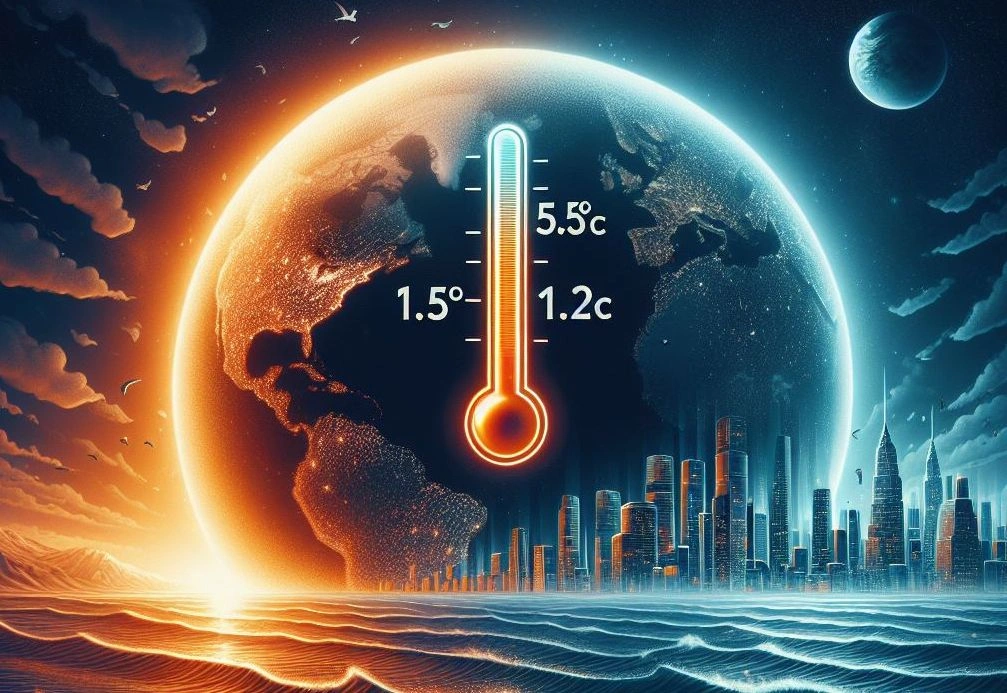
The fact that the Earth’s surface temperature has risen faster than it has in the last 2,000 years illustrates how dramatically people have affected things. We need to look into this quick global warming event right away because temperatures set records in 2024 and 2025.
Scientific Evidence of Unprecedented Warming
By studying tree rings, ice cores, coral reefs, and sediment layers, scientists have put together a picture of how hot it has been on Earth during the past 2,000 years. They discovered that the rate of warming right now is rather high. Studies published in top publications reveal that the temperature rise since the middle of the 20th century is far faster than it would be if nothing else changed. In fact, it’s higher than 99% of all trends that have lasted 51 years in the past.
Thorough investigations show that the world’s surface temperature has risen faster since 1970 than it has in any other 50-year period in the last 2,000 years. This speed rise has been backed up by scientific research since 1850. Two-thirds of the overall 1.2°C rise happened after 1975.
2025 was the third-warmest year ever. After 2024’s peak, the average temperature over the world was 1.47°C higher than it had been before industrialization. It looks like the temperature will go back up to 1.4°C or higher in 2026. This has happened for the fourth year in a row. This shows how quickly climate change is happening because of what people do.
Historical Context: Following the Little Ice Age
The temperature of the Earth has altered in different places and at different times throughout the last 2,000 years. The Medieval Warm Period lasted from 950 to 1100 AD, while the Little Ice Age lasted from 1500 to 1850. Before the Industrial Revolution, the temperature changed because of volcanoes and the sun. These changes only affected a limited section of the world at a time, unlike the heat we feel now, which impacts practically everyone.
The current warming is different because it is happening to 98% of the planet at the same time. This has never happened before. The second half of the 20th century was the warmest epoch, with temperatures rising by 1.7°C per century, which is much more than what climate models say is normal.
Paleoclimate proxies reveal that things are worse now than they were after the Ice Age, when the Earth warmed up at a rate of 1/10th of what it does now. Because of this divergence, the time after 1850, when industrialization started, was unusual.
The greenhouse gases left behind a human fingerprint.
Since 1750, things people have done, such burning fossil fuels, cutting down trees, and creating industries, have elevated the amount of CO2 in the air by 50%. This is the most CO2 that has ever been measured in human history. Methane and nitrous oxide make this worse, and isotopic evidence shows that humans are more to blame than natural sources.
Reports say that these greenhouse gases are responsible for almost all of the warming that has happened since 1950 and that they are far stronger than natural processes like El Niño. Models show that volcanic and solar activity would chill the Earth even if no one was around.
Burning coal, oil, and gas sends around 75% of the extra CO2 into the air. Cutting down trees and cultivating are two ways that land use changes can let methane out and lower natural carbon sinks. The greenhouse effect is worse when fluorinated gases are used to create things and cement.
This abrupt spike in global temperatures caused by mankind is distinct from earlier times because it wasn’t just one item that caused it.
The outcomes are happening right now.
When the temperature rises quickly, bad weather grows worse. From 2023 to 2025, there were record heat waves, floods, and cyclones. The 2022 flood in Pakistan, which saw 7.9 million people leave their homes, and the glaciers in Europe melting swiftly are two examples of how massive this is.
Since 2006, sea levels have been rising at a rate of 3.7 millimeters per year, which is twice as quickly as they used to. By 2050, this could put 1 billion people who live near the coast in peril.During the 1990s, glaciers lost mass 57% quicker, which might cut off the freshwater source for millions of people.
The earth gets hotter, and at some point, this hurts biodiversity. The sea ice in the Arctic is melting swiftly, coral reefs are losing their color, and animals are either relocating north or dying out. The repercussions on the economy increase worse, and experts say that for every extra degree of heat, GDP will drop by 10%.
In 2024 and 2025, thousands of people died because of very hot weather. By the middle of the century, they should happen five times more often. In 2025, the average temperature of the sea surface was 0.49°C higher than normal. This made storms and floods worse, killing about 33 million people in one disaster.
Because the earth is getting warmer quicker than it has in 2,000 years, it’s challenging for the world to maintain food safe, people healthy, and infrastructure working.
Problems and Rules in the Global Response
The Paris Agreement says that the temperature shouldn’t go up more than 1.5°C, but the fact that it did in 2024 is a significant red flag.
At the moment, solar and wind power make up 12% of the world’s electricity. That’s a good thing. But in other parts of Asia, coal use is still high, which makes it hard to raise.Carbon capture systems could catch a lot of carbon, but they need to be bigger.
If we spend the right amount of money, switching to renewable energy might cut emissions from energy use by 70%. Better houses and appliances can consume up to 40% less energy with energy-saving technologies. There aren’t enough places to store 2 to 4 gigatons of CO2 a year, but planting trees and other ways to get rid of carbon dioxide might work. The Paris Agreement can meet its goals with the help of carbon pricing and other policy changes, but politics can get in the way.
Scientists that study climate suggest that we need to utilize three times as much renewable energy by 2030 to arrest the warming trend.
You can move forward in two ways: by coming up with new ideas or by feeling like you have to act swiftly.
If a lot more people employed them, emerging technologies like faster rock weathering and direct air capture could get rid of up to 10 gigatons of CO2 per year. Demand-side actions, like eating less meat and making the best use of public transportation, help lower emissions at their source.
Every year at COP conferences and other international meetings, people can hold each other accountable and make bolder promises. Making personal choices, like saving energy and supporting policies, as well as taking action at the local level, all help bring about systemic change.
Countries need to spend more on green infrastructure to keep this going. For example, building more high-speed rail networks and wind farms offshore may replace fossil fuels and create millions of jobs.When the public and commercial sectors work together, they come up with innovative ideas for battery storage faster. This is important for using renewable energy reliably.
People also need to adapt how they act. For instance, towns can cut down on pollution and urban heat islands at the same time by placing some areas off-limits to cars and encouraging people to ride bikes. People are more likely to buy eco-friendly products if they know about them. This means that the market needs more low-carbon solutions.
Last Thoughts
The temperature of the Earth’s surface is rising faster than it has in the last 2,000 years. A big challenge right now is that people are creating greenhouse gases. This is backed up by both old and new climatic data. Because of the effects—worse weather, less biodiversity, and a strain on the economy—everyone needs to work together to avert global warming. We can prevent calamity in 2026 and beyond if we focus on renewable energy, efficiency, and getting rid of carbon. In the next few years, the globe will have to see if people can stop climate change from getting worse. The decisions we make now will have a long-lasting positive effect on the world.
Earth’s Surface Temperature Accelerates: Fastest Rise in 2,000 Years Signals Urgent Climate Crisis