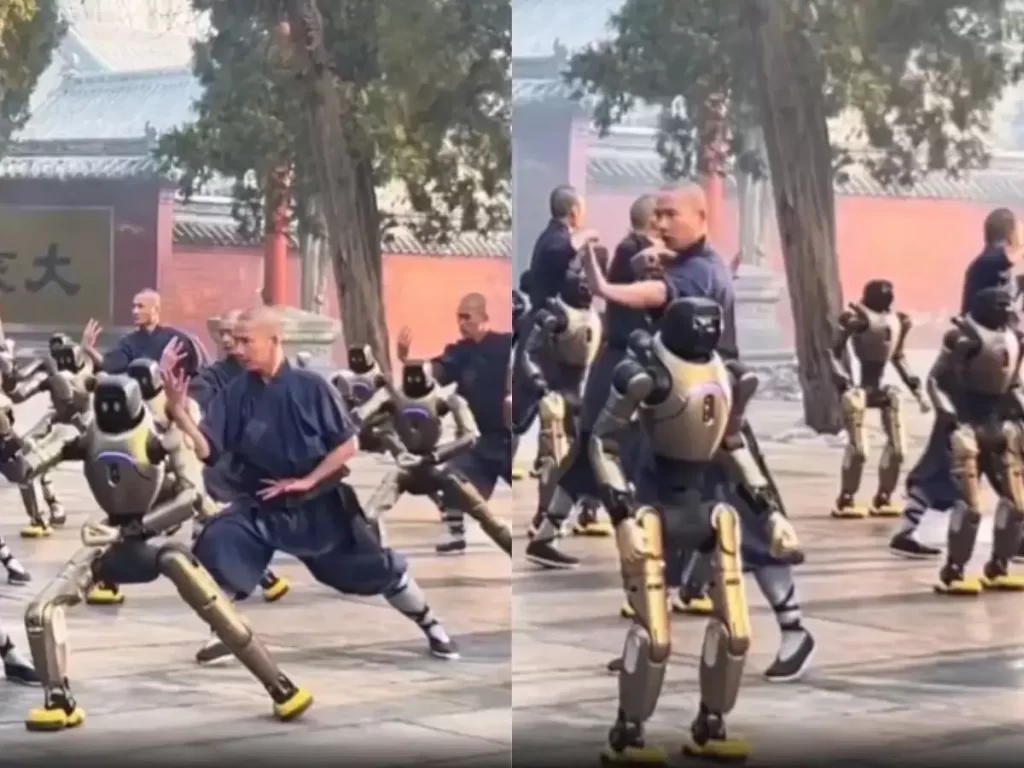
It’s great that Shaolin monks are now teaching robots how to execute Kung Fu. This is a terrific mix of old martial arts and current technology. People from all around the world have gotten quite interested in these movies and they are very popular. This amazing mix of technology and culture shows humanoid robots doing intricate forms in the holy halls of China’s Shaolin Temple. It starts a new time when AI will respect people’s past. People are sharing these pictures a lot on social media, and they are making people discuss about culture, new ideas, and the future of physical intelligence. A lot of people are amazed at how well the whirring servos and chanting masters work together.
In February 2026, sites like X, TikTok, and YouTube posted short videos of cute robots from companies like Unitree and Xiaomi practicing classic Shaolin moves like the Tiger Claw and Crane Stance. At this point, things got crazy. What started as a planned protest quickly expanded online and got more than 150 million views in less than a week. #RobotShaolin, #KungFuAI, and #TechMeets are some of the hashtags.People from Nagpur to New York talked about tradition. Some were amazed, while others held profound philosophical conversations.People who have been to the temple have seen weird things, like monks in robes changing the direction of a robot’s pivot while it was in the middle of a shape. The way they teach and the way the system offers exact answers make something beautiful that words can’t describe.
In late 2025, the Shaolin Temple in Henan Province, China, a UNESCO World Heritage Site recognized for Chan Buddhism and 1,500 years of martial arts, initiated this endeavor on purpose. The temple collaborated with the best robotics companies in China to digitize and share Kung Fu because fewer young people were joining and the monks were getting older. Engineers provided the robots complicated AI systems, like reinforcement learning algorithms that had been trained on a lot of data from videos of monks fighting, motion capture recordings, and philosophical writings regarding qi flow. What went wrong? Machines can not only duplicate things, but they can also change them. For example, they can avoid fake strikes with 85% accuracy and stay in meditation poses for a long time, all while obeying rigorous safety guidelines to keep the temple safe.
These Kung Fu robots are the best example of embodied AI from a technological point of view. They have neural networks like those that power self-driving vehicles, LiDAR to see where they are, high-torque actuators that give them the strength of great athletes, and gyroscopic stabilizers that help them move between forceful kicks and subtle balances without any problems. If you have better batteries, you can train for up to an hour without stopping. Computer vision can also notice subtle changes, like a monk’s weight changing or micro-expressions, which allows you guess counters. The Unitree H1 is a popular model that is known for how it works with people. It can hit with more than 500 Newtons of force and still seem graceful like Xiao Hong Quan. Safety procedures make ensuring that the force employed is safe for individuals. This illustrates that Kung Fu is all about controlled strength because joint sessions are more about learning than taking risks.
This isn’t just a gimmick for the Shaolin community; it’s a major step forward. Abbot Shi Yongxin has given the project a lot of support. He argues that robots are like modern-day disciples who help the temple reach more people around the world now that digital natives are in power. Urbanization has caused the temple to lose 20% of its new monks in the last ten years. Interest has surged by 45% since the movies came out, and thousands of people have attended virtual lessons with robot demos. Shaolin has always been willing to evolve. For example, it added Indian yoga to its practices in ancient times and Western boxing in the 1900s. They believe that AI is just another tool to keep their society going. Some people claim that “yi,” or spiritual intent, isn’t a part of real Kung Fu. Some people say that the machines’ perfect precision stimulates human students by displaying them pure form and taking away their egos.
People from all over the world have reacted, which has made the buzz grow a lot. Elon Musk, a millionaire in the computer business, joked on X about placing a Shaolin bot in a cage match. A lot of people talked about this post. People from all across the world used AR filters to replicate each other’s movements, which led to 600 million TikTok duets. Jackie Chan and other martial arts stars termed it “wuxia reborn.” Bollywood directors want to apply similar technology in their movies, which will merge Indian styles with a robotic touch. This is happening in India, where Kalaripayattu and other martial arts are prevalent. There were four times as many searches for “Kung Fu robot training.” This had to do with wider questions surrounding AI, like the growth of generative art and debates about whether machines can be aware. It supports China’s $20 billion robotics sector, which is predicted to grow three times as big by 2030 because of cultural exports.
If you take a closer look, you’ll see that the effects reach many various places. Students might be able to learn more easily from AI Kung Fu tutors if they could use apps to verify their form. This could cut down on injuries by 35% and assist students who aren’t in the same spot study faster. Gentle Shaolin flows in recovery programs can be excellent for the health care system. They help patients get well after strokes by making it 28% faster for them to move. The entertainment sector wants to make holographic dojos for VR fighting, and the defense industry wants to make training versions that don’t kill people. It makes you think about what’s good and wrong: Can silicon understand chi? The first attempts to use biofeedback loops to copy “emotional” responses to meditation chanting suggest that hybrid intelligence is conceivable.
There are still difficulties, which makes the win less fun. It’s hard to use a lot of them because it costs $60,000 to make each one. The software isn’t ready yet, either, since things like a Dragon Whip freezing in mid-air prove that it isn’t. Keeping the temple grounds clean and making sure that people don’t damage each other by accident are two environmental challenges. But things are getting better. Prototypes already feature haptic feedback, which allows you “feel” impacts. There are also ideas for international links, including Japanese karakuri-inspired bots and Brazilian capoeira hybrids.
When you compare items, you can see how much better Eastern invention is. Atlas from Boston Dynamics and other Western versions are great at parkour, but they don’t think as deeply as Shaolin, where every action is a reflection of Confucian harmony. Skill is shown by data snapshots:
Unitree H1 is good at high kicks and going fast (up to 3.5 km/h). There have been 50 million views on YouTube.
Xiaomi CyberOne is quite good at escaping grapples, which is a great skill for close-range forms.
Custom Atlas versions work like pounces, testing the limits of torque.
These numbers, which originate from several studies, show how specialized evolution is.
It’s a hit all over the world that robots learn kung fu from Shaolin monks.