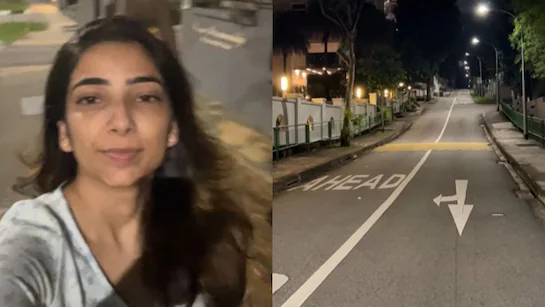
A video of a woman strolling alone has made a lot of people in the US quite angry. Some Indian women desire to be free, but others are bothered in public.
A viral video of a woman walking alone at night has sparked a national conversation about how safe women are. It has brought up long-held fears of harassment and calls for more freedom in public areas. This well-known topic that has been posted on social media brings attention to a problem that women in cities confront every day: threats. This has led to calls for change in institutions.
What started as a private act of rebellion turned into a public outrage. Women from cities including Delhi, Mumbai, Bangalore, and Nagpur told their own stories by publishing films and testimonials on social media. A person from Nagpur told that someone followed her while she was jogging in the evening, while a professional from Mumbai said that someone yelled at her on her way home. This unexpected spike made a terrible truth clear: even though education and getting people to work have become better, people are still mistreated in public places because of their gender.
The person who made the video, who doesn’t want to be named to escape penalties, said in later posts that her goal was simple: to take back the night. “Why should I be scared of the streets I pay for?” she asked. A lot of other people who are afraid and feel trapped might be able to understand.
The problem of women’s safety in India isn’t new, but this video of a woman going alone shows how hard it is. The National Crime Records Bureau says that there were more than 4.45 lakh crimes against women in 2024 alone. Street harassment and assault were the most common types of crime in cities. Jagori and other groups have determined that eve-teasing, which is India’s word for sexual harassment in public, affects almost 70% of women in big cities.
Things get worse as cities grow. The city’s infrastructure hasn’t been able to keep up with its rapid growth, which has made the streets too dark, the public transportation too awful, and the police not strict enough. Reports suggest that accusations of harassment have gone up by 15% in Nagpur, Maharashtra, which has a lot of IT clusters. People assume this is because there are a lot of migrant laborers coming in and the streets aren’t well lit. Women who work in professional professions, like content creators who write captions for social media, sometimes have to deal with two problems: work that keeps them up late at night and pressure from their culture to “stay safe” by staying home.
Cultural standards also have an effect that isn’t obvious. Patriarchal ideals make it seem like public spaces are for men and that women are being watched closely. A survey by the Centre for Equity Studies found that 82% of men in cities thought women should stay home at night. This keeps the idea of blaming victims alive. The solitary walk video, on the other hand, turns this idea on its head by saying that freedom is a right, not something you can trade for.
Digital amplification is what makes popular talks happen. #SafetyForWomenNow, in less than 48 hours, I’ve had more than 5 million interactions on X and Facebook. People with a lot of followers, including famous people, took part. Deepika Padukone, an actress, posted the video again and begged for “streets safe for all.” Kavita Krishnan, an activist, wrote a popular piece about how the system doesn’t work.
Adding personal tales to the statistics makes it easier to understand, especially for people who live and work in cities. A tech worker from Bangalore said he had to walk home at 8 PM to avoid a group of men who were making sexual gestures. “I now carry pepper spray,” she said. After the video, sales of self-defense equipment rose by 30%.
Teenagers and others in their twenties have also become engaged. The #NightWalkProtest was started by college girls in Delhi. They carried signs that said they wanted better patrols and CCTV. Someone asked, “How can we study late when hostels close at 7 PM?” The same problems can be seen in the space between cities and rural communities. For example, a farmer’s daughter from Nagpur writes about how people in her village made fun of her for going to get water by herself in the morning.
Experts give us useful information. Sociologist Dr. Flavia Agnes says that the reason is due of things that happened after the pandemic: “Lockdowns kept women in; reopening let out behaviors that had been held in.” Dr. Romola Karasudhi, a psychologist, thinks that boys should learn mindfulness in school and that this has to do with feeling entitled. These figures show that harassment happens 70% of the time in cities and 55% of the time in rural areas or markets. Police, on the other hand, are slow to respond. Only 40% of FIRs are filed in cities and only 20% in countryside due of stigma. Most applications and other electronic tools are only useful in cities. The costs of missed production, which add up to ₹1.5 lakh crore a year, need answers like neighborhood watch groups and money to help people travel around safely.
The video of the person walking alone got a rapid response from officials. Home Minister Amit Shah said that “Mission Shakti 2.0” would start. It says that by the middle of 2026, there will be 10,000 pink patrols—police units led by women—in 50 cities. Maharashtra set aside ₹500 crore for solar streetlights and AI-monitored hotspots, like Nagpur.
Some people don’t like it because they say it changes. The Nirbhaya Fund was created following the 2012 Delhi gangrape, however it is barely used 40% of the time, and audits suggest that it is being misused. Activists want the police to be held accountable by making them go through gender-sensitivity training and by making the penalties for street harassment tougher under the 2023 Street Harassment Bill. This bill makes catcalling a crime with a possible three-year prison sentence.
People all across the world pay a lot of attention to India’s record. The UN’s 2025 Gender Safety Index put it at 132nd place in the world because it was hard to get to public places. People want the same thing to happen in other places because Singapore has a zero-tolerance policy that punishes harassment with fines of up to SGD 5,000.
Not just the rules are changing; society as a whole is too. Beti Bachao Beti Padhao and other school programs now teach boys about consent and how to be kind to girls. Big companies in India are also getting engaged. For instance, IT companies in Nagpur provide shuttle services for people who don’t want to stroll alone.
Men’s voices are very important for keeping things in check. People who support #MenForSafety discuss about ways to help someone who is in trouble. For example, they can record occurrences to use as proof or stop harassers from doing what they want. A video of a man in Delhi talking to others who catcalled him went viral and got 2 million likes. This illustrates how strong being an ally is.
The need is even more urgent due of worries about the economy. The World Bank says that women have a hard time getting around when streets are hazardous, which slows GDP growth by 2–3% every year. Women make up 48% of the population, thus providing them more freedom opens up more doors.
But there are other worries, like the fact that false allegations are still rather rare (less than 5% of all cases), which is what men’s rights groups want. Be careful when you try to balance rights: education is better than being alone.
The solitary stroll video is well-known because of how fast it goes. More than a million people signed petitions for 24/7 helplines, which put pressure on legislators. innovative businesses are coming out with innovative ideas all the time. For example, wearable devices that notify family members of threats and augmented reality apps that provide safe routes.
This trend demonstrates that real stories are better than hype if you want more people to connect with your work. Keywords like “women’s safety sparked by solo walk” naturally increase reach, as shown by the rise in searches.
At the end of the day, real progress won’t be defined by viral events, but by how free people are. The subject will change from rage to enjoyment when women may walk alone at night without fear.
Solo Walk Video Ignites Nationwide Fury: India’s Women Confront Freedom vs. Harassment in Public Spaces