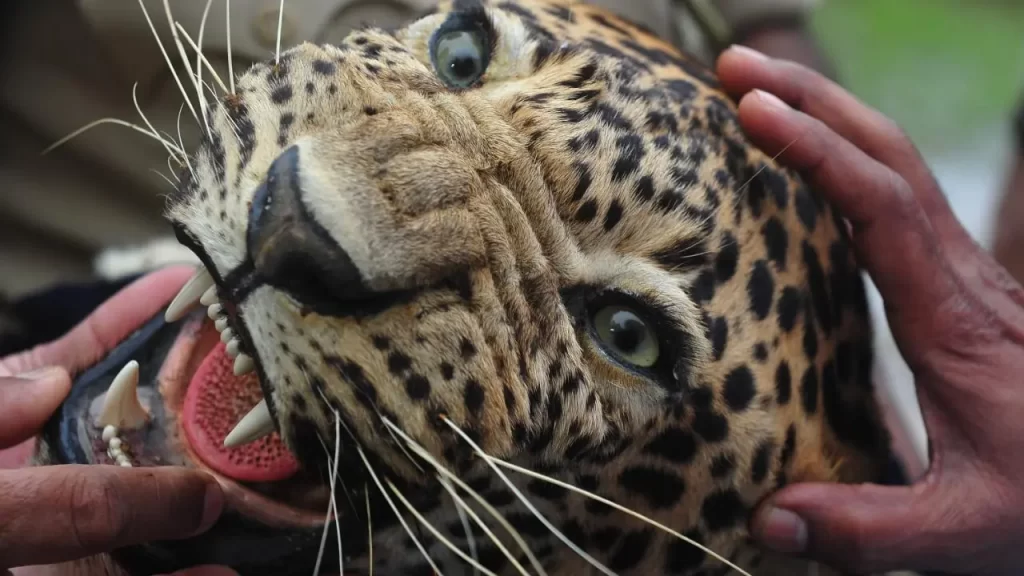
Millions of people have seen a heart-pounding movie about a brave animal rescue in a busy city. This has brought the subject of people and animals fighting more and more into the public view. This event shows how important it is for cities that are growing quickly to find ways to live in harmony with nature as they grow and nature strikes back.
The Rescue That Everyone Was Talking About
It garnered more than 50 million views on sites like X and Instagram in 48 hours. The video shows a group of local rescuers climbing a tall structure to remove a newborn leopard that was stuck on a small ledge. The video, which was first released by an NGO in Pune, India that protects wildlife, shows the cat pacing nervously while traffic horns and flashing lights below make a lot of commotion. Rescuers did a great job in the dark, using nets and tranquilizer darts to drop the drugged animal into a waiting rescue van.
This incident, which happened last week in Koregaon Park, a very busy area of Pune, highlights how people and animals are getting into more and more fights in cities. Leopards are creeping into areas where people live more and more because they enjoy to hunt easy prey like stray dogs and rats that live on the borders of cities. Experts believe that these kinds of break-ins have gone increased by 40% in Indian cities in the last five years. This is happening because the woodlands nearby are losing their homes and food. People like the film not just because of the drama, but also because it reveals how vulnerable both the leopard and the rescuers are in a real way. People are curious in how nature can coexist with people in modern cities.
This rescue is so powerful because it really happened and wasn’t made up. The unsteady handheld camera conveys real-time stress, like when a rescuer almost falls and the crowd screams, and the leopard makes its last, exhausted leap to safety. There were a lot of posts about it on social media. There were more than 2 million posts with hashtags like #UrbanWildlifeRescue and #HumanAnimalConflict all around the world.
Pune in the News: A Small Part of the Crisis
Pune is a hot spot for fights between people and animals due of its unusual terrain in the Sahyadri mountains. The city’s expansion has taken up forest pathways, which has pushed leopards from the surrounding Tamhini Ghat into neighborhoods. Local officials said they saw 47 leopards in 2025, up from 29 the year before. Three individuals died, and a lot of animals went missing.
Amit Khanolkar, a rescuer from the Pune Forest Department who is the star of the popular movie, claimed that the operation was typical but risky. He added in an interview after the rescue, “These cats are not aggressors; they are survivors in a world that is getting smaller.” The Maharashtra Forest Department states that 80% of urban leopards are young adults who are leaving their main areas. They are less experienced and more likely to mess up.
People in different communities react in different ways. People who live in communities that have been hit hard, like Baner and Aundh, have formed groups to keep an eye on things, set up motion-sensor cameras, and campaigned for stronger fences. But detractors contend that things like rescues that happen after the fact don’t take prevention into account. Dr. Vidya Athreya, an environmentalist who has studied urban predators for 20 years, says, “We’re treating the symptoms, not the disease.” Her study demonstrates that teaching people how to keep their trash safe and not feed stray animals reduces down on fighting by half.
Points of View from Around the World and the US
There are more than 500 conflicts between people and leopards in India every year, mostly in Gujarat, Uttarakhand, and Karnataka. There are slums around Sanjay Gandhi National Park in Mumbai, and there are 35 leopards living in a 100-square-kilometer area, which is one of the highest densities in the world. According to a government report from 2024, payments for losses were more than ₹50 crore ($6 million), which made budgets tighter.
There are a lot of things that are the same all throughout the world. In Brazil, capybaras dominate the streets of São Paulo. In Australia, kangaroos hit automobiles and kill 10,000 animals every year. Armed patrols are now in place because wild boars are damaging farms near Berlin. The United Nations Environment Programme argues that fights between people and animals cost the world $1.5 billion a year in lost business, not to mention the agony that can’t be calculated.
“Conservationists seek “smart urban planning.” One part of Singapore’s plan is green corridors, which are raised walkways that help animals cross roads without being observed. This reduces down on contacts by 70%. The National Tiger Conservation Authority in India wants new roads to have places where animals can cross, but these haven’t been built yet.
Advice and Numbers from Experts
In 2025, there will be 220 incidents, 12 deaths, and ₹15 crore in economic losses in Maharashtra. There have been 150 incidents, 8 deaths, and ₹10 crore in losses in Karnataka. There have been 110 occurrences in Uttarakhand, 15 deaths, and ₹12 crore in losses. These fights cost the world more than $100 billion in losses.
Dr. Bilal Habib, an ecologist who studies predators, says that we need to lower conflict: “GPS collars and AI cameras can predict movements and warn communities ahead of time.” Pilot projects in Uttarakhand have cut down on incidents by 35% using these methods.
Public health experts warn that zoonotic infections are a problem because wild animals in cities can spread diseases like rabies. After being bitten by a leopard, 20,000 Indians need post-exposure prophylaxis every year. The repercussions on mental health are huge; a survey of 500 people in Pune found that 62% of them felt uneasy after seeing the creatures.
The viral wildlife rescue has sparked an important conversation about the challenges that come up when people and animals live in cities.