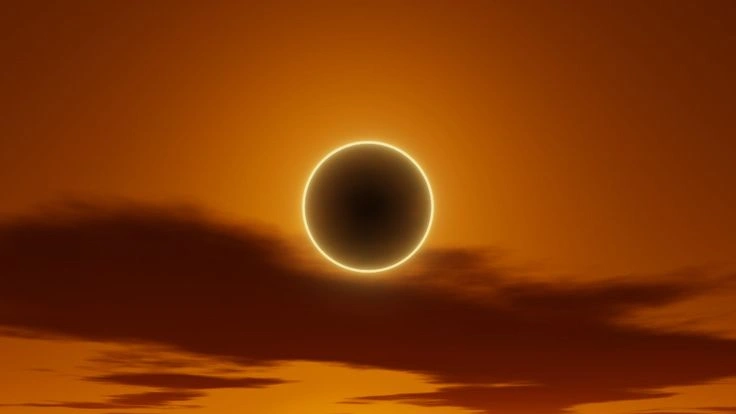
The annular solar eclipse on February 17, 2026, will be a stunning “ring of fire” show mostly over Antarctica’s frozen surface. This celestial occurrence, in which the Moon looks smaller than the Sun, makes a luminous ring around the lunar silhouette that fascinates scientists and astronomers all over the world.
Learning about the science behind the eclipse
When the Moon passes between Earth and the Sun but doesn’t completely cover the solar disk because it looks smaller from our point of view, that’s an annular solar eclipse. This position is because the Moon is close to its apogee, which is the farthest point from Earth in its orbit. It will be at this place on February 10, 2026, 6.8 days after apogee.
The eclipse has a magnitude of 0.963, which means that at its peak, the Moon blocks 96.3% of the Sun’s diameter. This leaves a bright ring visible for up to 2 minutes and 20 seconds in the central path. The most important scientific numbers are a gamma of -0.97427, which means the journey is close to the southern polar regions of Earth, and a total period of 271 minutes from the first touch to the last.
During annularity, the Sun’s corona may faintly be seen surrounding the ring if the conditions are just right. However, the photosphere is never entirely blocked, thus rigorous eye safety measures are needed. Experts say that you should only use ISO 12312-2 approved solar glasses since looking directly at the sun without protection can cause lasting damage to your retina from strong UV and infrared rays.
Maps showing the Path of Annularity and Visibility
The short route of annularity only goes across Antarctica, which is very rare. This makes it one of the most remote eclipses in the last few decades. The central line starts in the southern Indian Ocean, goes near the Ronne Ice Shelf, and terminates in the southern Atlantic Ocean. The moment of greatest eclipse is at 12:13 UTC.
At Concordia Station, the annularity starts at 19:46 local time, reaches its highest point at 19:47 with 92.46% coverage, and lasts for 2 minutes and 5 seconds. Using Google projections, interactive visibility maps show the saddle-shaped area of the penumbral shadow that includes partial views. Green curves mark the northern and southern borders of this area.
Partial phases reach the southern ends of Argentina and Chile, such as Punta Arenas, which has a maximum coverage of 1.81% over 44 minutes, and parts of southern Africa.
The best places to see the full annular view are Concordia Station in Antarctica (92.46% coverage for over two minutes), Casey Station (91.29% coverage for a deep partial), Cape Town in South Africa (5.19% at midday), Durban (16.10%), Punta Arenas in Chile (1.81% for less than an hour), and Maputo in Mozambique (13.10%).
Best Viewing and Safety Rules
Viewers should put safety first because the Sun is still partially visible. Never use cameras, telescopes, or other optical devices without the right solar filters. These can focus the rays and cause burns. Check the eclipse glasses for damage before you use them, and keep a tight eye on the kids.
Research sites like Concordia and Casey in Antarctica get specific equipment ready while fighting subzero temperatures and strong winds. Live streaming from these outposts will let people all across the world see the event, making up for the fact that they can’t be there in person. People in southern Africa, from Cape Town to Durban, can see parts of the Sun’s edge during the day.
Timing peaks are different: 14:43 local time in Cape Town, when the sky are clear in the summer, although clouds can be dangerous.
Importance in History and Culture
Solar eclipses have long been more than just science; they have become part of stories told in many cultures throughout the world. Hindus call this event Surya Grahan. It happens around Chinese New Year 2026 and represents a fiery change connected to the Year of the Fire Horse, which is a time of energy, bravery, and uncertainty.
In the past, annular eclipses have inspired awe. Ancient records from Saros series 121, which dates back to 944 AD, show that similar rings were seen as omens or signs from God. Astrologers say that this Aquarius eclipse is connected to social unrest, technological advances, or changes in the environment, although there is no scientific proof for this.
In the southern hemisphere, indigenous civilizations saw eclipses as cosmic dances, while modern Inuit and African societies see them as a sign of rejuvenation. This eclipse is even more mysterious because it can only be seen from the poles, which adds to its sense of isolation and awe.
Opportunities for Scientific Research
Antarctica’s clean darkness is the best place to study the Sun’s chromosphere during annularity. Scientists at Concordia work at temperatures as low as -50°C to set up coronagraphs and spectrographs. They are studying solar activity during the quiet Sun phase after the maximum in 2025.
Data collection focuses on Baily’s beads, which are bursts of light from solar valleys, and possible plasma ejections that would be hard to see otherwise. These kinds of missions put lives at risk to learn more about space weather that affects communications and power grids on Earth. The fact that researchers from India and Europe are working together on the event shows how important it is for research around the world.
This eclipse fits Saros 121, which happens every 18 years and 11 days. There were previous events in 2008 and future events in 2044. This helps with long-term solar pattern study.
Getting Ready for the Event: People Are Getting More Excited All Over the World
Astronomy clubs are getting ready for February 17 as it gets closer. Virtual observatories and apps indicate paths, and southern African tourism promotes partial views from Johannesburg (7.93% coverage) or Marion Island (47.62% coverage).
There is no visibility in India or the northern hemisphere, which makes direct access impossible, but web feeds from Antarctic bases make sure everyone can see. Weather forecasts say that the skies over Antarctica will be clear, which makes people even more excited.
Get ISO-certified glasses in stock early.
Watch live feeds from NASA or ESA partners.
Join citizen science by using apps to record partial observations.
The Rare Annular Solar Eclipse of February 17, 2026, in Antarctica’s Ring of Fire