Today is April 2nd. Yesterday, the internet was full of pranks, jokes, and deliberate misinformation — all in good fun, all clearly labeled as fiction. But the moment April Fools’ Day ends, something more serious begins.
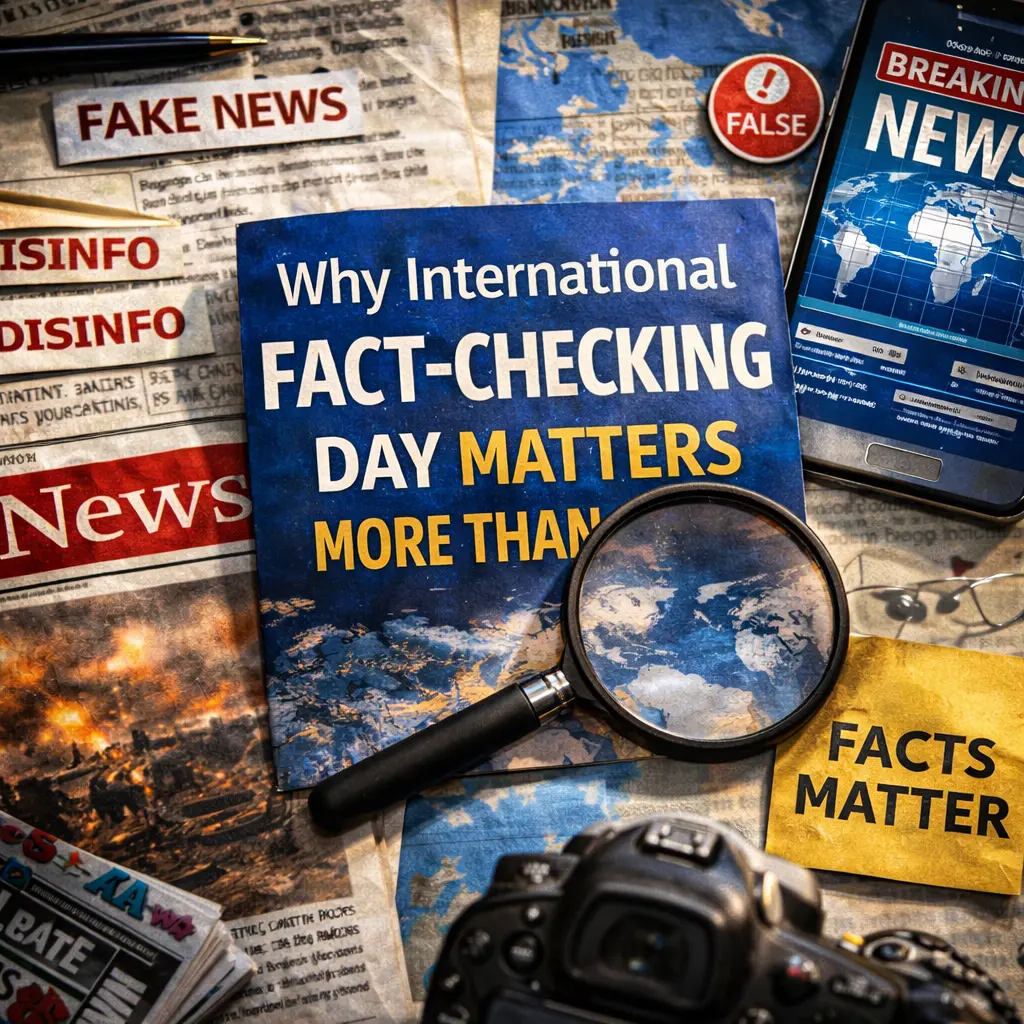
April 1 is a day for fools. April 2 is a day for facts. That is the spirit behind International Fact-Checking Day, a global observance that has quietly become one of the most important dates in the modern media calendar. And in 2026, with wars raging, elections looming in multiple countries, and AI-generated content flooding social feeds, the timing could not be more urgent.
How It All Started
The first official observation of International Fact-Checking Day was on April 2, 2017, but the concept was first conceived in 2014 at a conference for journalists and professional fact-checkers at the London School of Economics. The conversation that day was simple but sobering: political misinformation on social media was growing faster than journalism could keep up with. Something needed to be done.
The International Fact-Checking Network (IFCN) launched the day in 2016 to celebrate the vital work of fact-checkers worldwide and has marked it annually since. What began as a modest awareness campaign has grown into a genuinely global movement, drawing participation from newsrooms, universities, tech companies, and ordinary citizens across dozens of countries.
The date itself is deliberate and rather clever. It is observed on April 2, immediately after April Fools’ Day. The playful contrast suggests that once the jokes end, it is time to examine information carefully. Misinformation, after all, rarely announces itself. It does not arrive wearing a clown hat. It slips in wearing the face of a trusted source, a familiar voice, or a headline that confirms exactly what you already believed.
The Problem That Won’t Go Away
Let’s be honest about what we’re dealing with. In a world where news comes from all kinds of social media sources — ranging from Twitter to Reddit to Instagram — information and media can very easily be manipulated to misguide or sway public opinion. We have all seen it happen. A misleading clip goes viral before the correction even gets written. A false statistic gets quoted in a speech. A photoshopped image circulates for days, reshaping how thousands of people understand an event that never happened the way they think it did.
This is not a new problem, but the speed and scale of it are new. In earlier times, rumors might remain local. Today, digital platforms allow them to spread globally within minutes. Social media often rewards speed, simplicity, and emotional impact — qualities that can conflict with careful verification. In short, the architecture of the internet was not built with truth in mind. It was built for engagement. Those are very different things.
Fact-checkers grapple with dwindling resources and escalating attacks, both personal and institutional. The people doing this work — cross-referencing claims, tracing sources, spending hours verifying a single sentence — are often underfunded, understaffed, and increasingly targeted by the very people whose falsehoods they are exposing. That is the reality of journalism ethics in practice today.
What Fact-Checkers Actually Do
There is a common misconception that fact-checking is about “gotcha” journalism — catching politicians in lies to score points. That is a shallow reading of what the profession actually involves.
The IFCN boasts over 170 member organizations, each rigorously vetted and adhering to a stringent code of principles — a commitment to nonpartisanship, transparency in funding, and meticulous sourcing. These organizations do not just flag falsehoods. They explain their methodology. They publish corrections. They name their sources. In other words, they model the kind of media ethics that the entire industry should aspire to.
Research suggests that fact-checking can indeed correct perceptions among citizens, as well as discourage politicians from spreading false or misleading claims. The knowledge that a claim will be scrutinized publicly changes behavior — not always, not fast enough, but meaningfully over time. Facts, it turns out, do matter, even in an era when many people seem to have given up on them.
This Is Everyone’s Responsibility
Here is the uncomfortable truth that International Fact-Checking Day keeps returning to: professional fact-checkers cannot do this alone. There are not enough of them, and the volume of misinformation that circulates daily is simply too large for any network of journalists to fully manage.
It is not just important for professional fact-checkers to check facts, but for everyone to participate. That means each of us. Before you share that article, ask yourself: where does this come from? Is the headline telling the whole story? Does this source have a track record of accuracy? These are not complicated questions. They just require a moment of pause that social media is deliberately designed to eliminate.
Adopting a simple “pause before posting” rule can make a difference. Misinformation spreads quickly because it often triggers strong emotions such as outrage, fear, or excitement. Taking a brief moment to check the details helps prevent the spread of inaccurate claims.
Global awareness around this issue is growing, but so is the sophistication of misinformation. Every day is a race between those who manufacture false narratives and those who work to dismantle them. The gap between truth and falsehood has real consequences — for elections, for public health, for peace, and for the kind of society we hand on to the next generation.
Today, April 2, is the day we recommit to being on the right side of that race. Not just as journalists, but as citizens. Because in the end, a well-informed public is the only foundation democracy has ever truly had.