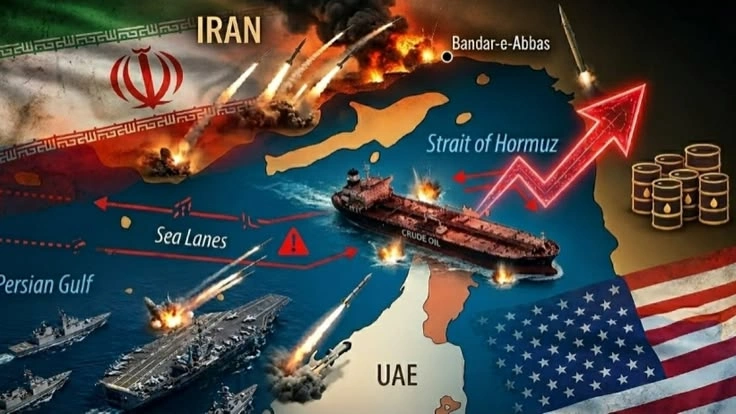
The flow of tankers through the Strait of Hormuz has come to a standstill, sending ripples of concern across the globe.
Ships are maneuvering to avoid trouble, insurance companies are sweating bullets, and the cost of oil is climbing—a precarious situation that’s unsettling energy markets. This crucial maritime route, responsible for about a fifth of the globe’s oil supply, is a bottleneck, and even small hiccups are creating major headaches that ripple well beyond the Persian Gulf.
For nations like India, dependent on imports from the area, this isn’t just a news story; it’s a reality of rising fuel costs and potential factory slowdowns.
As of early April 2026, satellite data and shipping trackers indicate that tanker transits have decreased by almost 30% compared to the previous month’s averages.
Iranian-backed militias are stepping up their intimidation efforts.
We’re seeing drones hovering over our vessels, ominous messages on the radio, and a few close calls involving limpet mines.
No full block yet, but the fear factor is real. Global benchmarks like Brent crude have jumped 12% in the past week alone, hovering above $95 a barrel. And with summer demand kicking in, how long before this tips into a full-blown energy crunch?
The Strait of Hormuz: A Vulnerable Lifeline
Imagine a narrow channel, barely 21 miles across at its narrowest point, wedged between Iran and Oman.
The Strait of Hormuz isn’t some obscure passage; it’s the critical channel for 21 million barrels of oil every day, along with a fifth of the world’s liquefied natural gas. Any disruption here doesn’t just send prices soaring; it chokes off supply chains stretching from Asia to Europe.
Recent flare-ups trace back to escalating Iran-Israel shadow wars. Tehran, smarting from sanctions and fresh airstrikes on its proxies in Yemen, has leaned on the Houthis and other allies to squeeze the strait. Last month, a Greek-owned tanker took drone fire, limping to port with hull damage. Insurers responded fast, slapping war-risk premiums that doubled overnight—now up to $50,000 a day for some vessels. Shippers are rerouting around Africa, adding weeks and burning extra fuel, which ironically pumps more emissions into an already warming planet.
Data from the U.S. Energy Information Administration underscores the stakes:
Daily oil flow: Typically 20-21 million barrels, enough to fill 1,400 Olympic pools.
Key exporters: Saudi Arabia (5.5M bpd), UAE (3M bpd), Iraq (3.5M bpd), plus Iran’s stealthy 1.5M bpd smuggling.
LNG impact: Qatar sends 80 million tonnes yearly through here—disrupt that, and Europe’s gas bills skyrocket.
Oman, playing neutral host, has boosted patrols, but it’s a band-aid. What happens if Iran mines the channel or sinks a ship? Ever wonder why no one’s built a bypass pipeline big enough to sidestep this mess?
Iran’s Playbook: Leverage and Retaliation
Iran knows the strait’s power all too well. Back in 2019, they seized a British tanker in tit-for-tat with London. Now, with U.S. sanctions biting harder under the new administration and Israeli jets pounding Hezbollah, Tehran’s dialing up the pressure. Supreme Leader Khamenei’s advisors have hinted at “closing the strait” if provoked further—rhetoric that’s spooked markets before.
But it’s not all bluster. Iran’s Revolutionary Guard has rehearsed swarm attacks with speedboats and missiles. Their oil exports, mostly to China via “dark fleet” tankers that dodge trackers, are down 15% this month. That forces Tehran to hoard or burn crude domestically, tightening the noose. Analysts point to internal docs leaked last week showing fuel rationing talks in Tehran—ironic for the country sitting on 10% of world reserves.
Still, balance matters. Iran needs the cash flow; a total shutdown would boomerang, alienating buyers like China, which guzzles 11 million bpd and sources 10% from the strait. President Pezeshkian’s moderates are pushing back against hardliners, but proxy attacks give deniability. It’s a high-wire act, and one slip could ignite wider conflict.
Global Oil Supply Ripples: From Pumps to Power Plants
The fallout? Rising energy prices are hitting wallets everywhere. In the U.S., gasoline averages $4.10 a gallon, up 25 cents in days. Europe, weaning off Russian gas, faces blackouts if LNG stalls—Germany’s already rationing industrial use.
Asia bears the brunt. Japan and South Korea, 90% import-dependent, are tapping reserves. China’s stockpiling like mad, buying discounted Russian and Iranian crude while urging OPEC+ to pump more.
Then there’s India. As the world’s third-biggest oil importer, Mumbai’s refiners gulp 5.2 million bpd, with 85% from the Middle East—Saudi, Iraq, UAE via the strait. Disruptions mean pricier diesel for trucks hauling veggies to markets, costlier aviation fuel grounding budget flights, and inflation ticking up. The rupee’s already wobbly against the dollar; add $10 oil spikes, and RBI rate cuts get dreamier.
IndianOil Corp reported last week they’re diverting two supertankers via the Cape of Good Hope—costing an extra $2 million each in fuel and delays. “We’re monitoring hourly,” a spokesperson said. Government advisors whisper of strategic reserve releases, but those 5.3 million tonnes cover just 10 days. Farmers in Punjab, reliant on diesel pumps, are grumbling as fertilizer costs climb. How does a nation of 1.4 billion cope when every extra rupee at the pump bites?
OPEC+ is scrambling. Saudi Arabia, with spare capacity of 3 million bpd, pledged voluntary cuts reversal, but members like Russia—tied up in Ukraine—drag feet. Iraq’s fields are maxed, prone to sabotage. A quick production bump could ease 2-3 million bpd shortfalls, but trust issues linger.
Economic Shockwaves and Market Mayhem
Markets hate uncertainty, and this is prime chaos. Wall Street’s energy stocks surged—Exxon up 8%, Chevron 6%—while airlines tanked. Hedge funds bet big on $100 oil by June, citing IEA forecasts of tightening supply.
Corporate America feels it too. Chemical behemoths such as Dow depend on inexpensive naphtha sourced from the Gulf; any disruptions there translate into factory shutdowns. Tesla and its rivals in the electric vehicle space are probably pleased, as surging gasoline prices are nudging buyers toward more environmentally friendly choices. Boeing, on the other hand, is grappling with difficulties, with delays mounting as jet fuel prices continue to rise.
India’s angle sharpens the lens. Adani and Reliance, building mega-refineries in Jamnagar and Ratnagiri, aimed to cut import bills. Now? They’re hedging futures at premiums, squeezing margins. Stock market volatility spiked; Nifty energy index swung 5% daily. PM Modi’s team eyes biofuel pushes and solar ramps, but short-term, it’s pain. Economists peg a 1% GDP hit if prices hold at $100—stinging exports amid a slowing global economy.
Geopolitics complicates things. Biden’s administration sent carriers to the Gulf, a move designed to prevent things from getting worse. China, meanwhile, is playing the role of quiet mediator, looking out for its interests in the Belt and Road Initiative. Russia, on the other hand, is smiling, shifting its Urals crude to India at bargain prices—a smart move in response to European restrictions.
Shipping’s Nightmare: Reroutes and Insurance Woes
Captains aren’t waiting for orders. Maersk and BP paused transits; others hug Omani waters. AIS trackers show 40 fewer tankers weekly. Rerouting south adds 10-15 days, $1-2 million per voyage.
Insurers like Lloyd’s of London hiked rates 300% for “high-risk” zones. Crews, mostly Filipino and Indian, demand hazard pay or jump ship. One Mumbai seafarer told contacts: “Drones overhead? Not for double wages.”
Pipelines offer outs—Saudi’s East-West carries 5 million bpd to Red Sea ports, UAE’s Habshan-Fujairah 1.5 million. But capacity’s capped; scaling takes years, billions.
Navigating the Storm: What’s Next?
No one wants war, but brinkmanship rules. Diplomatic channels hum—Omani sultans shuttle talks, UN envoys plead restraint. A ceasefire in Yemen or U.S.-Iran nuclear thaw could calm waters fast.
Yet risks mount. Summer hurricanes, Venezuelan unrest, even Canadian wildfires strain supplies. IEA members eye coordinated releases; India’s joining SPR drills.
For consumers, brace for pain: expect petrol at ₹110/litre in Delhi soon, groceries up 5-7%. Companies are adjusting, embracing remote work and conducting efficiency reviews.
Long-term? It accelerates the green shift. EVs in India hit record sales last quarter; wind farms off Gujarat multiply.
The Strait of Hormuz disruptions remind us how fragile our energy web is—one hotspot unravels the lot. Will cooler heads prevail, or are we staring down $120 oil? History says markets adapt, but not without scars. Leaders must act—diversify routes, boost reserves, cut demand. Until then, the tanker’s low fuel light flickers for us all.
Strait of Hormuz Disruptions Spark Global Oil Supply Fears as Prices Surge