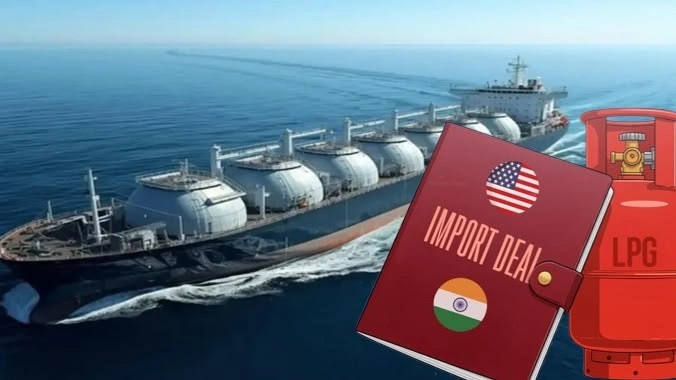
The government has quickly stepped in to help two huge LPG ships that were stalled in the dangerous waters of West Asia. This has calmed anxieties over India’s cooking gas supply. This happens as tensions in the region rise, with Houthi strikes on sea waterways interrupting global commerce lines. The timing couldn’t be worse for millions of Indian homes that depend on subsidized LPG cylinders. It’s a reminder that conflicts may affect people quite close to home, putting everything from daily meals to industrial output at risk.
Last week, the crisis began when ships carrying more than 100,000 tons of liquefied petroleum gas (LPG) to Indian ports became caught in the crossfire of new fighting in the Red Sea and Arabian Sea. India’s government used diplomacy and naval coordination to change the ships’ routes to safer ones near Africa. This not only saved the cargo, but it also showed that New Delhi’s power to protect its energy interests was expanding. As the West Asia crisis spreads through global markets, India’s involvement shines out as a smart mix of diplomacy and force that kept shortages from happening.
The Spark: Attacks by Houthis and problems with shipping
Imagine this: huge tankers moving across tiny straits and being hit by drones and missiles out of nowhere. That’s what ships have to deal with when they go through the Bab-el-Mandeb Strait, which connects the Red Sea to the Gulf of Aden. Since late 2023, the Houthi rebels in Yemen, with Iranian backing, have ramped up their attacks. They assert these actions are a demonstration of solidarity with the Palestinians, given the ongoing conflict between Israel and Hamas.But their attacks have hurt commercial ships a lot, sinking some and making dozens of others stop working.
Last Thursday, two LPG carriers flying the Indian flag, the MV Jagriti and MV Lakshmi, were attacked. They were on their way to Mundra and Kochi with propane and butane from Qatar’s Ras Laffan port, which is one of India’s main supplies of domestic LPG. Houthi drones flew above the ships, and the commanders sent out distress signals. In a matter of hours, India’s Ministry of External Affairs brought in the Indian Navy’s Western Fleet, while the Shipping Ministry worked with international maritime authorities.
Why LPG in particular? It’s not only about stoves in the kitchen. India gets over 60% of its LPG from other countries, mostly from the Gulf. This adds up to more than 12 million tonnes a year. If things go sideways, it could mean higher expenses and depleted stock at the depots. This is particularly concerning with the summer wedding season approaching.
The government’s rescue made sure that fuel supplies were safe in the short term, giving them time to build up their strategic reserves.
India’s Naval Edge and Diplomatic Push
India’s response was textbook efficient, but it wasn’t the only thing that happened. The Indian Navy supplied real-time escort, with its INS Vikrant carrier group patrolling the area. Sanjay Jasjit, a rear admiral, told reporters off the record that P-8I surveillance planes were able to follow the ships from 500 nautical miles away. “We converted a possible calamity into a safe passage,” he said, stressing how the navy’s Project 75I submarines keep an eye on hazards.
New Delhi relied on its relationships with Saudi Arabia, the UAE, and Qatar, which are its primary suppliers of LPG, to get what it wanted. Petroleum Minister Hardeep Singh Puri made a high-level call to Qatari officials that approved alternative charters. The External Affairs Ministry also sent warnings to more than 200 Indian-crewed ships in the area, many of which are run by companies like Shipping Corporation of India (SCI).
This isn’t India’s first time. In January 2024, Operation Sankalp stopped pirates from hijacking ships off the coast of Somalia. Now, as the crisis in West Asia gets worse, it has become a full-spectrum shield. The Directorate General of Shipping said that Indian ships handled 15% more LPG last year, even if there were risks, because of these kinds of actions.
Important facts about India’s LPG lifeline:
65% of imports come from the Middle East, with Qatar sending 50% and the UAE sending 25%.
5 million tons of domestic production come from refineries like IOCL’s Panipat.
310 million connections for subsidized cylinders, which stops black market increases.
What does this entail for people who work on ships? More than 10,000 Indians work on tankers around the world. Rescues like these save lives and jobs.
Economic Ripples: High fuel prices and problems with trade around the world
It’s not just a headline; the West Asia problem is affecting people’s wallets all over the world. According to Baltic Exchange indexes, the cost of shipping LPG has doubled since October. This is because ships are now taking a longer route through the Cape of Good Hope, which adds 10 to 14 days and $1 million in fuel expenditures every journey. India is the second-largest importer of LPG after China. If this continues, it might cost India an extra $500 million.
But the rescue made things less bad. Indian Oil Corp (IOC) and Bharat Petroleum (BPCL), two big companies in the public sector, said there were no shortages. Their terminal stockpiles were at 1.2 million tonnes, which is ample for six weeks. Retail pricing stayed the same at ₹803 for a 14.2 kg cylinder, which was good news for many who were tired of inflation. Industrial users, such petrochemical facilities in Gujarat and food processors in Tamil Nadu, were also happy.
It’s a different tale around the world. As Russian LNG supplies run low and US exporters turn their attention to Asia, Europe’s LNG terminals are in a race to get supplies. India’s quick turn shows how hard it is working to diversify: long-term arrangements with the US and Australia currently cover 20% of its needs. Experts are still worried, though. Vandana Hari, an energy analyst at Vanda Insights, says, “One more escalation, and prices could go up by 10–15%.”
Think about how this might affect ordinary life in India. What if there were no smooth gas refills during Diwali, or if small restaurants in Mumbai had to close? The government’s buffer, which is 5.3 million tons of strategic petroleum reserves, is a safety net, but it’s not unlimited.
Geopolitics on a larger scale: India’s balancing act in West Asia
India is on a tightrope here. Strong links with Israel (defense purchases over $3 billion a year) are at odds with ties to Iran (the Chabahar port project) and Gulf states (remittances from 9 million expats). The Modi government has condemned Houthi attacks at the UN while sending aid to Gaza by air. This is diplomacy at its most fragile.
This LPG rescue is part of a pattern. India helped set up the India-Middle East-Europe Corridor (IMEC) last year, which goes around dangerous waterways. The Ujjwala system has given 100 million rural women access to clean fuel, making supply security a political priority before state elections.
But there are still questions: How long can this naval babysitting last? And what if the Houthis attack Indian navy ships? “Are we ready for a patrol that lasts forever?” In a Delhi think tank meeting, one former admiral thought about it.
Voices from the Ground: Shippers, Families, and Experts Speak Up
Captain Rajesh Kumar of MV Jagriti told the story from the front lines: “We witnessed flares lighting up the sky. Navy helicopters came on time, and the relief was tremendous. Families in Kerala’s coastal areas waited nervously, hooked to their tracking applications.
People in the industry are happy. Ashwani Kumar, the president of FIEO, dubbed it “a lesson in how to be strong in the supply chain.” Environmentalists point out a silver lining: detours lower emissions in the Suez Canal for a short time, but overall carbon footprints go up.
Few people in Nashik’s busy markets or Delhi’s tall buildings connect the dots to West Asia. But this story shows how weak we are. India’s $125 billion energy import bill needs bolder action, like new refineries and green hydrogen pilots.
Why India Isn’t Panicking: Domestic Boost
Give credit to the prep effort. Since 2022, the Pradhan Mantri Ujjwala Yojana 2.0 has given over 30 million free cylinders, which has increased demand. ONGC and Reliance are increasing their local propane production with the goal of being self-sufficient by 2030. Bio-LPG tests in Punjab that mix farm waste with fossil fuels look promising.
In the short term, auctions for spot cargoes from Nigeria fill in the gaps. Long-term, Petronet LNG’s Dahej project will add 5 million tonnes of capacity by 2027.
India saves stranded LPG ships in the West Asia crisis and secures its fuel supply as tensions rise.