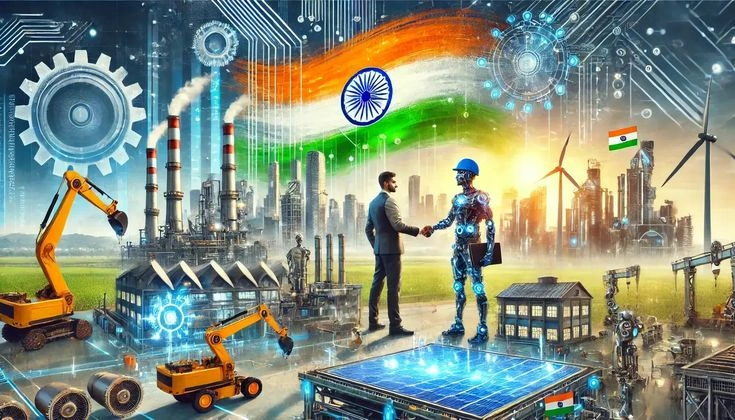
A quiet revolution is happening in the congested hub of Mumbai, where skyscrapers rise above the smoggy skyline and traffic never stops. India’s goal for urban growth is changing swiftly. Cities are no longer merely places where people dwell; they are also “engines of advancement.” This reform, which is part of recent improvements to fiscal planning, will pour trillions of dollars into infrastructure, housing, and smart technology. But when Prime Minister Narendra Modi’s government implements these changes to the budget in 2026, one question remains: Will India’s megacities actually help everyone get richer, or will they only make the difference between sparkling towers and enormous slums even bigger?
For a long time, cities have been the engines of economic miracles in places like China and Singapore. But in India, where more than 500 million people are predicted to reside in cities by 2030, the stakes appear very high. adjustments to the budget, like adjustments to the 15th Finance Commission’s recommendations and the push for municipal bonds, are making this vision stronger. We need to make cities work better if we want to accomplish our hard-to-reach target of 8–9% GDP growth. Let’s take it apart.
The Fiscal Backbone: Changes that are Helping Cities Grow
A significant aspect of this idea is changing how money gets to cities. During a bad moment for the world economy, the Union Budget for 2026–27 set aside a hefty ₹1.2 lakh crore for urban development. This is a 25% increase from last year. This isn’t just arbitrary spending; it’s supposed to turn cities into engines of growth.
One of the most essential improvements is to give Urban Local Bodies (ULBs) more control over their own money. The 74th Constitutional Amendment has been a paper tiger for a long time, but now it gives states incentive to give up some of their rights. For instance, adjustments to property taxes in states like Maharashtra and Karnataka are projected to triple city revenues by 2030. Mumbai’s BMC might make more than ₹1 lakh crore a year if digital evaluations stay in place.
There is also a rise in municipal bonds. Last year, Pune, which is in Maharashtra and is the user’s own backyard, made ₹200 crore through green bonds for projects that are excellent for the environment, such as solar-powered streetlights and facilities that turn trash into energy. More than 12 cities in India have used this market to raise ₹4,000 crore since 2017. These bonds, which are backed by money from the government, lower the cost of borrowing and show that investors have faith in the government.
Fiscal federalism is also highly significant. The Finance Commission raised ₹4.36 lakh crore from 2021 to 2026. Sixty percent of that money went to urban needs like water supply and sanitation. But what truly made a difference? Rewards based on how well you do. Cities that meet certain criteria for dealing with solid waste or cutting down on water that doesn’t make money get more money. Last year, the Bruhat Bengaluru Mahanagara Palike (BBMP) in Bengaluru won an extra ₹500 crore since they lowered water losses by 15%.
NITI Aayog says that Indian cities make approximately 60–70% of GDP but just 35% of the people. These steps are supposed to remedy this. They can’t pay off their debts since they don’t have enough money.
Focus on Flagship Missions: From Smart to Lasting
The large plans are an important part of any conversation on urban strategy. The Smart Cities Mission (SCM) made 100 cities better. It is now in its extended phase till 2025, but the consequences will persist for a long time. Indore, which is often named India’s cleanest city, used SCM money to classify rubbish with AI. This cut the quantity of trash delivered to landfills by 40%. In the meantime, Pune put up smart traffic lights that made traffic 20% less congested on major highways.
The Atal Mission for Rejuvenation and Urban Transformation (AMRUT 2.0) is all about water and sewage. It wants to spend ₹2.87 lakh crore to bring water to all 500 cities by 2026. This meant that 1.5 million families in Chennai had running water all day, every day. They didn’t had to use tankers for the first time in decades.
The purpose of PMAY-Urban 2.0 is to create 2 crore affordable dwellings by 2030. This would help housing a lot. Some of the fiscal initiatives that are supporting private investment are loan guarantees and interest subsidies. Delhi’s push led to the building of 1.5 lakh apartments, which included both high-rise buildings and groups of low-income people.
The urban branch of the Jal Jeevan Mission is quietly heroic. Their aim is universal access to tap water by 2028. While data indicates a 40% increase in coverage since 2021, cities like Jaipur continue to grapple with the effects of arid conditions.
Here’s a brief overview of the mission’s impact:
The Smart Cities Mission has seen the completion of over 7,000 projects, with an investment of ₹1.7 lakh crore. IoT sensors are now monitoring air quality in 50 cities.
Under AMRUT 2.0, 1.5 crore additional water taps have been installed, and the sewage treatment plant’s capacity has increased by 30 million liters per day.
PMAY-Urban has approved housing for 1.2 crore homes, with 80 lakh already finished. The current focus is on exploring rental housing solutions.
These figures represent more than just statistics; they are vital resources for countless city dwellers.
Case Studies: Pune and Beyond as Models for Expansion
Pune serves as an excellent illustration of “engines of progress.” Hinjewadi, home to major tech firms like Infosys, contributes 10% of Maharashtra’s GDP. Thanks to tax reforms, the city successfully issued India’s inaugural green municipal bonds in 2024. These bonds are funding a solar park with a capacity of 100 MW and 500 EV charging stations.
Traffic? An integrated command center uses real-time data to cut commute times by 25%. In Pimpri-Chinchwad, 50,000 workers live in areas where housing is cheap. This is a decent balance between growth and fairness.
Think on the big picture: India’s cities are like China’s urban clusters, where Shenzhen went from being a fishing village to a technology hub. Gujarat’s GIFT City in Ahmedabad is a mix of smart planning and fintech that has attracted about $10 billion in investments. But what makes India better? A lot of young people—65% of them are under 35—are willing to work in cities.
What about cities that are in the second tier? There are also changes happening here. Coimbatore’s textile industry is going green by using wastewater again, which is boosting exports by 15%. These smaller engines save big cities from growing overly busy.
Highway Problems: Inequality, the Environment, and Gaps in Execution
Plans often go awry. McKinsey estimates that India’s urban centers will require an additional $1.5 trillion in infrastructure investment by 2030, driven by the rapid influx of people into cities. Dharavi, a sprawling slum in Mumbai, is a stark illustration, housing a staggering 65 million residents. While decentralizing financial resources appears beneficial, many Urban Local Bodies (ULBs) are struggling to secure the necessary funds. A mere 20% have implemented accrual-based accounting practices.
Climate change presents a significant and escalating threat.
The monsoon floods of 2025 devastated Bengaluru, demonstrating that the city’s drainage issues couldn’t be resolved with funds from the AMRUT program. Delhi’s air quality deteriorates annually, reaching hazardous levels. Urban emissions have climbed a staggering 20% since 2020.
Enforcement moves at a snail’s pace, and the government forfeits a significant chunk – between 30% and 40% – of potential property tax revenue.
How do we make sure that growth doesn’t leave half of the city behind? Every day, policymakers ask themselves that question.
Moving workers around makes things harder. A lot of people live in dangerous situations, even as 100 million people move from rural areas to cities to work. Ayushman Bharat Urban’s portable health insurance and other changes are designed to help, but the magnitude of the program is significant.
As the economy develops, India’s cities are becoming engines of growth.