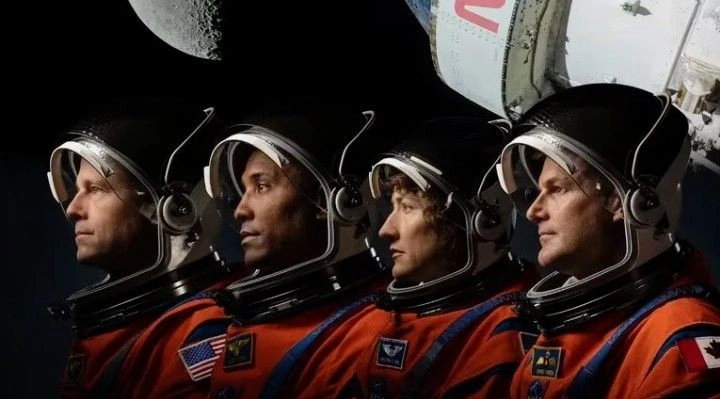
NASA’s Artemis II mission just finished what a lot of people are calling a game-changer in space exploration. The four-person crew on this historic expedition flew around the far side of the Moon, which is the farthest any people have been from Earth since the Apollo missions over 50 years ago. It’s not just a big deal; it’s a promise kept. This crewed test mission shows that we’re on schedule to land people on the moon again after years of delays, rocket tests, and nail-biting preparations. But what does this mean for India’s plans to explore space more, or for the race to the Moon? Let’s get started.
The Mission That Changed How We Travel in Deep Space Imagine this: On September 23, 2025, four astronauts buckled into the Orion spacecraft and launched from Kennedy Space Center on the huge SLS rocket. They flew around the Moon for more than ten days, getting as far away from Earth as 400,000 kilometers—farther than Apollo 13 did in 1970 on its own unscheduled adventure. Artemis II sent back crisp 4K video, live streaming of the crew floating in space, and even selfies with Earth rising over the lunar horizon. This is very different from the grainy black-and-white TV shows from the 1960s and 1970s.
The crew, which included Commander Reid Wiseman, Pilot Victor Glover, Mission Specialist Christina Koch, and Canadian Mission Specialist Jeremy Hansen, did not land. This was only a test run. Orion took off without a hitch, detached from the SLS boosters while ground control cheered, and briefly docked with a SpaceX Dragon capsule to transfer supplies (a salute to private collaborations). They put life support systems, navigation thrusters, and solar arrays to the test in the unforgiving vacuum of deep space. They landed in the Pacific Ocean off the coast of Baja California on October 3, 2025, and recovery ships brought them on board with big smiles.
What does this mean right now? We’ve been stuck in low-Earth orbit for decades with shuttles, the ISS, and SpaceX Crew Dragon runs. That barrier was broken by Artemis II. It flew more than a million kilometers, exposing Orion to cosmic radiation levels that humans hadn’t seen since Apollo, and came home without any problems. Early reports say that the heat shield held up during reentry at 40,000 km/h and glowed like a meteor. No big problems. That’s a lot for what’s next.
Meet the Artemis II Crew, who are leading the way.
These astronauts are not like the others. Reid Wiseman, the commander, led from the front with the toughness of a Navy test pilot. Before joining NASA, he flew combat missions. Victor Glover, the pilot, was the first Black astronaut to go deep into space. His steady hand kept Orion on track even when there was a solar flare warning. Christina Koch? She has spent more time in orbit than practically anyone else (328 days aboard the ISS), and she is ready for Artemis III’s arrival. Jeremy Hansen is Canada’s first deep-space astronaut, and he adds an international touch—Canada is providing the Canadarm3 robotic arm for future flights.
The friendship amongst the astronauts during their post-mission news conference really stood out to me. They laughed about missing pizza, said that the Moon looked “like a cosmic golf ball up close,” and answered questions on everything from feeling sick in zero gravity to seeing how fragile Earth is from far away. Have you ever thought about what it might be like to view our world as a pale blue dot while billions of people are watching? Their stories make the tech more human.
Important crew stats:
The total time in the air was 238 hours and 57 minutes.
Distance: 1,120,000 kilometers.
There are 42 orbits around Earth and 1 flyby of the moon.
Firsts: The first crewed flight of Orion and the first woman and person of color to fly to the moon.
This varied group of people shows how much NASA wants everyone to be included. After the flight, Glover talked about how important it is to inspire youngsters in underserved areas: “We’re proving that space isn’t only for a few people anymore.”
Tech Wins: Orion and SLS Steal the Show
Orion, NASA’s elegant capsule made by Lockheed Martin, was the main part of Artemis II. It’s not just a simple pod; it has powerful abort systems that might get the crew to safety in the middle of a launch, AI-assisted flight computers that can process petabytes of data, and an Airbus European Service Module that takes care of propulsion. The flyby tested everything in the Van Allen radiation belts, where solar particles hit like cosmic shrapnel. What are the results? Orion’s shields worked, and the crew’s exposure to radiation kept below limits.
Then there’s the Space Launch System (SLS), which is 98 meters long and NASA’s biggest rocket. It used 2.8 million kg of fuel in eight minutes to reach escape velocity. Expensive? Yes, each launch costs roughly $4 billion. But it’s made for the hard lifting that Apollo couldn’t do. For now, SLS is in charge of crewed departures, but SpaceX’s Starship will take over for landings.
India is keeping a tight eye on everything. In 2023, ISRO’s Chandrayaan-3 soft-landed near the south pole of the moon and collected soil. NASA exchanges non-sensitive technology through the Artemis Accords, which 45 countries, including India, have joined. Could Indian astronauts get a ride? India’s science minister, Jitendra Singh, suggested possible partnerships after Artemis II, with the goal of creating shared habitats by 2030.
Overcoming Obstacles: Delays, Drama, and Determination
Things didn’t go smoothly for Artemis II. Launched late because tests were canceled in 2023 and 2024 due to hydrogen leakage. A broken valve on Orion pushed back Artemis I’s uncrewed run to 2022. The overall Artemis program’s budget overruns reached $93 billion by 2025. Some people in Congress and other critics complained about the prices when SpaceX lands boosters for pennies.
But NASA changed course. They changed the way crews rotated, improved ground systems, and relied on private partners like Boeing for SLS cores and SpaceX for fuel depots. The flyover avoided a little thruster problem by changing the power supply, which shows how smart people can be in real time. After the expedition, Wiseman joked, “Space doesn’t care about your schedule; it humbles you.”
This makes competition stronger around the world. China’s Chang’e-6 took samples from the far side in 2024, and Russia’s Luna-25 crashed, but they’re planning to come back. In 2025, Europe’s Ariane 6 finally flew. Artemis II reminds everyone that America is back in the game, but now it’s a team effort.
Eyes on Artemis III: The Moon Landing is Coming Up
After the flyby, everyone is now focused on Artemis III, which is set to launch in late 2026 or early 2027. That’s the big one—the first time people have been to the Moon since Apollo 17 in 1972. Starship Human Landing System will take two astronauts (one woman and one person of color) to the South Pole, where there is a lot of water ice that can be used for fuel and life support. Koch might be on it, which would make her the first woman to walk on the moon.
Are there going to be problems? Starship is still proving to be reliable after explosive tests, although moon dust could become stuck in suits. But it gets its information directly from Artemis II’s data, like radiation mapping and thermal performance. Think about mining helium-3 for fusion energy, or building permanent bases by 2030.
This opens doors for India. ISRO could send rovers or shelters to Gaganyaan’s crewed orbital test in 2026. What does this mean in the world? Climate change is pushing resources off of Earth. Space solar power might send clean energy to Earth. Artemis II isn’t just a flyby; it’s the start.
Why This Changes Everything for Space and Us
Artemis II’s visit of the Moon set new records: it was the deepest crewed flight since Apollo, the first successful Orion mission, and a plan for long-term Moon operations. It spent billions, had problems, but got the job done. The crew’s safe return, full of stories of the Moon’s rough craters and the glow of Earth, brings back that Apollo amazement.
Artemis II’s daring flyby of the moon: the most daring step back to the moon by humans since Apollo