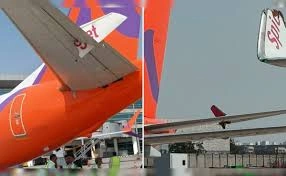
A minor but unsettling “wing‑to‑tail” collision between a SpiceJet and an Akasa Air aircraft on the ground at Indira Gandhi International Airport (IGI) in Delhi has underlined just how tightly packed the world’s busiest single‑terminal airport has become. The incident, which played out during a busy afternoon taxiing operation, left both planes with visible damage but no passengers or crew injured—an outcome operators and officials are calling “fortunate” rather than routine.
The episode, which happened on a typical weekday as Delhi’s airport juggles upward of 1,500 flights a day, has now triggered a formal investigation by the Directorate General of Civil Aviation (DGCA), along with the temporary sidelining of the pilots and the air traffic controller involved. At a time when India’s aviation sector is racing toward 1,000‑million‑passenger status within the next decade, the scrape on the tarmac raises uncomfortable questions: how much tighter can our taxiways get before the law of averages starts turning near‑misses into something more serious?
What exactly happened on the taxiway?
Details so far paint a picture of a classic ground‑handling incident, the kind that rarely makes headlines unless things go wrong. Around 2.15 pm near Terminal 1, a SpiceJet Boeing 737–700, operating flight SG 124 from Leh to Delhi, was taxiing in after landing, moving toward its designated parking bay. At the same time, an Akasa Air Boeing 737 destined for Hyderabad—flight QP 1406—had just pushed back from the bay and was being positioned on the apron for engine‑start and subsequent taxi.
According to preliminary statements from the DGCA and airline‑issued notes, the right‑hand winglet of the taxiing SpiceJet aircraft came into contact with the left‑hand horizontal stabiliser (tail section) of the stationary Akasa plane. The impact was not high‑speed—a taxiing conflict rather than a runway collision—but it was enough to cause visible damage to both aircraft. Photos and videos that circulated online show a bent or fractured winglet on the SpiceJet jet and a clearly dented or misaligned section of the Akasa plane’s tail.
Despite the awkward geometry of wings and tails nudging each other, everyone on both aircraft remained safe. The SpiceJet plane had carried passengers from Leh, and the Akasa aircraft was clustered with passengers preparing for Hyderabad. No injuries were reported, and evacuation procedures were not required. Both planes were subsequently grounded for inspections, delaying the onward journeys of hundreds of travelers in a sector where even minor disruptions are felt across the network.
Why this kind of “near‑miss” is worrying
Ground collisions between aircraft are not unheard of at major airports, but they still sit outside the norm in India’s tightly regulated, yet fast‑expanding aviation ecosystem. In some global hubs, such incidents have historically served as wake‑up calls: wing‑tip scrapes, tail‑strike mishaps, and taxiing conflicts have often preceded stricter movement‑guidance protocols, better signage, and more structured ground‑control procedures.
What makes the Delhi episode stand out is where it happened and how crowded the scene was. Terminal 1 at IGI, which now largely handles domestic carriers, sits in some of the most congested airside real estate in the country. Taxilanes slip between narrow apron segments, and the frequency of aircraft movements—especially during peak afternoon and evening hours—means that even a slight misjudgment in position or turning angle can translate into a physical contact.
The DGCA has already flagged that the winglet of the SpiceJet aircraft struck the “horizontal tail surface” of the Akasa jet, technical language that hints at a lateral misalignment rather than a head‑on clash. For casual observers, this might sound like a minor dent, but for engineers and insurers, it can mean repair‑time measured in days, asset‑down time, and potential changes to how the involved aircraft are deployed in the short term. It also raises an obvious question: if two professional crews and a trained air traffic controller ended up in this situation, what safeguards are still missing from the ground‑traffic choreography?
Regulatory and operational response
Within hours of the incident, the DGCA acknowledged the event and announced that the concerned air traffic controller and the SpiceJet pilots involved have been “derostered” pending probe. That is, they are temporarily relieved from active duty so that investigators can review radio transcripts, radar and surveillance data, and cockpit voice recordings without the pressure of operational rotations.
The regulator’s public statement framed the affair as a “minor collision” that occurred while the SpiceJet aircraft was taxiing in after landing and the Akasa plane was in the process of being repositioned. The language used—“derostering” rather than suspension—suggests the preliminary assumption is of an operational error or misjudgment rather than criminal negligence, but the full findings will emerge only after the investigation closes.
Akasa Air, in its own communications, stressed that its aircraft was stationary at the time of impact and that all passengers were accounted for without any injuries. The aircraft, which was preparing for QP 1406 to Hyderabad, was taken back to the bay for a safety check, and the flight was either cancelled or rescheduled, depending on the carrier’s internal recovery plan. SpiceJet, meanwhile, grounded its aircraft in Delhi for inspection, disrupting connectivity for passengers who had already completed the Leh–Delhi leg and were hoping to connect onward.
For both airlines, the incident is an operational headache more than a financial crisis, but it still adds to a growing list of pressure points that Indian carriers face: volatile fuel prices, airspace congestion, and the constant balancing act between schedule‑adherence and safety.
Safety, congestion, and India’s aviation explosion
The collision at Delhi feeds into a broader debate about how India’s aviation infrastructure is keeping pace with demand. In FY 2024–25, the country’s domestic aviation market alone crossed 150 million passengers, and industry forecasts project that this could more than double by 2035, assuming continued economic growth and rising middle‑class air travel.
Delhi’s IGI Airport, despite adding Terminal 3 and upgrading runway and taxiway capacity, is already operating near or above its design throughput on many days. The airport has three terminals and two runways, but peak‑hour surface congestion—especially around the domestic axis near Terminal 1—can still create a “bottleneck‑like” feel on the tarmac. In this context, a minor wing‑to‑tail incident can feel less like an isolated accident and more like a symptom of a system that is being stretched.
Many aviation experts in India have been quietly pointing out that surface‑movement incidents—incidents on the ground, as opposed to mid‑air or runway‑end accidents—are one of the front‑line indicators of how tightly the system is operating. When taxiways get crowded, communication becomes more critical, and the margin for error shrinks. In a slower‑moving environment, a pilot might have time to abort a turn or confirm a position; in a faster, busier setup, that decision window can narrow dramatically.
So how many more “near‑misses” is the system willing to tolerate before rethinking the way aircraft are sequenced on the ground? Or put another way: when will India treat ground‑traffic management as seriously as runway and airspace safety?
What this means for passengers and airlines The direct impact on passengers is more delay and inconvenience than danger. For instance, the Delhi-Hyderabad route is among India’s busiest domestic corridors, and disruptions are likely to have a knock-on effect on other cities.
The incident is a reminder for airlines that even minor tarmac incidents can be costly in reputation and operational reliability. Both SpiceJet and Akasa Air have built their brands on punctuality, affordability and modern fleet image. A visible wing‑to‑tail collision, even with no injuries, can damage that perception in the public’s eye, especially in an era when airport mishaps are captured on phone cameras and shared in minutes.
Inside the industry, the episode will likely fuel more internal discussions about standard operating procedures, cockpit crew coordination during taxi, and the clarity of ground‑control instructions. Some carriers could re-introduce training modules for crews on low-speed taxiing, wing-tip awareness and communication protocols with ground handlers. Others might argue for better surface-movement guidance systems, digital displays of taxi routes, or more use of surveillance tools to monitor the position of aircraft in real time.
Minor aircraft collision at Delhi airport: SpiceJet and Akasa planes graze each other on taxiway, no injuries reported